Kellerweiss

Although Beer Tinted Spectacles was not set up with the objective of reviewing beers, there are times when a singular beer warrants that attention; when a beer triggers memories or is so enriching that it creates new ones. And the beauty of this is how subjective, personal that experience is, how evocative of a moment in time.

This was a case in point. We’d arrived at the airport in Florida earlier evening, and after the bright, breezy coolness of the UK in April, the humid heat of the central Florida swamplands slapped me like a warm towel after a particularly energetic Thai massage. The sort of massage necessitated by limbs and bones crushed and twisted from economy seating, and the endless fanning by rank cabin air, recycled through 350 sets of hairy nostrils. It was the bliss of a cavorting into a sauna and throwing water on the coals or skimpily running through the snow, between the pines and jumping into a Turkish bath.

Acculturation isn’t such a major concern when you’re a Brit travelling to the U.S. – so much of our lives and lifestyle is shared, familiar. Yet, there’s still a huge difference actually being there, immersed in it, rather than watching on it on Dave. My orientation is built around two things: geography (“Where the hell am I? Which way is north?) and shopping (“What do the locals eat round here? Oooooo look, Peanut Butter and Honey Oreos!”).   Due to my line of work, I’m pretty familiar with US food retailing; nonetheless, wandering up and down the aisles still gets me excited – product ideas get swiped with careful abandon.

Then there’s the beer. It’s like youthful love: heart fluttering, shallow breathing. I approach the aisle: the options, the choices; unheard of brands, local brands, or rarities in the UK, readily available here. And there’s the way beer is sold: the main fixture was 100% chilled (anathema to some I know, not to Tinted); 6 packs, wide bore large cans, narrow bore small cans – and so much craft (50% of the space) and many, many more craft beers in cans than the last time I was Stateside. And Big Beer was interesting too – no point in being sniffy; nice to see the old school Coors Banquet ‘stubbies’ and gratuitous use of thermochromic ink*. Great too, to see interesting displays and on pack promotions; there’s always room for another koozie or bottle opener in the Tinted House.

One beer stood out for me though: both because it looked tremendous, but also because it’s a beer style I have a particular fondness for. I love Bavarian wheat beers, not just for the unadulterated refreshment they offer, but also for their hidden complexity and their presentation. When I drink a good one, I think of Münich beer gardens or shady terraces gently stepping down to the river. I think of warm Summer evenings; bratwurst cooking over wood; of raucously green fields, readying themselves for harvest. I think of an impromptu disco at The Turf Locks in ’91 where we danced to the Cult at one moment and a Steeleye Span reel the next (Hey! Blame the DJ) fueled by pints of Tanglefoot and Royal Oak. In my mind’s eye, I see the foothills of the Bavarian Alps, the rolling fields and away, away in the distance the snow-capped rising spires ascending. Fuse that with the entrepreneurial passion of the New World and the dancing bars on the graphic equalizer go banzai.

IMG_3436This is everything that Sierra Nevada Kellerweiss meant to me: the best of the old world and the new, all swaddled together in a autumnal coat. I was going to buy a six pack but only got two bottles as I was in the market for breadth that day (alas, alas).

And what can I say? It was as well-structured and brewed as any Sierra Nevada beer: the esters like a home-baked banana bread, not full on ripe skins. The body, through its natural carbonation from a healthy slug of yeast was dancing and swirling (this is a Hefe weizen, ‘yeast wheat’ after all); the body was a translucently pale, frosty yellow. As wheat beers go, not as complex as Schneider Weisse, but as drinkable as the lighter styles, such as Erdinger – yet, all the time with a grainy hoppiness that marked it out as just a little different. A beautiful beer. I have spoken to someone at Fullers and with Victorian haughtiness, demanded that they import it. He didn’t say no.

*Given that I pioneered its first application on beer, it warrants a mention, don’tcha think?

© David Preston, http://www.beertintedspectacles.com, June 2015
Bier und pretzeln

Our U.S. beer trip – well, I say that, but actually it was a holiday to Disney and the Gulf Coast with the kids – but you know what I mean – the beer trip, started with a wind up.

We were going to tell the kids at Christmas, but frankly their behaviour on the day didn’t warrant it, so we held the news back. And somehow, with the deft touch of time, the idea metamorphosised into a trip to Germany. Handy, that indirect flight via Frankfurt. But Germany? For two weeks? At Easter? “But dad, why do we need swimming trunks and beach towels?” asked my eldest. “Errr… there’s the largest indoor water park in Europe” I lied, unconvincingly. And damn, if she didn’t look it up on the internet too, but we brushed it aside and stealthily had a new Center Parcs built to accommodate my Pork Pies. “But what is there to actually do in Germany, Dad?” probed my youngest, incredulously, a weak seam obviously evident. “It doesn’t sound very exciting.”

But somehow the answer was much easier, and excitement veritably bubbled up from me. “Bier and pretzels”, I confidently replied. “Yes, bier and pretzels – or pretzelN,” – I stressed, always eager to fit in some extra curricular essential learning. And I meant it. Well the baked goods part in particular, them being below the legal drinking age and all that.

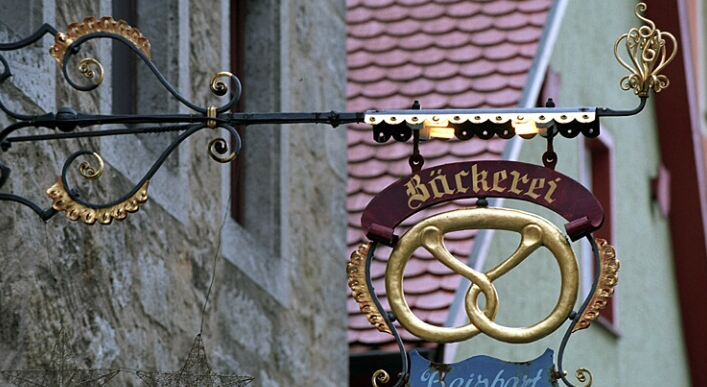
Pretzel signAnd they could see I really was excited. I told them of Mr. Jeffers, my first German teacher, who changed from the standard first language lesson from numbers 1 to 10 and ‘hello’s’ to how to order a beer. What would the number crunchers at Ofsted think today? But I remember it to this day and that’s surely the most important thing. I told them of a trip to the Rhine valley when I was a teenager and seeing the bäckerei with their gold leaf pretzel signs outside and glass shelves overflowing with wonderful rye breads, pumpernickel and amazing cream cakes. I told them about my first visit to Germany, also on the Rhine valley, and going to a würst and senf festival in the town we were staying in. A country where the festival is the sausages and mustard, not the accompaniment to something else. And these were not those briney, skinny, industrially squeezed sausages you buy in tins and plopped in a fluffed up white roll. There were sausages of all colours, shapes (well, not all shapes; they were mostly sausage-like) and manner of meaty flavours, cooked over wood barbecues. I can still smell the tingle of the appley charred smoke in my nostrils and picture it drifting down the bunting clad street. And then, to top it off, the creamy, vinegary soft, spiciness of the mustard. This wasn’t street food: this was beyond that; this was deeper, more heartfelt; this was passion, German food culture and love served up on a plate.   And I told them about the vine shaded beer gardens sloping down to the Danube in Regensburg with yeasty, clovey wheat beers and the accompanying oven bottom, bready sweet, dampfnudeln to fill up holes in the stomach, all presided over by a clucking Herr Ober who ruled the roost like his own front room, all clucking and full of pride. I told them too about the Cannstatter Volksfest and the Oktoberfest, but omitted many essential details.

Well, that served me right. My contagious enthusiasm was passed on, and suddenly the kids are researching things to see and do in Germany (distance no object). The Black Forest; the Eifel mountains; Cologne cathedral; a boat trip on the Rhine or Mosel. Oh, and the biggest indoor swimming centre in Europe, naturally.

IMG_3394In the end, the secret remained safe right through to the transfer desk at Frankfurt airport, where we had to check the Gate number for Orlando. My youngest was both delighted and upset. “Does this mean I won’t get to try a proper German pretzel?”. Tears were welling up and everything. So there we were, in the transfer terminal. Me with a glass of local Licher Pils, beautifully served of course, in a simple, stemmed glass and pretzeln all round: crisp, dark outers with the slash of double cream coloured dough poking through; lightly pebble dashed with rock salt for that crunchy bite.

No more wind-ups now: time to get back to Germany proper. 

© David Preston, http://www.beertintedspectacles.com, May 2015

The Session #98: Cans or bottles?

the session beer blogging fridayThe Session, a.k.a. Beer Blogging Friday, is an opportunity once a month for beer bloggers from around the world to get together and write from their own unique perspective on a single topic. Each month, a different beer blogger hosts The Session, chooses a topic and creates a round-up listing of all the participants, along with a short pithy critique of each entry (see link, posted to comments in due course). This month’s Session is by Nathan Pierce at Micro Brewr (www.microbrewr.com) on the topic of cans or bottles. He asks effectively, which are better? And he wants to understand different perspectives – a brewer; a distributor, a consumer?

I’d been meaning to write a post on small cans for a while and as fate would have it, it’s been like buses, three at once. But for anyone with even a passing interest in beer, you can’t have failed to notice small cans’ accelerating emergence as a form of beer packaging. And we are talking small cans here – that’s an important distinction. I can’t speak for other markets, but in these islands, whilst 330ml cans are the largest can size by volume sold, the market for them is all in soft drinks. For beer, it’s 440ml, 500ml, or the full pint, 568ml (a piece of Frankenstein packaging if ever I saw one). Essentially, consumers are totally accepting and happy with the 330ml can as a ‘format’, but reject it when it is used outside of the context they understand it in – in other words, for beer. It is, as is so often the case when trying to elicit consumers’ views on things, highly irrational.

Because, let’s be honest – and no insult is intended here to Nathan who set this month’s Session topic – this whole question is deeply irrational. I mean choosing a can over a bottle? It’s a can. A metal thing. Extruded. Everyday. Extremely dull. Let’s get over it shall we?

But that would be to ignore the strange and often unfathomable way we work as consumers, as drinkers, as humans. We say rational. We do irrational.

The evidence? In a few years, the perception of beer in cans has affected – or at least started to affect – a complete about-face. Just 5 or 6 years ago, cans were persona non grata when it came to craft packaging. More than that, even for the big brewer brands, cans were the rather scruffy and probably illegitimate cousin of the ‘proper’ forms of beer packaging, of draught (draft) and bottled. One turns ones nose up at cans. Stella Artois as an example, sells huge quantities of cans – 30% of its mix – but you’re unlikely to see cans feature on their posters. Carling – the UK’s biggest beer brand – as good as has no bottles. Projects to launch one in the range had names like ‘Icon’ or ‘Hero’… a classic case of putting bottles on a pedestal, even though, in this case, it’s would create a very stunted tail, attempting to wag a chunkily obese dog. I mean, why bother? What’s the fuss about? Oh, hang on, consumers prefer bottles, don’t they? Don’t they?

Well let’s attempt to answer that by putting ourselves in the shoes of a consumer. And by doing that, surely, surely, it’s confirmed as a silly debate. Surely, any packaging is just a way of stopping the beer falling out?  

If it only it were that simple. And if only it were down to consumers. Of course the views of ‘opinion formers’ matter. Funny that, because here we’re talking about people who own or operate small brewers are now impacting drinkers behaviour and perceptions. Who were, until recently consumers, not brewery owners, and you can bet your hind legs they rejected cans! Whether that’s true or not isn’t the point though, what’s good now is that cans are being considered again by the serious cognoscenti. How opinions alter when the winds of change shift.

Roosters cans_fotorSo first I’m going to attempt to be rational. I like cans. They have clean lines, feel good in the hand and chill quickly. They make that pleasing ‘pffft’ when you nip the tab back, and I even like the sound as the metal rips round. I’m amazed that can makers can make metal so thin yet the whole thing is so sturdy when full. Cans pour well too, particularly with those wide mouth ends, although sometimes I’d like to see an old rip off can end again – you know the sort we used to collect for Blue Peter. And there are some pleasing new matt varnishes, which are delightfully tactile. Yes, I’m a self-admitted can stroker*. And there are some great graphic applications and designs coming through which I wrote about recently. But ultimately, it’s a can. And look, I seem to have strayed into being irrational. Tricky, isn’t it?

And there are downsides to cans too. I mean all the educated opinion formers say they chill down quickly. They warm up quickly too. There are some questions about the food grade lining on the can insides. And you know, there are occasions with steel cans in particular that I can taste tin. Really, it’s not my perceptions. It’s there.

But here’s the thing. I like bottles too. They have a refined elegance which a dumpy can just can’t carry off. It’s like Yasmin Le Bon married to Danny de Vito. Bottles have interesting labels, ideally thick gauge paper for me, and sometimes that lovely textured foil around the neck. I like sliding my nail between the foil and the crown and teasing it away. And they chill down and warm up nice and slowly. People blab on about sun struck quality but all the reliable research that I’ve seen (and commissioned in my time) suggests – sadly perhaps – that most UK beer consumers not only can’t recognise the lightstrike character but in almost 50% of cases prefer it! Heresy, I know, but then again, there are occasions when I like a bottle of Corona.

I guess what I’m saying is, well two things. First, we can debate this as much as we want but it’s all a bit crackers, a bit pointless. Why beer drinkers like things is not going to be down to chilling times, or lightstrike resistance, or environmental impact – it’s just not. It’s down to whether “I like it” – or more to the point – whether “I’ll be called a dick by my mates if I’m seen drinking it / from it”.   And second, it’s horses for courses. If beer drinkers become accepting of both, then that’s good for beer isn’t it?

Perhaps not…. here’s a parting thought. The big brewers seem very excited about craft brands moving into small cans. Why would that be? Why are they excited to see craft brewers investing in canning lines or finding innovative solutions to canning – sharing facilities, mobile filling lines and so on?   It’s simple. Bottling is a more imprecise practise – it’s like a tough rally car, high performance but can still keep going with a bit of dinking and wear and tear. Canning on the other hand is like a F1 car. There’s no way, no way on this earth, that craft brewers will be able to do it anywhere near as effectively, efficiently, cleanly (some would argue), nor – most importantly – cheaply as the big boys. Visit a canning line of an ABI or Carlsberg. They run at thousands of cans filled per minute. Per minute. And the craft brewers want to take their exciting brands, their interesting beer styles – which the Big Boys struggle to create – and put them into small cans – a format the Big Boys have failed to make credible. Whilst the craft brewers are spending their marketing Pounds or Dollars in bringing drinkers into cans the Big Boys are licking their lips.

*I shall soon write a horror novel, entitled, “Can Stroker’s Dracula”

© Beer Tinted Spectacles, 2015

Small beers

There’s a ‘born again’ zeal of enthusiasm about cans amongst the craft beer fraternity; it’s intriguing and amusing. For years, brands of beer that put their product in cans were deemed in some way cheap or sold out. There was a lingering perception of ‘tinniness’ but also associations of ‘13½ Free!’ or ‘500ml extra value’ or even the faintly ridiculous pint cans that you still see in the UK, which seem to be tottering along on super high heels, just waiting to ‘do a Naomi Campbell’.   It’s been a source of frustration for can makers for years and their industry body, which is imaginatively titled the ‘Can Makers’. Because, cutting through any of their potential bias, cans really have been a brilliant beer package for donkey’s years. They are incredibly light to transport (filled and unfilled); rugged, despite the incredible thinness of the can walls; efficient conductors of heat so they chill down quickly. And they are also flavour fast: the cans are lined with a food grade film which prevents any contact with the steel or aluminium walls and of course, no light is going to sneak through, eliminating the threat of light strike.

So it must be down to the craft brewers. They have stepped in and reversed the decline in cans’  perception, because otherwise, nothing is different.

Except, no. There are a few differences this time round. And it’s the craft brewers who have seized them.

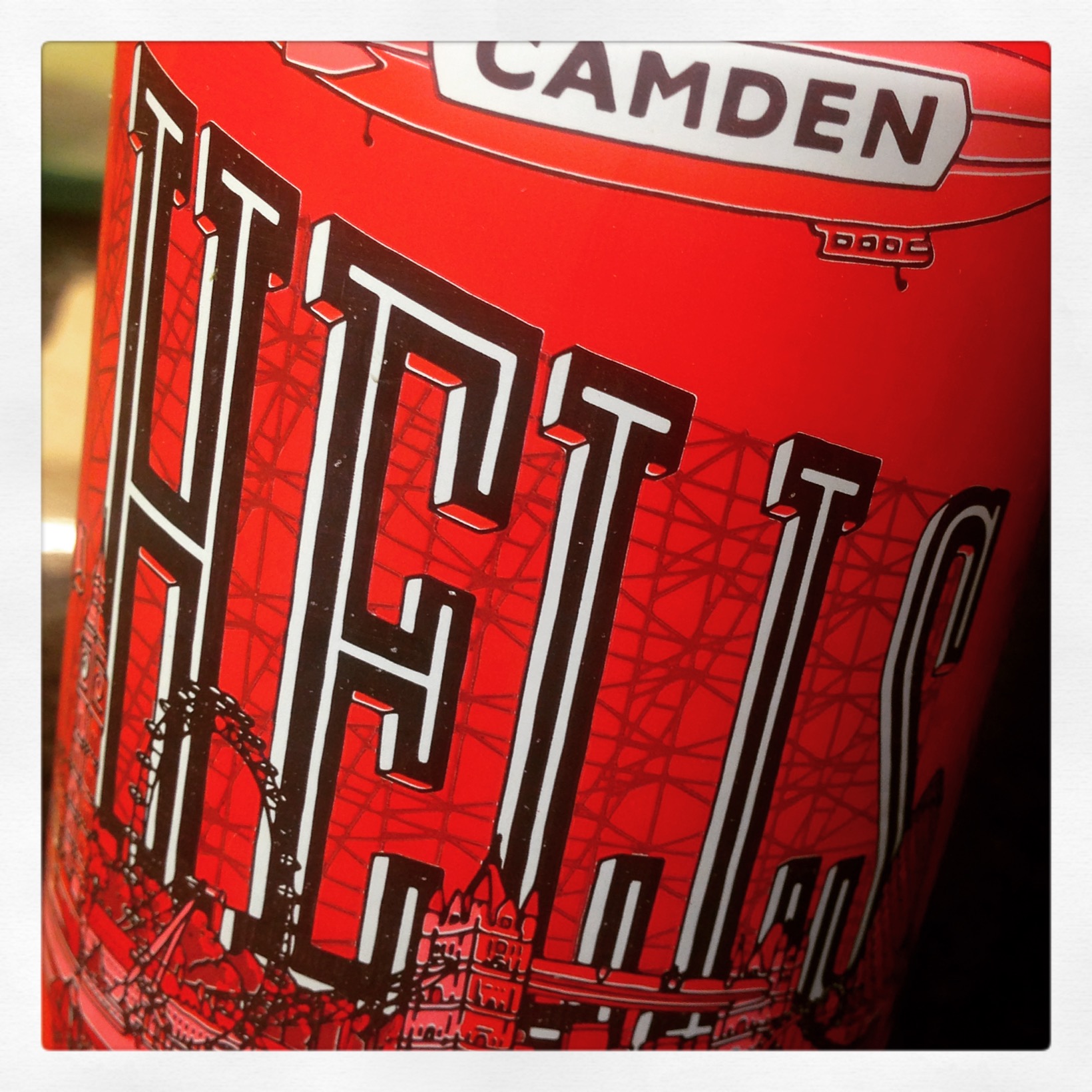
Camden Hells: great design, right size. It all feels, well, right.
Camden Hells: great design, right size. It all feels, well…. just right.

The first is size. The craft brewers have embraced small cans – better, for the often more challenging styles of beer they’re brewing, but also, just a more enjoyable portion. 330mls are hand sized and the volume fits in a wider range of glassware; they’re less likely to warm up as you drink too (it’s gone). Truly, it’s always baffled me why UK beer consumers simply wouldn’t accept a can size in beer that is totally acceptable to them in soft drinks and totally accepted when they travel abroad. Different beer in a different pack – that seems to have done it.

The second is finish. The craft brewers are embracing the material and its potential in a way that few of the more established players have done or are attempting now. More often than not, a brand’s design is simply ‘applied’ to the can and disharmony is the result (I know, been responsible for a couple myself). Where the design joins – tricky; the way the logo works with the curved face – a challenge. Brand owners and design agencies have broadly given up, resulting in something…  just not right. But some of the craft brewers have said: how can we use the shape of the can to enhance our brand? To take it on and improve it? Beavertown is the notable example here: their cans are art, quite literally. There are no issues with worrying about facing them forward, as they can be faced anyhow and make a panoramic comic book shot working along the shelf. Magic.

And there’s feel too: varnishes and textured finished have been around for a few years, but it’s taken the craft brewers to use them to their potential. Why? Because they’re not scrimping for savings, worried about the added ‘on cost’. The value built into their inherent proposition allows them to buy slightly more expensive cans and reap the reward. Look out for stippled matt finishes and spot varnish. Little touches yes, but in the hand, they transform how the can feels and even – gasp – make you think about drinking from it.

IMG_2959
Can design mastery from Beavertown. Wonderful stuff.

But one issue is overlooked. Unlike bottling, canning your beer is a more serious financial proposition. Can lines aren’t cheap – and they’re certainly more expensive than bottling lines. They’re also a bugger to run – the tolerances compared with bottling are much tighter – think Formula 1 car vs rally car. Both high performance, but one takes it to another level.

And then there’s the cans. This isn’t like buying a run of labels for bottles: there’s no writing them off by popping the old labels down to the local recycling tip. Buying a run of cans is a major undertaking and if you buy them, by god, you use them.   And finally, there’s a structural question. Whilst bottling lines are – broadly speaking – ten a penny, canning lines are something else. There are fewer of them; they’re largely fully employed and also, and this is a big issue if you brew 10 barrels a week, massive. There are whole canning lines dedicated to Coke. Not Coca-Cola’s range of products, just Coke. 24 hours a day. All year. Picture it: “’Scuse me mate, can we fit in a run of 8 Ball Rye next Tuesday?” “Er…. no”. So what’s happened? Well, the incredible thing is that some of the brewers have taken on the challenge and have bought canning lines. That takes big balls. Big balls of lead. But there’s beautiful commercial creativity too: there are operators now running mobile canning lines. They come to you. Fill. Clean down. Offski. That is brilliant.

And the even better news is that it’s just begun. Tinted was responsible for bringing thermochromic – temperature sensitive – ink onto cans 10 or so years ago. But 5 years from now, that is going to look – aptly you may feel – like very small beer.

© Beer Tinted Spectacles, 2015

La San Fran Diego

In 1999, the now long-suffering Mrs Tinted was only the short suffering Mrs Tinted. We decided to fly to California for our first wedding anniversary in fact: into San Francisco; a brief excursion north into Marin County (mountain biking pilgrimage), then Napa (wine pilgrimage) then down the fault line – the Big Sur coast (“Warning, bends in road for next 99 miles”) via Carmel (Clint Eastwood), Monterrey (Jack?), then Saint Luis Obispo to Santa Barbara (Santa Barbara Brewing Company, good hefeweizen and chicken burger), avoiding LA (saving the smog for another time) before R&R in San Diego.

I had few expectations of San Diego: it was designed to be a restful full stop at the end of our holiday before the flight home. It turned out to be yet another highlight.

From a beer point of view, to say California is a delight seems trite and unsurprising nowadays. Back then however, the beer scene was still emerging, albeit at pace, but remained centred on San Francisco. We drank Anchor of course, which was all that it promised and more: malty and dry, yet smooth too. We found great bars in the city (Jack’s Cannery) and in the country – a small brewpub in Napa City served a rip-roaring IPA that we wolfed down with wood fired pizzas before it became standard. But San Diego? Well, suffice it to say, we weren’t expecting any such surprises: we were going for the weather, nice beaches, no doubt, a day trip to Tihuana and probably a few bottles of Tecate.

Gloriously off script, the perceptions were all wrong. The Zoo: incredible (the incredible masticating Panda); Upstart Crow, a little bookshop… no, actually my favourite bookshop in the whole world (for a time at least) down on the quay. Adobe settlements; The Padres baseball team, with excitement building as they strove to win the World Series (they didn’t in the end), and our hotel, a sort of half America’s Cup cum half bric-a-brac temple cum half archaeological salvage thrown together in an arresting way. A hotel considerably better than my fractions.   And it turned out, the nascent brewing scene was the cherry on the vacational cake.

Oh, I know that beer geeks will likely sniff: but we both really enjoyed Karl Strauss Brewpub (and I’m happy to admit that I Iike ‘Rock Bottom’ too – better that than a Hungry Horse any day). Most of downtown San Diego is so unprepossessing, and it fitted right in, with a concrete camouflaged frontage. Not the beers though: there was Red Trolley Ale, immeasurably better than the average for that oddly faux – and typically unrewarding – beer style of ‘Irish Red’. It foamed and fizzed and had a lovely malt character. Tower 10 IPA, now a range mainstay, was what you’d expect: a blast of grapefruity C hops and a solid malt backbone. And located dangerously close to Hotel Bric-a-Brac and opposite the airport runway (here I go, ‘sell, sell, sell’) was Oggi’s Pizza & Brewing Co. We ordered take out from it one night and only called in right at the end of the holiday:  cue general werreting and gnashing of teeth. The beer was nothing memorable (for craft) other than it kept great company: the view across the beach, the bay, the gentle sizzle from what most Americans consider the best climate in the country. Oh, and pizza. Don’t forget the pizza.

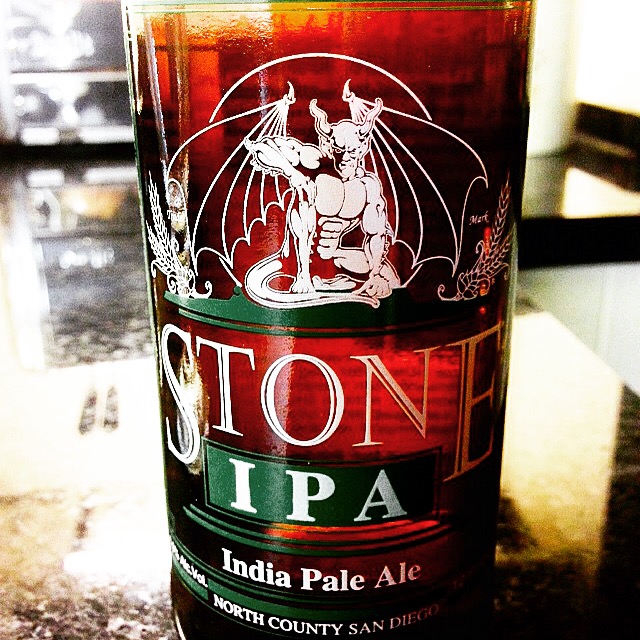
"My precious Stones"Today I suppose much of the talk of San Diego is about Stone Brewing. In ‘99, it was a shadow of its future self and I didn’t, as I undoubtedly would now, make a diversion out to Escondido to visit the bar and shop. But I was still excited to get hold of a couple of Stone beers just after Christmas through Beer Hawk: not being that close to a regular supply here in Burton on Trent (I mean, why would Burton on Trent have a decent beer shop FHS?). In fact, drinking these beers fired up for me a mélange of California, not just San Diego. A sort of ‘La San Fran Diego’.

From San Diego there’s the understated bullishness, the challenger mentality that comes from being the US’s eighth biggest city, yet squeezed right up against its second biggest. Take the IPA: this is not a beer by halves (or thirds). There’s a spicy, hop leaf aroma that’s full on yet appealingly dry and dusty. The alcoholic warmth is marked but not over-powering, and a mouthfeel that’s chewy, with round caramel and a pearl barley breadiness.

From LA? Well, there’s brashness and confidence; perhaps some artificial inflation too: I mean, the IPA is an umphhhing 6.9% and the Ruination IPA is a wheezing 8.2%. These beers do not whisper into the room. They drop in, in a mechanically powered suit and then blow the head off the guests sitting round the table, pronouncing “I AM Runination Man”. These are after all, the beers that started an arms race.

IMG_2936But there’s some San Francisco too, some old school California. A bit more culture, sophistication; keeping something back – the fingerprints of Anchor and Sierra Nevada linger here still. The Ruination for example, makes a strong pronouncement, but it’s actually remarkably restrained. The aroma is earthy and spicy – not fresh spices but roasty and dungy (this, as I have said before, is ‘a good thing’). The alcohol may put hair on your chest, but it’s combined with fruitiness too. Ruination is 100+ IBUs. That’s a lot. Yet it doesn’t drink that way; it has a strong malty sweetness, which acts as a foil, a counterpoise. It’s a ruinously good drop.

© Beer Tinted Spectacles, 2015