The Session #69: The Perfect Beer World

the session beer blogging friday“The grass is always greener on the other side”, so sang Glaswegian post-Britpop crooners, Travis; “the neighbour’s got a car that you wanna drive”.

Dear old Fran Healy, where are they now?  Mind you, it would be easy to agree with his sentiment when considering this month’s blog topic – the perfect beer world.  For UK readers, it could be like the latest British Gas adverts – idyllic & psychedelic pints of frothy ale, always full, never drunk, in carefree orbit around our mini planets. But really. Where will it take us this navel gazing at a Beer utopia? Frankly I don’t see any positive value in that exercise – so in true politician’s style I shall answer the question my own way. And it’s still a good angle because the trials and tribulations of life are written into the weft and weave of beer itself.

The lesson of time immemorial.  From fantasy worlds like Star Wars or Harry Potter; to the real world –the motivations are the same.  Good versus evil;  failing, getting up and trying again, or just staying down. The big guy vs the little guy. Of man and woman, race and religion, tribe or creed.  And it’s all here in ‘Beer – The Board Game’¹.  Let’s consider the United Kingdom as said board game to illustrate.

The playing surface plots international brewer against start up micro; of wholesaler against cash and carry; of national pub chain against a family run independent pub; of government policy against pressure group set against a three dimensional backdrop of street scenes inspired by market towns the country over. And we have our equivalent of  ‘Chance’ cards?  The rise of teetotalism (‘Go To Jail. Do Not Stop at The Red Lion’); the growth of non-alcoholic drinks, coffee in particular (‘Advance to Starbucks. Lose 5% market share’); the media stoking the flames of ‘binge Britain’ or neo Prohibitionists in the US (‘The local authority orders you to clean up the vomit. Lose 2% market share’).  Oh, and good ones too, like (‘Cask Beer Reports sector in growth by 2%.  Collect 3 free beer tokens’).

But this is a board game: players will win and players will lose.  If you work for Waverley TBS, my genuine commiserations; if you work for Punch – your business model doesn’t seem to be working fellas, maybe take a look at it again.  The government, with its incessant and anti-competitive above inflation duty rises… well they are doing the equivalent of perpetually building hotels on Park Lane – but one day the property bubble will burst and the rents won’t come in.

Beer is playing out the game. From some angles it seems precarious – per capita consumption in western markets is falling…but in eastern, emerging markets it is growing.  The inexorable rise of pale lager is being challenged: indigenous and new beers are appearing again, and like life, the fun is in the hunt, in taking part.    Elsewhere spirits are back in growth or the growth in cider threatens ‘the pint’.  They are players in the game and they have every right to try and win. Pubs are closing at an alarming rate, but some of the best bars ever are opening up and down these islands.  Supermarkets are slashing the price of beer…. but they are dedicating ever more space to speciality ales and lagers.   No, the perfect beer world is here warts and all, best that we see the game board, get stuck in and plan our moves ahead.

¹ Don’t even think it. I got there first: ‘Beer – The Board Game’© Preston Enterprises, 2011


Beer gameOh, hang on……….damn!!


© David Preston, Beer Tinted Spectacles, November 2012

The conundrum of ‘new’

Innovation: desired and feared in equal measure by senior executives in businesses round the globe. On the one hand, the school of ‘innovate or die’ – typical in fast moving consumer goods or high tech environments – the mindset, the belief, that ‘you’re only as good as your last success’.  Such is the level of competition amongst companies, many live in fear that if they don’t innovate, if they don’t slice the salami of consumer needs and understand deeper, more penetrating insights about the countless ways we live our lives, then their business will be in mortal danger.  Famously, the 3M Corporation, notable for inventing Post-It notes¹ tasked itself with ‘The 30% Challenge’ – generating 30% of worldwide sales from products launched in the last 4 years.  That’s worth a brief pause to consider.  30% of worldwide sales from products less than 4 years old.  I haven’t worked there. I don’t know if it’s a goal that is regularly achieved (but I believe they still use it as a corporate objective), but let me tell you: that is, to quote Jim Collins², a ‘big, hairy, audacious goal’.  Glance through the business pages on a weekly basis; read the Annual Reports – for most businesses, ‘innovation’ and ‘lifeblood’ are symbiotically linked.

Yet on the other hand, there’s the rather unfashionable, whisper-it-lest-you-are-heard, view.  That innovation isn’t essential. It’s a school of thought I’m increasingly persuaded by – particularly when it comes to beer.

Let’s interrogate this a little more.  Start with consumers, drinkers, customer – call your fellow human beings what you will. People who buy stuff.   In the last couple of years, I’ve done research across a dozen, more, different categories of product – bread, beer, wine, spirits, coffee, tea, paper products, banking, pizzas, weight loss, soft drinks, hotels, restaurants – you name it.  Here’s the thing – the linking thread. In 90% cases, the people working in the business are convinced that they must have new.  Innovation in product, in service, in experience, in something.  But in every case, every case, consumers don’t see the need.  The reaction by the client is never, therefore, to walk away and spend their time and money on something else, but rather to find a need.  The hunt for insights commences, driving motivations behind why we do what we do, and why we spend. And inevitably, it’s ‘slicing the salami’ – the supposed need is ever so thin, ever so see-through, ever so…false.  And of course, it’s perpetuated by consultancies and agencies – walk away from food on the table?  Best not.

But of course, we do want new. We say we don’t, but we behave ‘we do’. We love our iPads and Galaxies; we like our Tivo boxes, we like folding bikes, naïve smoothies and gooey puds. Heck, we even seem to like Irish & Belgian ciders.

IMG_0849Beer hats on sale now.  Go on, you know you want one.

And what struck me about beer is the difference between what the brewers (typically the big boys) ‘say’, and how the brewers (typically the little boys) ‘behave’.    Because I don’t think beer needs innovation. By that I mean, I don’t think in the beer market consumers want innovation. As far as I can see beer isn’t broken.  What they do want is discovery (or re discovery) of new flavours, styles, places; authenticity; connectedness to memories or good times.  On reflection, it seems no surprise that what links successes in the western markets is a perception of smallness.  The two decade explosion of North American craft beer; the rising tide of cask beer revolution in the UK from over 1000 small brewers again (cask is now back in growth in the UK); the craft movement in Australia and New Zealand; speciality brands in France, the Low Countries, Scandinavia, Italy.  And by the way – this doesn’t mean the big players are not involved – Molson in Canada owns, and has left alone both Creemore Springs and Granville Island; ABI owns stake in a number of US craft businesses – but rather it’s a ‘skunkworks’ approach outside big business that is the success formula: have idea – try in market – refine – build.    It’s an attitude about understanding what the drinker wants through, well, going out drinking, rather than relying on large amounts of market analysis and research that has the higher strike rate.    From someone who works in innovation and research it’s an uncomfortable thing to admit; but on the other, there’s something exciting about understanding intuition, about seeing beers that were clearly hunches be successful.  Now that would be worth understanding.

¹By the way, have you seen the price of Post-Its nowadays? Pant-wettingly expensive.

²Jim Collins, Jerry Porras ‘Built to Last’ (1994)

© David Preston, Beer Tinted Spectacles, October 2012

Capital Idea

1989 was an auspicious year. First year at Uni and loving the new life away, it was a time of tremendous discovery – about myself and about life in general – much of it quite mundane, like how to actually make some food. It was also the start of my real years of beer discovery – living in the south west, enjoying pubs like the Drewe Arms at Drewsteignton, The Nobody Inn at Doddiscombleigh, The Warren House Inn right in the middle of Dartmoor and the pubs by the river and canal in Exeter – the Double Locks, The Turf and The Bridge in Topsham.

Against this rural setting of beer swigging idyllic yokels, three of us made a trip during a holiday to Burton upon Trent. Rumour had it, this was the ‘home of British brewing’ but we knew little of it truth be told. There were breweries, there were pubs and it wasn’t that long a drive from our home town in the north west. My brother, Wilko and I made the trip. We tossed for designated driver, but we planned a long enough day trip to allow for a couple of guilt free pints early doors.  The details are unimportant – we visited the Bass Museum, The Burton Bridge Brewery, the now defunct Thomas Sykes brew pub in the grounds of the recently close Everards brewery and otherwise took in the ambience of the town. The ambience being rough round the edges and distinctly whiffy, with the sharp tang of Marmite, meat processing, coffee from a nearby Nestle factory and beer all mixing together to form an aroma that gagged in the throat and flared your nostrils wide as they flapped on autopilot attempting to beat back the nasal assault.

Twenty or so years on the town has changed a little.  Few nasty niffs today but still the sense of brewing nobility; in fact a sign outside Molson Coors (then Bass) is supported by the words ‘Burton on Trent: World Brewing Capital’.  Which got me wondering: because let’s face it. It isn’t is it?  It was, sure; and yes, there’s no denying a lot of beer is produced each year across the different breweries in the town, but the truth is, this innocuous phrase is puffery, a product of our heritage mentality.  It’s so easy to revere the past above all else and as our Primary Industry – manufacturing – declines, so our Quaternary Industry – Nostalgia – booms.

What is a ‘capital’?  What do you need?  Power is one:  government, authority, bureaucracy.  Culture another – museums, art, music. Industry – or business power, not necessarily the manufacturing.  Creativity, influence…  collisions that throw off opportunities, possibilities.  Burton as a place of brewing influence had these once. Not today.  You can level the same at other brewing ‘capitals’ – Milwaukee; Berlin; St Louis.

Today it seems there’s emerging a new array of brewing hearths – cities, towns, regions, that can lay claim to the title of ‘world brewing capital’.  The strongest for me is the west coast USA – from San Diego in the south of California up through the sequoias to Portland, Oregon and beyond. Brewers united by being unfettered by ‘rules’ of the past;  pushing at the edges and in some cases long-jumping into a new space altogether.  And these aren’t just micros here – Widmer, Sierra Nevada, Anchor, Stone – all have scale – big enough I’m sure to be on the radar as potential acquisition targets for the global brewing concerns.  Only here, I would contend is there a culture of experimentation, trial, listen, tweak, improve.

Watch for the future, my vote would have to go to Italy. Craft brewed beer is about 2% of the market in Italy but it is growing in double figures year on year – with again, the spirit of curiosity, of discovery driving it forward – free from a burdensome legacy assisting a vibrant brewing scene. So too in parts of Scandinavia where brewers, fuelled in part by a healthy food movement are beginning to push into rediscovering and experimenting with indigenous raw materials, styles and ingredients.

The old capitals, Belgium, Germany (Munich in particular) and the Czech Republic are on a watching brief.  Belgium in particular has always had a culture of inventiveness but it remains to be seen if the domination by ABI and Heineken of the local brewing scene will create a market structure that stifles or creates the next wave. Likewise Czech, with so many of the big brands in the hands of multinationals and an industry structure whereby water is more profitable than beer, signals warnings for the future. Consolidation, focus, scale will be the watch words – the space for small scale, inventive brewers will be there to take.

Where does that leave Blighty?  Well, we seem to have come full circle. The big brewers and big retailers have managed to fight over the train set and break it.  The flair, the Heath-Robinson Garden Shedness, has passed elsewhere.  Far from being concentrated in one town, inventive brewing is scattered again across our towns, cities and villages.   Burton’s particular challenge is to grab this mantle back – but even if it doesn’t, the future is beginning to look bright again.

© David Preston, Beer Tinted Spectacles, October 2012

Extra mature.

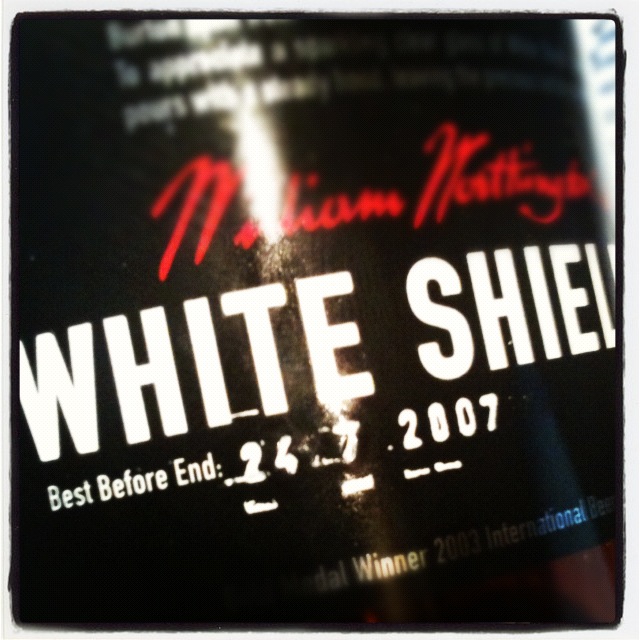
There was a case of it dustily resting behind a shabby curtain in a rented house. Not an old suitcase but a proper case of old beer; thick, corrugated card on the inside with dividers between the bottles and brightly decorated, old-school style decoration on the outside. On opening, red and silver crowns looked up at us like baby birds expectantly waiting for the next worm from their mother.  This was a beer I hadn’t heard of at the time and was long out of date: Worthington’s White Shield.  It was the early ‘90s, but the beer had gone out of date in the late ‘80s.  Back then, my brother worked in beer distribution and when they closed an old warehouse in Wolverhampton or Grimsby or some such place, a few pallets of mysterious, out of date products had been found – in the days before SAP operating systems this sort of thing could actually happen.  It seems that they were products returned by customers because they had damaged labels, but as far as my brother could see, only one bottle in the 24 had a scuff.  So he happily handed over a couple of blue notes and carefully sat two cases of the beer in his boot.  From there, the last leg to his ‘cellar’ behind the dusty curtain could be transacted.

IMG_2287

Not quite the label on the mystery bottles, but not far off.

My brother you see, was in the know.  Not only did he know about White Shield at the time, a beer often referred to in hushed reverential tones, but he also knew that on big beers, proper beers, a sell by date was misinformation.  That’s why he had tiny nips of Thomas Hardy’s Ale uncomfortably lying at funny angles in his wine rack – decorated with thick gold foil and wire and string wraps over their crowns.

White Shield has travelled, in many senses of the word.  Born out of one of the Worthington brewery’s original India Pale Ales, it fell out of favour after Bass and Worthington merged in the 1920s as gradually focus fell onto the red triangle.  But for years, decades in fact, the beers were kept separate, Bass becoming predominantly a draught beer (red triangle on draught, blue in bottles) whilst Worthington’s India Pale Ale got renamed ‘White Shield’ and stayed in bottles. It also retained its secondary bottle conditioning – the art of adding a small glug of yeast before sealing the bottle. This seemingly inconsequential but tricky act is the key to bottle aging.  White Shield was also travelled during its many unloved years, being brewed by King & Barnes and Shepherd Neame if I recall correctly. Today it is brewed back in Burton at the National Brewery Centre and bottled by Fuller’s (who have the kit to add yeast for bottle conditioning).

Sadly I don’t remember the taste of the bottles found behind the curtain. I do know that they were 7 years past their drink by date, that the colour had a canal murkiness but the beer got drunk.  And it did leave a mark, as to this day, I age White Shield…and just last week I broached a case of 2007 ‘vintage’.  White Shield tasting notes normally conjure up cake. Not Victoria Sponge with cream and strawberry jam but deep, dark fruit cake, all raisiney & packed full of currants, glace cherries and shavings of almonds.  I always consider it a malt led beer with just an edge of oranges or citrus fruits. When young, it also has a distinct sharp, metallic character, is a bright red brown and tastes strongly alcoholic despite its modest strength (5.6% ABV). So it’s a cracker, no doubt.

Yet it’s a cracker that gets better with age.  The beer I drank last week would have been brewed in January 2005, its use by was July 2007, so that means it had over 5 years of additional bottle aging, 6½ in all.  And it drank much softer, with just a slight vinous character like Madeira or sherry. Its colour had darkened substantially, conker-brown now like Tudor furniture. Hop character was virtually non-existent but the malt complexity was as pronounced as ever – with none of the harsh metallic edges. Still a cracker, but a cracker of a different kind.  We’ll see how it stands up to another few years.  The only rub is the yeast, or lack of it. When my brother and I drank the beer from behind the curtain it had a centimetre of yeast at the bottom.  You had to pour with a steady hand which given the murkiness, we failed to do well enough.  But the 2007 vintage has a mere dusting across the bottom of the bottle – less yeast, less secondary fermentation, less potential to develop character.

IMG_2262Proof of the fruit pudding is in the drinking

Saying all that, a famous beer brand stoutly advertised for many years that ‘Good things come to those who wait’. Right message. Wrong brand.

© David Preston, Beer Tinted Spectacles, October 2012

The brown signs to Burton-upon-Trent

There must have been a slightly incredulous look on my face when a colleague at work, who is part owner of a small brewery in the south east, suggested to me that Windsor, and not Burton on Trent was one of the original homes of UK brewing.  In fact, there seems to be the root of a hypothesis here and in truth, Windsor, like many towns (and perhaps more than most) did have many breweries – some burgher breweries, started by influential locals to ‘control’ the trade for some purpose, most, ‘alehouses’, more akin to modern-day brewpubs.  The claim though is ultimately hollow: you can argue all you like that is was Fry’s chocolate of Birmingham that was the first real brand of chocolate, but it was the Cadbury Family who unequivocally made the city famous for the product and their company with it.

I will not repeat the story of Burton in any great detail: the discovery of the ‘miracle’ water by Saint Modwen; the growing fame of ‘Burton Ale’ with the growth of the canal system & the Baltic trade and latterly, ultimate fame for the town and many of its companies with the annexation of India Pale Ale by the likes of Allsopp’s and Bass and the trade with India.  Industrialisation & imperialism catapulted Burton into a famous brewing town and with it a secure place in history – along with Plzen, Milwaukee and Munich.  It is one of the great hearths of worldwide brewing. Or was.

This week, after their purchase of StarBev, a conglomerate of eastern European businesses stretching from the Czech Republic through Romania, Molson Coors announced that it is centralising its European operation into one, based out of Prague. Geographically it all makes sense, yet you can’t help but feel that the legacy of brewing passed down to the current management team has yet again been forgotten – terminally so in this case. Of course, the company is at pains to point out that Burton will remain the UK headquarters, and they are investing a pretty significant amount into the brewery in the town at the moment bringing as much as they can onto one site in the town.  But they know it; we know it.  The impact of this announcement will be profound: Burton or UK based support roles will move; UK brewing will be consolidated; marketing will centralise to Prague as much as is possible; local sales teams will need to cow-tow to central diktats – Burton for Molson Coors will become, just as Edinburgh or Manchester are for Heineken, or Plzen is for SAB Miller, a town where they happen to have a beer factory.  It is a clear case of brewing Darwinianism: the commercially fittest adapt and survive.

They join the list of brewers who started, or relocated to the town for its raw materials and skills:

Brewer Date of Closure / Acquisition
Benjamin Printon 1729
James Musgrave & Sons 1803
Samuel & William Sketchley 1790
Thomas Dickens 1800
Benjamin Wilson 1807
Joseph Clay 1813
William Worthington 1927
William Bass 2000
John Walker-Wilson 1790
Hill & Sherratts 1820
John Greaves 1815
Samuel Allsopp 1913
Thomas Salt 1927
Lewis Meakin 1822
John Marston 1898
John Allen Bindley 1914
Burton Brewery Company 1915
Ind Coope 1913 (merger with Allsopp)
Charrington 1926
Truman, Hanbury, Buxton & Co 1971
Mann, Crossman & Paulin 1958
Peter Walker 1923
Sydney Evershed 1909 (merger)
John Thompson 1898 (merger)
J Nunneley & Co Mid 1900s
John Bell & Co 1901
Henry Boddington & Co 1892
James Eadie 1933
Thomas Sykes 1898
William Everard 1985
Marston, Thompson & Evershed 1999
Molson Coors Brewing Company 2012

Note there were other companies but their dates of demise are less clear.

Yet in all of this, there are signs of hope.  The raw materials, skills and passion to brew great beer in the town are still there.  Burton Bridge is testament to it; and other brewers, although tiny, do exist – Tower Brewery and Old Cottage are small acorns.  Great beers are still brewed – Molson Coors are brewing some great Worthington beers, including White Shield, at the National Brewery Centre, and Marston’s are brewing Bass as well as Pedigree at the Albion Brewery.  But you know, something happens when the brewery leaves the town.  The Marston’s brewery is no longer the humming centre of energy it once was; Bass has declined six-fold since the Government intervention into the acquisition of the old Bass Breweries by InBev – who immediately lost focus, put it in keg and generally gave it a proper back-alley beating.  Let’s hope it survives (and pray someone buys the brand off them).

It will be a sad day indeed when the only remnants of brewing in Burton are the brown tourist signs directing you to the National Brewery Museum, shopping centres with statues of Coopers of yesteryear (ironically, the one in the main shopping centre has a time capsule built into its base – how prophetic) and walking trails prompting you to see the towns former brewing glories.  I’m hopeful the new management of Molson Coors can turn their business around whilst having just the occasional glance in the rear view mirror to remind themselves of the great brewing legacy they inherited and for which they should feel a responsibility to pass on to future generations.

Museum

The National Brewery Centre: what will the attractions of tomorrow be?

© David Preston, Beer Tinted Spectacles, October 2012