The Session #70: Sausages

the session beer blogging fridayThis month’s communal beer blog is about ‘Hype’ in beer. Well it got me thinking about one of my favourite texts on branding – a little, easy to read book by David Taylor entitled, ‘Where’s the Sausage?’ With a name like that, it would be easy to classify it along with classics like ‘Who Stole My Cheese?’, ‘Kiss That Frog’ and other such daftly named tomes with zero afterlife, but no. ‘Where’s the Sausage?’ has a serious, memorable and most of all common sense message:  in all your marketing efforts, if you build your brand on dodgy claims and weasel words, if you believe the hype so to speak, then you are building your house on sand and at some point it will all come crashing down.  Or, as a wise old sage of a boss once put it to me, ‘If you put red diesel in the tank son, don’t suck on the exhaust’.  In the case of ‘Where’s the Sausage?’ the exhaust sucking is committed by a Marketing Director (ex advertising agency, as they always seem to be), who forgets the proud porky legacy of this particular butchery concern, and ambitiously moves them into sausage (read: “Meat Feast!”) pizzas.  And Italian sausage at that. In so doing, the distinctiveness, the quality and most importantly, the truth is lost. Without spoiling this future Hollywood hit for you, the day is saved by a couple of old boys who snuffle in the truffles to find out what the company did best, and make it appropriate for the market today.

SausagesAnd sausage is an appropriate metaphor for beer on two counts. Firstly, some beers actually taste of sausage. No, really.  Empirical evidence, of one, has demonstrated that Aecht Schlenkerla Rauchbier (a Bavarian smoked beer) does taste of spicy salami amongst other things (car tyres?)

Secondly, there’s the act of slicing the sausage. Classic brand building thinking has you hunting for unique selling propositions for your brand. For finding a new slice on the category.  To demonstrate this, and in deference to my friend and ex colleague Chris, let us at this point refer to the case of the humble tomato.  It was not that long back that you went to the supermarket and you bought a bag of tomatoes.  Snooker ball size. Round. A shade of red, generally. Typically loose, but sometimes pre packed in 6’s in to a tray with plastic wrap round it.  Then the hype begins: ‘Tomatoes sales are growing, how do we increase them further?’   A creative session is organised. Suppliers are invited in. Growers get together.  Bigger multipacks. Smaller mulitpacks. Smaller tomatoes. Bigger tomatoes.

‘We need to make them more glamourous, give them more appeal!’ ‘Beef tomatoes’ ‘Cherry tomatoes’, ‘Plum Tomatoes’ (fresh not tinned), ‘Mini Plum Tomatoes’.

‘Sales are slowing, we have to make the tomato sexy.’   ‘Santos Plum Tomatoes’, ‘Sicilian Mini Plum Tomatoes’, ‘Vine ripened tomatoes’ ‘Green tomatoes’

And on, and on.

For a while sales increase. And like blood around a floating corpse, sharks begin to circle. More supermarkets get involved.  Growers swap from unfashionable crops (like hops, or apple trees) and build greenhouses for their tomatoes. Yet at the same time, imports increase as the Dutch and the Spanish eye our supermarket aisles longingly. Then the Americans pitch in the off season, and before too long the Chinese too.

And the result?

Sales begin to flatten. Shoppers don’t know where the hell to find tomatoes. You know, the ones that are snooker ball size, round and red… lost in a sea of senseless packaging and niche offers that you only buy at Christmas. So competition increases, prices come down (‘Great news for the consumer’ chime in the Government, productively), growers lose their margin and ultimately sales drop away as interest in tomatoes falls away.

So be careful what you wish for beer world.  Look at lager brands in the UK:

Sausage: you start with Skol and Long Life. 
Slice 1: sales begin to grow, incomes Carling Black Label , Carlsberg and Heineken. 
Slice 2: we need to add more appeal: Fosters, Holsten Pils, Becks. 
Slice 3: we need to sex it up: Grolsch swingtops, Stella Artois, Carlsberg Export.Slice 4: we need to get adults drinking on more occasions: stubbies, embossed long neck bottles, 
Slice 5: we need bigger packs for Christmas: 8s, 12s, 24s, 18s, 16s, 
Slice 6: what if people could give our brand as a present? glass packs, collector schemes. 
Slice 7: I don’t want sex, I want lust! Peroni, Peruvian beers, Thai beers.  
And the result?  Death by 1000 cuts, or at best, one of those part segmented saveloys you buy at the chippy… a supermarket range you don’t know where to start with and boxes of beer priced cheaper than bottled water.

My advice: heed the warning of history. Cask, craft and bottled ale may be a reactionary response to the slicing of the sausage. We can enjoy it now, bathe in the revolution. But at what point does the magnetism of the knife begin to take hold? More slices? More claims? More weasel words? Less truth?

Triple Black Pacific IPA anyone?*

*Served in ‘une chalice’, of course

© David Preston, Beer Tinted Spectacles, December 2012

The Session #69: The Perfect Beer World

the session beer blogging friday“The grass is always greener on the other side”, so sang Glaswegian post-Britpop crooners, Travis; “the neighbour’s got a car that you wanna drive”.

Dear old Fran Healy, where are they now?  Mind you, it would be easy to agree with his sentiment when considering this month’s blog topic – the perfect beer world.  For UK readers, it could be like the latest British Gas adverts – idyllic & psychedelic pints of frothy ale, always full, never drunk, in carefree orbit around our mini planets. But really. Where will it take us this navel gazing at a Beer utopia? Frankly I don’t see any positive value in that exercise – so in true politician’s style I shall answer the question my own way. And it’s still a good angle because the trials and tribulations of life are written into the weft and weave of beer itself.

The lesson of time immemorial.  From fantasy worlds like Star Wars or Harry Potter; to the real world –the motivations are the same.  Good versus evil;  failing, getting up and trying again, or just staying down. The big guy vs the little guy. Of man and woman, race and religion, tribe or creed.  And it’s all here in ‘Beer – The Board Game’¹.  Let’s consider the United Kingdom as said board game to illustrate.

The playing surface plots international brewer against start up micro; of wholesaler against cash and carry; of national pub chain against a family run independent pub; of government policy against pressure group set against a three dimensional backdrop of street scenes inspired by market towns the country over. And we have our equivalent of  ‘Chance’ cards?  The rise of teetotalism (‘Go To Jail. Do Not Stop at The Red Lion’); the growth of non-alcoholic drinks, coffee in particular (‘Advance to Starbucks. Lose 5% market share’); the media stoking the flames of ‘binge Britain’ or neo Prohibitionists in the US (‘The local authority orders you to clean up the vomit. Lose 2% market share’).  Oh, and good ones too, like (‘Cask Beer Reports sector in growth by 2%.  Collect 3 free beer tokens’).

But this is a board game: players will win and players will lose.  If you work for Waverley TBS, my genuine commiserations; if you work for Punch – your business model doesn’t seem to be working fellas, maybe take a look at it again.  The government, with its incessant and anti-competitive above inflation duty rises… well they are doing the equivalent of perpetually building hotels on Park Lane – but one day the property bubble will burst and the rents won’t come in.

Beer is playing out the game. From some angles it seems precarious – per capita consumption in western markets is falling…but in eastern, emerging markets it is growing.  The inexorable rise of pale lager is being challenged: indigenous and new beers are appearing again, and like life, the fun is in the hunt, in taking part.    Elsewhere spirits are back in growth or the growth in cider threatens ‘the pint’.  They are players in the game and they have every right to try and win. Pubs are closing at an alarming rate, but some of the best bars ever are opening up and down these islands.  Supermarkets are slashing the price of beer…. but they are dedicating ever more space to speciality ales and lagers.   No, the perfect beer world is here warts and all, best that we see the game board, get stuck in and plan our moves ahead.

¹ Don’t even think it. I got there first: ‘Beer – The Board Game’© Preston Enterprises, 2011


Beer gameOh, hang on……….damn!!


© David Preston, Beer Tinted Spectacles, November 2012

The Session #67: How many breweries?

the session beer blogging fridayI’m late.  A summer break that was well overdue, led to relaxation of body, mind and fingers to keyboard. My first missed deadline and I think serendipitously so as it turns out as the topic of this month’s ‘Big Session’ is about the future of the US craft market – where will it go and specifically how many breweries will there be a few years from now?  Fortune favours the procrastinator. Just as I experienced my first writers block – unable to find an interesting angle into the topic without covering old ground, so our good friends at CAMRA’s PR team spring into action to announce that in the UK, we have just passed the 1,000 brewery mark for the first time in donkey’s years*.

An interesting juxtaposition. The night before I heard this, I had attended leaving drinks with a former colleague at the large brewer we had both worked for.  She was skating through the room with delight and expectation to the new challenges ahead.  Lovely though this was to see, less so were the cold, grey faces on others left behind (apparently this all changed later on when Shots got involved). They seemed battle scarred and weary through years of long hours trying to turn round a business sailing towards a maelstrom whilst fending off all the non value added dross that goes with working in big businesses.  Declining beer consumption; much-hyped strategic initiatives around such glossy topics as promoting beer for women, grand trumpetings for major relaunches… all broken and scattered like the flotsam and jetsom washed up on the rocks from a shipwreck, tempted by the wreckers’ false lights to the shore.

Yet British brewing – ale brewing, small-scale, round the back of the pub, in the garage, an industrial unit brewing…well that’s something else.  Since I lifted my head back above water and began to see the beer category as a drinker again, it’s shocked me how it feels in rude health. New breweries opening, a mad new name for a beer to conjure with every week, an amazing range on sale in a supermarket – both domestic and foreign beers.  The big boys and ‘craft’ boys are like gypsies with daggers; tied at the hip, reticent to reach into the others’ fight space ifor fear it will be the last thing they do.

Brewery numbers here and across the pond is rather like the Olympics medal table:  despite our geographical compactness and rather miserly 60 million inhabitants the UK now has 1,000 breweries. The U.S., for all of its 360 million good folk, has only 1,989.  So whilst we can enjoy the moral highground on this particular score, the reality is we should enjoy the fruits of our brewers and our brewsters while we can.

This may sound heretical, but history suggest cycles, and economic reality tends to support it too.  Here’s my thinking:

1) Despite the growth in breweries, the hard reality is that people in both countries are drinking considerably less than they did 5, 10 years ago.  And within this, the mix is changing. Both markets are still seeing the growth of wine (albeit this isn’t as inexorable as it seemed a few years back), mass produced ciders, particularly over here, but even now in the US and a spirits market that is fighting back after a torrid couple of decades.

2) The real competition, the reason why CAMRA are now slowly but certainly moving their focus to saving our pubs, is the rise of the coffee shop.  Drawing in consumers from dawn until dusk for the inexpensive treat that used to be the sole realm of alcohol.  With a decreasing amount of disposable income in our pockets nowadays it’s going to continue to have implications.

3) Supply and demand.  There is excess brewing capacity in the UK yet new starters are building new breweries, and to a lesser degree new packaging lines at a rate of knots.  The rate of craft brewery failure is less publicised but look carefully and there they are.  Small companies, launched on such optimism and belief yet over-stretching themselves by building assets wanted but not needed.

4)  The big boys will take note and they will act.  What’s the biggest ‘craft’ beer in the US?  Boston Lager?  Sierra Nevada Pale Ale?  Brooklyn Lager?  Nope – Blue Moon from Miller Coors.  You may argue it doesn’t count – it’s not a ‘craft’ beer.  But the drinker isn’t bothered.  Blue Moon looks like a craft; and it smells like one. By God, it must be one. And frankly, Keith Villa is a lovely chap and we know where his heart is really, so it’s all OK. Isn’t it?  Well Molson Coors are small fry when it comes to the real boys in town: take Anheuser Busch Inbev not only developing their own brands but investing in crafts. I know: I bought some Goose Island only today from a Waitrose.

Don’t get me wrong. I’m not a doom-monger.  I’m loving what’s going on in beer at the moment – and I’d probably re-mortage the house to start a brewery if I thought Mrs P wouldn’t butcher off my dangly bits and feed them to her mother’s Jack Russell, but those who are pro beer, pro taste, pro the individual taking on the behemoth…well let’s be prepared and make sure we build great beer brands, not just great breweries.

© David Preston, Beer Tinted Spectacles 2012

*It’s over 70 years apparently, which by my crude maths takes me to 1942…the War…you know, know the best time for breweries you’d think?  In fact, weren’t some nationalised??

**And here’s an interesting fact, courtesy of the American Brewers Association…

US craft beer image

The Session #66: One Beer to Rule Them All

the session beer blogging fridayOne Beer to Rule them all.  Of course, for any lover of beer this is an impossible task, yet a beautiful, playful one at that.  So I saw the subject of this month’s Big Session blog and decided, no matter how difficult it proves to answer it.  To find the one beer to rule them all.

But why impossible?  For many drinkers, perhaps it is easy just to pick one beer and say, ‘that’s it, that’s the one. My beer’. Not for me.   It’s the seemingly infinite number of great beers available today, increasing seemingly exponentially that talks about the healthy future for beer.  There’s even new styles emerging, either inspired by the past or just the crazy playthings of brewers willing to mash concoctions into something drinkable.

What should go into consideration – what makes a Beer a pretender to the One Beer Crown?  How about balance?  That subtle interplay, that dance that a great beer has from the initial aroma, the dimensions of its taste, its appearance and its presentation.  I choose beers on each of these alone.   Then there’s moreishness.  I remember a great quote from a beer executive that I used to work for – “The great thing about our beer is, it’s drinkable”. I kid you not.  Actually, I know what he was driving at:  there is something great when you have a beer, and from the first sip it’s enticing you back to a second.  Often because that thing that attracted – the aroma, or the taste say – you want more of, or often because you can’t quite put your finger on what makes it great.  For me, this is a sign of a great beer, and narrows down my list.

And versatility.  I’ve lost count of the number of brewers who bang on about beer and food, and not really know why this is important other than a band seem to be on a wagon.  I like my beers to be versatile – fundamentally they must stand up on their own right. They must be intriguing, moreish, and damnably tasty. But I want it to go with my pizza on a Friday night and be able to stand up to Fajitas too. That’s a lot to ask – so it narrows the list further.

There are other variables. Patriotism is one.  I’m proud of great British beers. I am happy to admit there are beers in my repertoire that aren’t in my Top 10 best ever beers but that I want to drink because I want them to continue brewing what they do.  And memories. Budvar is a beer that I’ve drunk on some happy times in great places. So it’s up there for me….but that alone is not enough.

Ah, the tyranny of choice, and a spectrum of considerations from tangible on the one hand to seemingly irrational on the other. But I will get to it.  I’m not going to list my Top 10. I’m going for the jugular.

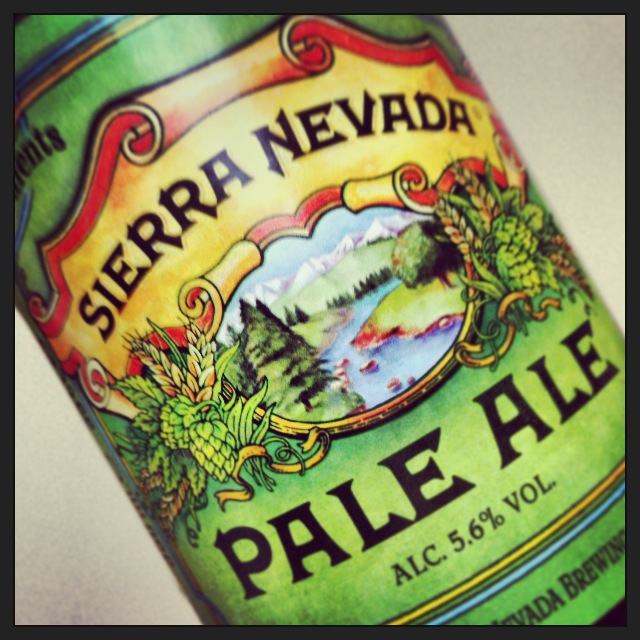
My One Beer combines complexity of taste with moreishness; multidimensional taste reward with just the right amount of alcoholic hit;  a bottle shape I love and a label design I wished I had designed myself. Its presentation invariably fires up my pleasure neurons with a thick, tight white head, and copper colour.  The story of the brewery – from start up to boundary pushing present day;  where it’s from and the appeal of the lifestyle.  In short, it’s got everything. It is Sierra Nevada Pale Ale.

This being the case, it is only fitting to finish in lamentable tribute to the inspiration for this month’s theme…

Three Beers for the Czech-kings under the sky.
Seven for the Belgian-Monks in their Abbeys of stone.
Nine for Bavarian Counts who would their beers lie.
One for Uncle Sam on his Hoppy throne
in the Land of Cali where the craft brewers vie.
One Beer to rule them all.
One Beer to find them,
One Beer to bring them all and in the hoppyness bine them
in the Land of Cali where the craft brewers vie*.

…and, of course, to reserve the right to change my mind next time round.

*JRRT: sorry.

IMG_0554

© David Preston, Beer Tinted Spectacles 2012

The Session #65: You’re never alone with a Strand

the session beer blogging fridayIt’s funny, drinking alone.  For many of my friends it just isn’t done; an admittance perhaps that your socially failing.  Another example of modern day liberal mindedness gone too far though I fear.  My father in law has set off for the pub by himself, every Sunday, most weeks of his adult life, and possibly a few before that.  He doesn’t ring around in advance to ask who will be there; no checking of social media sites or text messages and no sending of pigeons either come to think of it.  He gets up late; has a shower and heads off.  He will sit at the bar and drink a pint of whatever takes his fancy, but is within the bounds of his respectable repetoire.  Bass, yes.  Old Speckled Hen, yes. Landlord, yes. London Pride, no. Bank’s, no. Greene King IPA, nay, nay and thrice nay. Pedigree, pub dependent.

But of course, the beer is of little relevance in this scene. Sure, it’s part of the pub currency… a pub currency that has linked these visits from the time he started. Memories of beers that have come and gone; of public houses now just houses, and Landlords now lording it under the land behind the Church. And sure, despite what he says, the pint itself matters even less when most of the time he sluices a Gold Label into it anyway.

Because in reality, he never does drink alone. John is someone who is an institution in his village in a way I can never been in mine – he has lived there all his life; his business is there; his family are around him. And his extended village family too – people he has known all his life; or their children, new bucks he gently teases about their effiminate ways… even if he wanted to be alone, he couldn’t be.  And while he may complain about this from time to time, he knows as well as everyone else that he wouldn’t have it any other way.  If the pub has no other customers, then he chats to Tom, the Landlord; if he knows no one in the bar, he either introduces himself, or much more likely, is introduced. So, even though he is by himself, he is most definitely not alone.

I’m different. Sometimes I need my space. Once or twice a year, I really do need to be alone and just let the cobwebs that have accreted over the passing months get blown away.  I’ll go to the hills and walk, or set off on my bike.  But this isn’t the everyday me.  I have what I deem to be an curious individual trait, which of course, is common to most:  from time to time, I like to be alone in others’ company. the hustle and bustle around me; the chatter; the greetings; the people-watching.  I observe it directly or in the corner of my eye as if floating like an invisible orb above the scene, but actually being in it is critical.  Because I can choose to participate if I want to.

And beer doesn’t always feature here.  Before I had children, the occasional Sunday newspaper, bag of crisps and a pint was more occasional than not; today, it’s more likely to be a snatched 30 minutes between the parental taxi duties. Not that I’m complaining.  Because the shimmering image of those Sundays, sitting at a big oak table, with a broadsheet spread out in front of me and a pint of …ooh, let’s say, Broadside, my accompaniment, is always there. It may take me until retirement to live that dream frequently again, but I can dine out on the thought of it happily until then.

© David Preston, Beer Tinted Spectacles 2012