Making a bee-lion for Manchester

Alerted to their existence by a nice piece on the Pellicle podcast, engineering a visit to a Manchester Union stockist (a stylish modern local in Ancoats, Elnecot) was a pre-requisite of a recent trip back to my home city.

Time comes around. Not that long ago, if you wrote about lager there was a sniffy ‘big brewer apologist’ air attached to you. Lager, was the inference, was the domain of mass-production brewers, those who could brew to a super attenuation strength (12 – 13%ABV) and ‘liquor down’ to the desired market strength they wanted ‘in the glass’; those who could replace a pure malt bill with filler (malt, rice, dandruff – the usual); and those who could, apparently, only sell their inferior wares because they had big marketing budgets and scale. So to write that lager was really where it’s at and one day, you’ll come to your senses… well, huff, puff and hufflepuff to you, lager-boy.

Not now. Surely now, even craft brewers are seeing the irrefutable twofold logic – the logic of the head – that our market is still ostensibly a lager market i.e. most beer sold is lagered beer – and the logic of the heart too – that a well brewed lager is a thing of joy. Scratch that… it’s a two, three or four ‘things of joy’ because the first should always call out for a second.

So good for Manchester Union – giving in to those two dimensions of logic and setting out on the noble mission of ‘brewing the finest lager in Manchester…’.

They’ve not cut corners. Designing a decoction mashing regime into your brewing kit was seen as unnecessary madness by their consulting experts. But they did it anyway, finding the brew-kit solution in Bolton of all places. And that two step decoction process is right there in the glass; you can taste it and you can feel it. The taste is that subtle layering of flavours you only get with decoction – there’s the clean maltiness of course, but there’s more. Is it an ever-so-slightly burnt biscuit note? Just there at the tail end of the after taste? A mushroomy roundness (this is a good thing, trust me). And the feel; that rounded, 3 dimensional coating quality that infusion mash lager can never replicate. Like a Zulu battle plan, this lager invites you in to the centre, then surrounds you on all sides. Then pokes you with a sharp stick to order another.

Next time, the dark lager…why are these so rare? And for now, unless you live in Manchester, Manchester Union lager will remain just that, a rare find. But not for long surely – after all, there’s a second part to their purpose – “…famous the world over”.

Is it ‘craft’, really?

Few can have failed to have noticed, read about or become embroiled within the debate about the definition of ‘craft’ beer. A veritable game of semantic ping-pong or something much more serious, central to the very existence of independent, quality and taste-forward brewers? Yet, rather like many terms in business, ‘craft’ has moved from becoming something aspirational and positive, to something that is now merely an ‘amplifier’ – slipped on to a word to add weight and a veneer of artisan connotations to a brewer’s otherwise (likely) mundane credentials.

Most come at this debate through the lens of small, independent brewer defence: how dare these global multi-nationals (falsely, they say) claim our territory? These mass-manufacturers with their cost-orientation, process and efficiency fetishism, brewing imitations of the real deal. These profit-inebriated numbers machines that are only bothered about Executive remuneration and shareholder return. And damn them, these hard-nosed, ruthless bastards who have determined they can’t win the battle through imitation, so are intent upon gobbling up true craft brewers either through stealth or manifest over-bidding.

Switch views though. Plop yourself in the seat of a start up brewery, doing well, say three or four years in. Launched the company through skill and passion and vision. The head brewer is perceived to be the face in the brewery tap, but in reality he or she is putting in 16 hour days, with little help;  up with the lark to prepare the first brew of the day, and then lost in a fug of measuring, tasting, scrubbing out, washing down, problem solving, fire-fighting and customer-handling before having to down tools and go out and sell to pubs where there is no shortage of choice, enjoying an effective over-supply price war and frankly, such variable standards of serve that you have no guarantee that what you’re brewing will taste anything like i’s intended to. It’s no game for slackers; and that raw, nerve-tingling passion and drive can only take you so far when the only thing you are truly drunk with is the creeping, imperceptible fatigue of non stop graft.

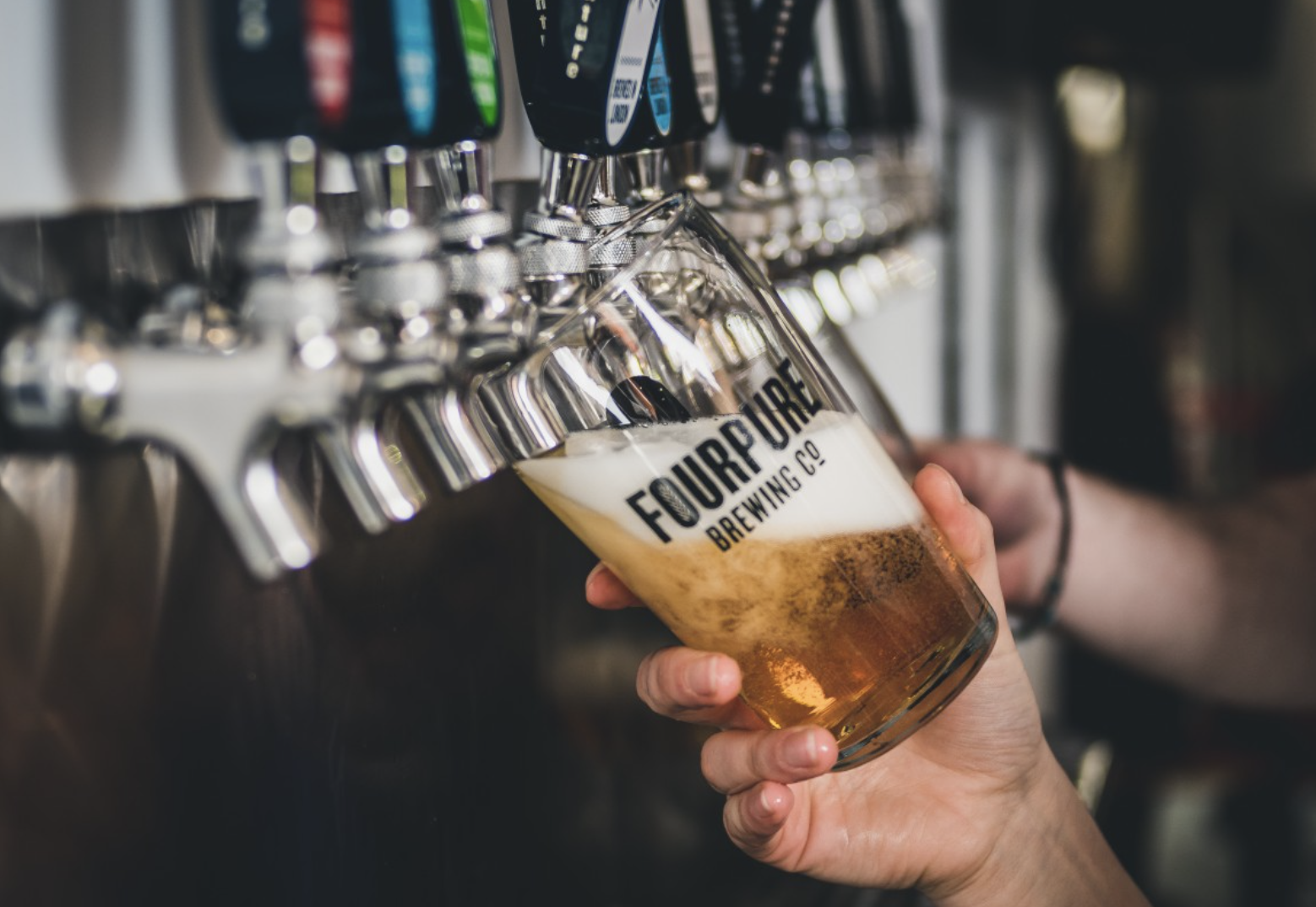
What are the options then? You sell out; or you drive growth, efficiency and mind your costs.  Take a moment to read this extract from Four Pure Brewing’s recent blog on their upcoming expansion:

The heart of the expansion will be a state of the art 4 vessel Craft-Star brewing system from GEA. The Brewhouse is best in class for automation and beer quality, it’s the first of its kind to hit the UK and places us at the forefront of what is an increasingly demanding industry. In addition to production capabilities, it also supports our long standing commitment to sustainability and reducing the environmental impact by deploying outstanding credentials from water use and energy saving to heat recovery and vapour condensing.

The investment also includes the purchase of some additional pieces of the quality puzzle including an upgraded centrifuge, a precision carbonation module, malt and spent grain silos and 12 shiny 200hL fermentation tanks.  All of this equipment will be installed over summer and producing beer in September.

Determined to lead in education, efficiency and quality control, we’re not just focused on our brewing and packaging capabilities, there is a real drive to optimise process and practices across the business

This is no gibe at Four Pure, whose plans are exciting and heartfelt. Keeping brewing in the Capital; reinforcing sustainability, increasing capacity. But really look at it. The truth is that change the name and the scale of the fermentation vessels and you have a large, transnational brewer. This is the language of process and efficiency; heavens above, even the word “optimise” is used, and that’s a Four Pure10 pointer in our game of Business Bullshit Bingo™ here at Tinted Towers.

So, is this ‘craft’? Really?  How can we spend our time debating what ‘craft’ means when the ‘craft’ brewers are doing what the big brewers have been doing for years – recognising that making profit in brewing is damned hard and to be successful, you have to brew consistently excellent product, as efficiently as possible and brew it right, in terms of your people and the planet.  Wait! Did I hear you scoff?  Sure, corporate programmes of ‘Corporate Social Responsibility’ may be some politically correct window dressing for some of these companies, peppered with buzzwords and shrouded in a cloak of ebullient social feeds, but don’t doubt that these companies don’t mean it; and don’t doubt that they won’t make a difference.

The point is, big or small, you have to run your business well. And the ‘craft’ brewers who don’t will fail. It’s a tough, unrelenting and unforgiving beer world. There’s no point being a poet about it.

And it also shines a light on what we must protect in beer – what 30 years ago had almost been lost entirely. Because there clearly are significant differences between these up-and-coming ‘craft’ brewers and shareholder owned, profit-driven multinationals. Sometimes it’s the soft, intangible factors: a purpose or ‘credo’ as Brew Dog would have it. Often it’s about the manifesto that these companies have for their people; how they deal with one another and their customers. But the truth is, the real discriminator can only be one thing: that at the heart of the business, like a Framboise Supernova, is the beer.  Really at the heart of the business; not fancy words and nice pamphlets for the company induction days. The commitment to brew beer that is true to itself, is incisiveness in pushing the boundaries in technique and taste, is vehemently aggressive in protecting flavour and how that flavour is arrived at.

Take a look at how the big brewers products change over time and track them. What you see that beer is peripheral to their businesses. It’s just a tool for printing coinage.  Product flavour profiles changing; alcohol levels falling for the savings; ingredients bought more cheaply or switched for inexpensive or more high-yielding alternatives; processes shortened and switched to squeeze more out of the metaphorical tea bag. In fact, you can guarantee that the tea bag brewing process is currently being pursued – so much easier to clean the Copper.  It doesn’t mean that these companies can’t brew great beer: of course they can. They’re brimming with talented, passionate people who want to do the best they possibly can. But they’re knowing or unknowing puppets to the profit machine and personal beliefs and integrity around beer count for nothing.  That’s what’s under threat from the rafts of ‘craft’ acquisitions currently gong through. It’s the culture and commitment to beer that goes, enshrined in independence that protects what’s really important. When that’s gone your beer will not be far behind. A threat then to your beer; not today, not tomorrow and probably not next year but soon, very soon.

The tyranny of choice

There’s been something of a furore over Carlos Brito, AB Inbev’s top dog, over his comments about beer drinkers being tired of choice – and for balance, it’s important to mention that he was specifically talking about distributors and retailers, and how much choice they could actually carry on shelves. Yet customer and consumer are umbilically linked, so by default he is saying the consumers too, are tired of choice.  And according to ABI’s earnings release briefing, craft beer sales in the U.S. are slowing, hence it must be so.

As you can imagine, a furore.  Because surprise, surprise, here are AB Inbev, now commanding one third of global beer sales, concerned about any affront to their brands, their competitive edge, their ability to dominate the market.  An agenda of consumers ‘tired of choice’ means ‘you don’t need to stock unusual craft brands, but you do need to stock nationally / globally recognised brands‘ – ooooh, and look – we have lots of them.

The thing is though, the provocation from Brito does have more than an edge of truth about it, depending on how you view the world.  Take the U.K. beer scene at the moment. ‘Explosion’ is not too dramatic a term for the number of breweries that have opened and continue to open. Each month sees a closure, but each month see many more openings. The leaky bucket overfloweth.  Go one level below this and there are serious implications.  Each brewery will have, say, a minimum of three brands, probably three of four core brands and then a selection of in / out products too. So let’s say that there are now (round numbers), 2000 breweries, each selling five beers. That’s 10,000 brands of beer minimum (someone I’m sure will have the actual numbers on this, providing they’re watching the press releases daily.). There are about 150,000 licensed premises in the UK.  In theory that means most bars can carry an entirely different range from one another (OK, there may be 14 other ones carrying the same range nationwide).

Now clearly, this is theoretical. Because the truth is more stark. In fact, most bars have a limited number of taps and lines. Choice, in draught in particular, is not finite. Many of these lines will be keg, a small number hand pull. And of the 10,000 brands of beer on sale, probably 9,800 are craft and cask brands. The number of mainstream, keg dispensed, national brands is slight in comparison, dominant in sales though they are.  9,800 beers competing for, say, one of three hand pull spaces on a bar or God forbid, one of the keg lines owned by a multinational.

You can’t build recognised brands in this environment, unless you own an estate and demand they carry your range.

And there’s the rub.  The truth is that there’s so much choice now that the market isn’t saturated, it’s super-saturated.  Just like the supermarkets have bred a generation of deal junkies, rather than being tired of choice, we have a spoilt generation of beer drinkers who are trial junkies.  You can see it where every you go. Looking along the bar. Spotting the new beers. Examining ABVs. Asking for recommendations, a sip, a third. Buying a flight of different beers. Every beer a different beer during the session. Switching between styles. Ever more choice at home.

Oh sure, there are implications for drinkers.  It can be bamboozling. So many choices, where to start?  Which style between the many I like? Which strength? Colour? Hoppiness or maltiness? Sweet, sour, bitter, dry?  How to make sense of that, goodness knows.

There are implications for customers too. If you are in some way tied in to a brewer or supplier, how to offer the choice? How to run a business based on strong sellers with the roller coaster of guest beers being so important? How to manage the tensions (under the bar) between keg and cask, cider and lager, craft and real ale, spirit vs wine, whilst all the time having to deliver a stonking food offer.  I love pubs, but it’s a hell of a job to get right, particularly with those damned drinkers constantly demanding something new every week.

But what’s the alternative?  Take London just 10 years ago. I was in beer sales down there at the time. Most bars had some combination of Heineken, Kronenbourg, John Smiths and Strongbow, or Stella, Boddingtons, Becks Vier. Becks, Budweiser in the fridge. Everything else scrapping for space round the edges. Ok – so perhaps this picture is a little dramatised, but even if it’s only half true, compare it with today.  Bars bursting with choice. Beers on rotation. New breweries introducing new styles. Rarely a Stella or Bud to be seen, at least in a place where you’d want to be seen too.  Do we want to go back to a world of Stella, Becks, Corona wherever we go? Do we want to see Mr Brito’s thin, assassin smile widen further?

Give me the tyranny of choice any day.


Revitalisation

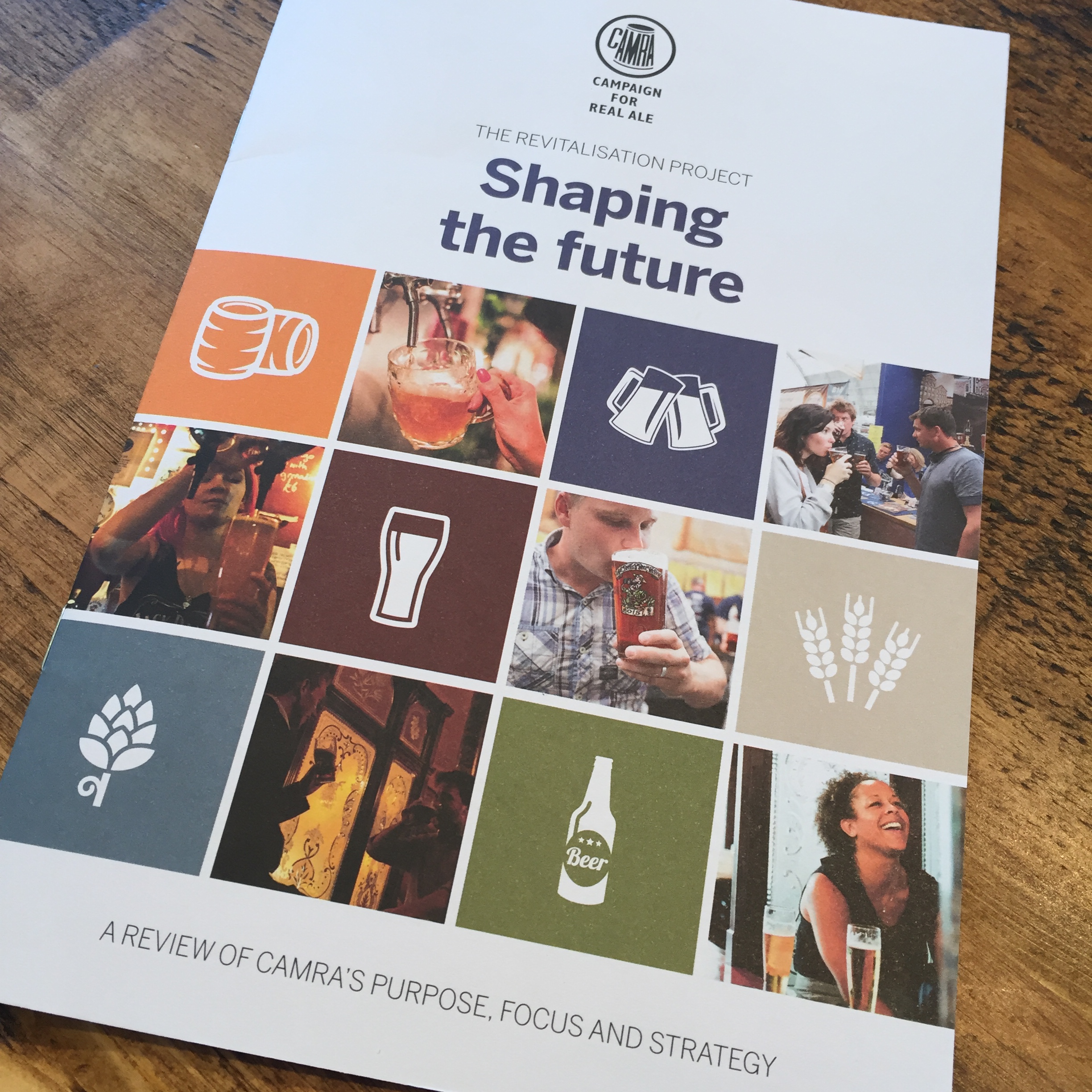
This week The Campaign for Real Ale (CAMRA) announced their ‘Revitalisation Project’, called ‘Shaping The Future’. The subtext describes it as a review of their purpose, focus and strategy and has been brought about by the raft of changes and issues that have occurred since the consumer group founded in 1971.

Issues such as scope and purpose: should CAMRA be about real ale only, good beer, real ale, cider and perry or any number of potential combinations and additions? How widely should CAMRA campaign and on what issues?

Issues such as their frame of reference: should CAMRA be about beer drinkers, all alcohol drinkers, pub goers or frankly anyone with an interest? And should CAMRA focus on the on trade, with challenges around declining and closing pubs, often in rural communities and / or should it focus more on the increase in drinking in home?

Issues such as the changing nature of socialisation. In their data, they claim that there could be more coffee shops 10 years from now than pubs, and many of these coffee shops could be serving beer (and unlikely, you imagine, to be serving real ale, cider or perry).

Issues such as governmental pressure: actually it only gets a brief mention, but when you have the Chief Medical Officer and anti-alcohol pressure groups both making (many have argued, deeply spurious) claims about what constitutes a healthy level of alcohol consumption, then whether you’re Big Beer or craft beer, you need to consider your response.

The review needs to be root and branch. The issues are existential, or, at least, they are fundamental to what CAMRA is all about.
CAMRAPossibly the biggest issue, wide ranging in scope and for some pernicious in nature is rooted in the rise of craft beers that came about following the introduction of Small Brewer Duty Relief in 2002. A brief background: the increase in the number of breweries was something to be celebrated by CAMRA, they played a pivotal role in the policy and there’s no doubt that the increase in small breweries went hand in hand with the increase in number of cask beers available, not just because of our brewing and drinking culture but also because the process of brewing and packaging cask beer is more straightforward (which is not to say it is easy) and fundamentally, cheaper. There’s no need for pressurized kegs, expensive pasteurisation and filtration systems, automated filling machines and all the paraphernalia that attends filling kegs. With beer in casks, the ability to keep, handle and deliver a quality product is as much the responsibility of the publican as it is the brewery, if not more. And there in a nutshell, is the rub. Many craft brewers, not just the more ambitious, but also those dedicated and passionate about quality soon have an issue with cask. Put simply, that precious quality is just too variable. The result: more investment in kegging; more stimulus from the U.S. brewers (untroubled by the cask / keg question) and more ‘craft keg’ beers available.

Skip back 40 odd years to see the parallels. The ‘Big Six’ breweries actively managing down and phasing out their cask beer due to, you’ve guessed it, the variability in quality (amongst other things, like cost), often put down to the lack of training and skills of publicans. There were, of course, many publicans then, just as there are now who could serve a cracking pint of cask. And there were many, probably more, who find keeping cask, fettling it, tapping, spiling, broaching – all of that – troublesome and perhaps not worth the effort.

Another issue for cask is seemingly prosaic but critical – yield. In a keg, the central spear reaches down through the inside of the keg and almost touches the base. The beer is propelled out using a dispense gas. Finish one keg; wrench off the coupler, attach to the new keg, carry on serving. Industry estimates of waste from a keg put it at around 5-8%. Not so with cask. More beer is left in the cask (some because it is the yeast sediment, the remainder due to the cask shape) and more is lost as the last drinkable beer splutters through from the old cask and the first draughts are pulled through from the new. And then there’s the beer left in the pipes overnight, which (you hope) is pulled through and discarded. How much is lost? Well estimates vary from 15% up to 30% and more (that’s from an industry source by the way, not an arbitrary guess). Put simply, it’s very easy to pour 30% of your profits from cask down the plug-hole.

Which is not, in any way, to say ‘give up on cask’. But to not recognise – and in this case, for CAMRA to not fully recognise – that today, the situation is wholly different that it was when they founded. We are not talking about replacing Draught Bass with Worthington ‘E’. We are not replacing Courage Directors with Watney’s Red Barrel. We are not talking about getting rid of John Smith Magnet and shoving on Webster’s Yorkshire Bitter or Trophy Best.  We are talking about a bar or pub having a crack at selling any one of thousands, literally thousands, of exciting, tasty, experimental, classic, not-quite-right, full on, challenging, mundane, surprising beers that just so happen to be packaged in a container called a ‘keg’.

As someone who runs a brand building company as my day job, there’s an interesting parallel here and something for CAMRA to consider. Whatever they do, they mustn’t believe that ‘the job on cask is done’. The revival of cask beer has been sensational, but despite appearances to the contrary perhaps, it remains fragile. Most beer drunk in the UK is keg lager. Pubs are closing at 27 per week (according to CAMRA) and many, many more remain unsustainable. In a typical bar, there are only a few cask lines, and now with the amount of new breweries, there is so much choice for the publican that running a small cask led brewery is horrendously tough – commercially in particular. Lay on top of that all the issues with keeping cask, serving a high quality product and lower yields and the odds remain stacked against it. We need cask champions still. We need a consumer group fighting its corner. We need to keep on educating publicans to the wonders of cask beer and the criticality of quality. We cannot afford to get bored or distracted. CAMRA must keep the core of what they do – protecting real ale (and for me real cider and perry too – they probably need the help even more) – keeping it alive and fundamental to their central purpose. Great brands keep their core dynamic and fresh. CAMRA’s core is cask.

Yet great brands also focus on what’s coming up – what’s new and may be the ‘core of tomorrow’. So CAMRA must have a duel focus on cask and great beer, no matter how the brewery chooses to package it. Of course, ‘great beer’ is subjective. Pilsner Urquell, served from the tank at The White Horse in Parson’s Green is delicious. It is ‘great beer’. But PU, like many others is now a cart horse in the stable of a large multi-national, consolidating brewery. Not only do they have enough money to look after themselves, they are also only driven by profit. If PU proves to be a challenge to grow, it will sadly be reprioritised or even discarded and the focus will move elsewhere. So we are talking about a different form of ‘great beer’. CAMRA must champion beer from independent brewers, who are fashioned as much from sharing their passion, championing brewing and brewing heritage, making products with integrity not just efficiency, as they are from making a decent wage. And not just small brewers either – but independent brewers. From Elgood’s to Fuller’s, from Brew By Numbers to Magic Rock, from Marston’s to Skinner’s – even, whisper it – to BrewDog too.

Because let’s be clear. CAMRA have done a terrific job saving cask beer. But the independent craft beer ‘movement’ has done a significantly better job in making the whole beer category fresh and vibrant and attractive to people wouldn’t have even considered beer in the past at all. It might not have been directed nor seem coherent, but it’s done it – and in a quarter of the time. If CAMRA isn’t willing to stand for that, then it deserves to lose its relevance.

© David Preston, Beer Tinted Spectacles, 2016

Craft and consolidation

I’ve thought long and hard about a Tinted perspective on the ‘craft’ debate. Industry insiders and writers of all denominations here in the UK, in the ‘States and elsewhere have chipped in to make this a rich vein of beer column inches. Should I join in?

The answer I reached is no. And not because it doesn’t matter, but because it’s already too late. “Craft” as a word is already baseless, devalued. It’s become so over-used, so stretched that not only has it lost any useful meaning but it’s crossed the line and become unhelpful and confusing. At its bluntest it is a false amplifier, used to cast a positive halo on something questionable; at it’s most sophisticated, it adds no value to the more knowledgeable drinker who’ll work out for themselves what’s good and what’s not.

If we truly think that ‘craft beers’ are motivating for many drinkers then what do we think craft means? Or more to the point, what should it mean? Surely, you would imagine, it should involve some craft, some learned skill, human artistry, or personal flair. I like ironwork when hammered and hewn by a smith; or glass art, igneously brought to life by the likes of Jo Downs. To me that is a ‘craft’. One piece, similar on face value, is totally different from the next. Each with its own unique fingerprint.

For me ‘craft beer’ should mean this too. A while ago, I visited the Žatec Brewery in the Czech Republic. It was fairly tumbledown, apart from where investment had been made in key places: in the copper room; in fermentation, in yeast propagation and in new lines throughout. In the main, Žatec brew familiar Czech, lagered beers, not the mega hop profile of a West Coast pale ale, or the counter-intuitive thinking of a black IPA. But their beers are craft: the ingredients are picked, selected and loaded by hand. Fermentation is judged to be completed by the brewmaster not the stopwatch, maturation also. There is some slight variation in the end result, precisely part of its charm. They’re now half owned by Carlsberg, but are they any less craft?

Likewise, I recently visited Westons cider mill in Much Marcle. The vat shed there is one of the wonders of British cider making; there must be over 50 oak vats, all old, all named, unique in height and girth, strapped together with iron belts and carrying titles as varied as ‘Gloucester’, ‘Worcester’ and “Aston Villa’. But every drop of Westons cider spends time in those old oak vats. There’s just no way on earth that each batch can be 100% consistent, yet alone the fact that much of their product is ‘vintage’ so will vary enormously from one season to the next dependent on the fecundity of the harvest. Surely, this is craft? Yet within cider circles, merely because of their ‘scale’ (medium-large in cider terms, modest compared with many breweries, minuscule compared with brewing multi-nationals) many commentators claim that they can’t be described as such. They remain wholly family owned and independent.

Yet equally, I have been round a number of craft breweries who use spankingly new, gleaming stainless steel equipment and whose brewing process features automation (grist loading, hop addition for example) and is run from an iPad. Is this craft?

Our perspective has become cock-eyed. What we have to nurture is something entirely different. What we have to nurture is the human desire for variety, to be curious, to discover and try new things. A desire that in the late 60s and 70s was almost suppressed. The role of ‘innovation’ in proper beer remains as important today as it has ever been. On the one hand, we have the major international brewers putting much of their focus into mass-produced hybrid products (part lager, part spirit, often mixed not brewed) that do little for the brand other than confuse and are, in essence, a way of supplying easy drinking, relatively low cost alcohol to young adults. Conversely we have a push for discovery and rediscovery in genuine beer from national brewers to micros (and even, more patchily, with some multi-nationals) that matches this human trait and is breathing new life, new vigour back into beer. This is what we must protect, through our inventiveness and as drinkers, through out wallets.

Because have no doubt. The threat of mega-consolidation is a looming large now, dwarfing any petty questions of how to define ‘craft’. The economics of acquisition demand cost and efficiency savings. Savings mean cuts, closures and simplification. Brands will die; brew streams will be reduced, provenance will count for little. And as in turn, growth slows, so the eye of the multinational looks out into the world of burgeoning smaller brewers and eyes them lasciviously. Once they’re ‘synergized’ into their networks, the clock on them being able to carry on brewing in the way that the Founders intended, the way that built the brand and brought them success, is ticking. Tick follows tock follows tick.

So call it craft if you want to. Call it ‘interesting’. Call it ‘flavoursome’. Call it what you will. To me, it doesn’t matter. But whatever you do, support independent brewers who continue to innovate and brew with principle. A dark shadow is growing.

© David Preston, Beer Tinted Spectacles, 2015