Honey, honey

Some flavours just seem to have that magic fairy-dust effect. Elderflower for one.  If you want to make a drink a bit more adult, a bit tricksy, a bit special, just add ‘a touch of’ elderflower. Bottle Green, Belvoir cordials and their ilk all seem to be enjoying the benefits from the wave of the proverbial Elder Wand.  Lemongrass and ‘Sweet’ Chilli (whatever that is) are enjoying the same transformational effect on food. Take Walkers Ready Salted. Pack in matt finish bag. Add ‘Sweet’ Chilli. Boom!   Other flavours though just polarise. Ginger is one.  There’s a world of difference it seems between a fiery Tam O’Shanter of Idris or Old Jamaica and the subtle hint of Canada Dry or Fever Tree.  And honey.  Other than the texture, there seem few similarities between honey and marmite, but their ability to put people into a ‘Lovers’ camp and a ‘Haters’ camp is most definitely one.

I was mulling on this on Tuesday just gone as I drank – and more to the point – enjoyed, a bottle of Skinner’s ‘Heligan Honey.’  It’s amazing where drinks concocters find their raw ingredients in the quest for ingredient one-upmanship. New Zealand, Chile (not ‘sweet Chile’ note) and Kentucky have all been put to good use in beer in recent years. Organic is assumed and Manuka, well, frankly, yesterday’s news my friend.  And so it is the case with this beer: ‘the subtle addition of real Cornish honey will give your palate a buzzzzz!’ – the honey being from the working gardens / farm / Victoriana themepark of the Lost Gardens of Heligan in Cornwall (Skinners being from Truro, even further down towards the pointy bit of our islands).

The way I see it is brewing with honey is a natural thing to do, not just because it’s natural but because presumably, it’s a great, easily fermentable source of brewing sugar. And those memories: sweet hot toddies when you are under the weather, or bronze-red runny honey drizzled oozingly onto steaming porridge (or triggered by my mate Neil’s ice cream toppings at Uni, honey, golden treacle and clotted cream, scooped, slid and generally coaxed onto a ’99 Flake).  Good memories all, and deep anchors in the mind.  Yet honey as a brewing ingredient flatters to deceive.  Somehow it doesn’t pull it off. There’s either the lack of balance with insufficient hop ‘cut’ to even out the beer, or strangely, too little honey character and disappointment all round.  I was drawing the conclusion that honey beers are like learning to ride a unicycle: a great skill and all that, but largely useless in getting you about, which is rather the point after all.  But Heligan Honey may just keep them on the agenda – although described as a ‘pale amber’ light refreshing bitter’ on the label – I would describe it more as a hazlenut colour and the honey is treated well. Enough that you know it’s there with deft touches of background sweetness, but not enough to give any cloy. And enough in fact to continue to perservere with beers containing the original amber nectar.

© David Preston, Beer Tinted Spectacles, October 2012

The Session #67: How many breweries?

the session beer blogging fridayI’m late.  A summer break that was well overdue, led to relaxation of body, mind and fingers to keyboard. My first missed deadline and I think serendipitously so as it turns out as the topic of this month’s ‘Big Session’ is about the future of the US craft market – where will it go and specifically how many breweries will there be a few years from now?  Fortune favours the procrastinator. Just as I experienced my first writers block – unable to find an interesting angle into the topic without covering old ground, so our good friends at CAMRA’s PR team spring into action to announce that in the UK, we have just passed the 1,000 brewery mark for the first time in donkey’s years*.

An interesting juxtaposition. The night before I heard this, I had attended leaving drinks with a former colleague at the large brewer we had both worked for.  She was skating through the room with delight and expectation to the new challenges ahead.  Lovely though this was to see, less so were the cold, grey faces on others left behind (apparently this all changed later on when Shots got involved). They seemed battle scarred and weary through years of long hours trying to turn round a business sailing towards a maelstrom whilst fending off all the non value added dross that goes with working in big businesses.  Declining beer consumption; much-hyped strategic initiatives around such glossy topics as promoting beer for women, grand trumpetings for major relaunches… all broken and scattered like the flotsam and jetsom washed up on the rocks from a shipwreck, tempted by the wreckers’ false lights to the shore.

Yet British brewing – ale brewing, small-scale, round the back of the pub, in the garage, an industrial unit brewing…well that’s something else.  Since I lifted my head back above water and began to see the beer category as a drinker again, it’s shocked me how it feels in rude health. New breweries opening, a mad new name for a beer to conjure with every week, an amazing range on sale in a supermarket – both domestic and foreign beers.  The big boys and ‘craft’ boys are like gypsies with daggers; tied at the hip, reticent to reach into the others’ fight space ifor fear it will be the last thing they do.

Brewery numbers here and across the pond is rather like the Olympics medal table:  despite our geographical compactness and rather miserly 60 million inhabitants the UK now has 1,000 breweries. The U.S., for all of its 360 million good folk, has only 1,989.  So whilst we can enjoy the moral highground on this particular score, the reality is we should enjoy the fruits of our brewers and our brewsters while we can.

This may sound heretical, but history suggest cycles, and economic reality tends to support it too.  Here’s my thinking:

1) Despite the growth in breweries, the hard reality is that people in both countries are drinking considerably less than they did 5, 10 years ago.  And within this, the mix is changing. Both markets are still seeing the growth of wine (albeit this isn’t as inexorable as it seemed a few years back), mass produced ciders, particularly over here, but even now in the US and a spirits market that is fighting back after a torrid couple of decades.

2) The real competition, the reason why CAMRA are now slowly but certainly moving their focus to saving our pubs, is the rise of the coffee shop.  Drawing in consumers from dawn until dusk for the inexpensive treat that used to be the sole realm of alcohol.  With a decreasing amount of disposable income in our pockets nowadays it’s going to continue to have implications.

3) Supply and demand.  There is excess brewing capacity in the UK yet new starters are building new breweries, and to a lesser degree new packaging lines at a rate of knots.  The rate of craft brewery failure is less publicised but look carefully and there they are.  Small companies, launched on such optimism and belief yet over-stretching themselves by building assets wanted but not needed.

4)  The big boys will take note and they will act.  What’s the biggest ‘craft’ beer in the US?  Boston Lager?  Sierra Nevada Pale Ale?  Brooklyn Lager?  Nope – Blue Moon from Miller Coors.  You may argue it doesn’t count – it’s not a ‘craft’ beer.  But the drinker isn’t bothered.  Blue Moon looks like a craft; and it smells like one. By God, it must be one. And frankly, Keith Villa is a lovely chap and we know where his heart is really, so it’s all OK. Isn’t it?  Well Molson Coors are small fry when it comes to the real boys in town: take Anheuser Busch Inbev not only developing their own brands but investing in crafts. I know: I bought some Goose Island only today from a Waitrose.

Don’t get me wrong. I’m not a doom-monger.  I’m loving what’s going on in beer at the moment – and I’d probably re-mortage the house to start a brewery if I thought Mrs P wouldn’t butcher off my dangly bits and feed them to her mother’s Jack Russell, but those who are pro beer, pro taste, pro the individual taking on the behemoth…well let’s be prepared and make sure we build great beer brands, not just great breweries.

© David Preston, Beer Tinted Spectacles 2012

*It’s over 70 years apparently, which by my crude maths takes me to 1942…the War…you know, know the best time for breweries you’d think?  In fact, weren’t some nationalised??

**And here’s an interesting fact, courtesy of the American Brewers Association…

US craft beer image

Groupdrink

Doom Bar.  Where did it come from all of a sudden?  Sharp’s Brewery isn’t 20 years old yet their flagship brand, named after a sandy marine ramp, that squelches around the low tide mark and is generally frequented by sea molluscs, crustaceans, kelp and assorted ships’ keels, is one of the UK’s fastest growing cask ales.  Fascinating.  And what makes it fascinating is that this is a genuine brand – it hasn’t earned its success as a function of a strong tied estate which gives a beer a springboard forward, gets it noticed; and it isn’t over-marketed. I mean, take the badge on the beer engine. It’s not exactly a design classic is it?    Simple, punchy, sure…but superlative design, no.  Then there’s the beer – purist or not, put a cask ale in a clear bottle and whether you like it or not, you’re supping on stoat¹ before you know it. And frankly, it isn’t a bad beer; equally it isn’t great, it does what it was designed to do: sit in the middle of the market and appeal to most.
doombarSo all this got me pondering on how brands get created.  Because despite CAMRA’s claims to the contrary, it isn’t marketing money. Oh sure, it helps, don’t get me wrong, and certainly, you would be utterly slack jawed if you knew how much money breweries (and not just the ‘big’ ones – let’s not fall into that trap) throw at winning and keeping distribution² (ie the stuff that we, as drinkers, don’t see).  And yes, it buys a nice font, and a few glasses for us to purloin, but there’s obviously much more to it than that.  Think of the brands that are spending big today: not that many. And think of the brands who have spent big until recently but just can’t stem the decline: Tetley’s, Boddington’s for example.  Broadly speaking, it seems that advertising money keeps you there, but it doesn’t get you there. More often than not in fact, it seems to be that the main audience is the Tesco or Morrisons Beer Buyer: ‘Look!’, the advertising says, ‘my owner is serious about me. List me, please!’

None of this explains Doom Bar that’s for sure.  Their approach has been to PR the hell out of their brewer, Stuart Howe, allowing him free rein, and slowly build from their heartland, out. And my, they’ve done this relentlessly and ‘executed’, as the Americans would say, superbly. Good for them.  But arguably, what they have done is no different to a vast array of other great brands, that have much more varied degrees of success. Take one example: Timothy Taylor’s Landlord – it’s been kicking around for yonks compared with Doom Bar, but it sells nowhere the near hundreds of thousands of barrels Doom Bar sells a year…and is, if you’ll forgive my personal taste, a vastly superior beer.

It’s tempting to deconstruct the inputs of the brand. The stuff it’s doing and gets to market. It’s glassware. It’s assorted ephemera – drip mats and all that.  Even the pubs it’s sold in. The myths and legends that emanate from its PR team. But I don’t think it’s that. My theory is this: it’s groupthink, or clearly in this case, groupdrink.

Go with me on this. I run lots of research with consumers across all sorts of different types of products – dairy, coffee, tea, soft drinks, banking, snacks – you name it.  And one of the biggest issues I contend with is groupthink. The tendency for humans, when they get together or socialise to adopt collective behaviour, views, opinions and attitudes. It’s remarkable because it takes no time at all – literally minutes.  It’s fascinating to watch the dynamics in a group: here are total strangers – never met before, unlikely to ever meet again. Yet within minutes they are watching how their peers in the situation are reacting; what they are saying and how they are saying it. It’s an innate human trait – more than that, a desire to fit in.  All sorts of tricks are attempted to avoid it- typically, asking for individual, written responses, done in silence before the group start discussing.  Of course, there’s a huge amount of difference in opinion when you do this, but again, within minutes, the lifelines are being thrown out: ‘Well, when I first saw it (lets say it’s an idea for a new beer) I liked it, it sounded really appetising. But now I’ve heard what this lady has said, I’ve changed my mind’.  There’s lots of scientific study in this area and it confirms what you don’t want to hear: I’m afraid, just like in The Life of Brian, you’re not an individual.  Human tendency is actually to conform. And ultimately, be conservative.

So the question is: how do you get your brand to the trigger point? To that point of reputation where a few people, just a few, are actively drinking and recommending your brand.  And in a situation where the context is positive.  This for me, is the happy serendipity that faced Sharps. Wittingly or unwittingly I’m unsure, but they chose to build their brand out of Cornwall, and specifically that part that has a lower concentration of Cornish, and a higher (albeit seasonal) concentration of tourists.  Tourists with a predeliction to come back year in year out; to bring their children and pass on that gene. To pop down for long weekends whenever they can, and if fortunate enough, buy a second home down there.  To sail in the Camel Estuary and pop over to one of Rick Stein’s bistros for a spot of supper. This is the emotional context that comes washing ashore with Doom Bar. And before you know, you unknowingly want to fit in, so you order a pint…

It can be replicated too. Sure, not exactly (albeit  Adnams has the wind in its sails for a similar reason), but building positive context and association around your brand is doable. Take Brew Dog; unless you live in Pitlochry, it’s not exactly on your door step, but their positive context is the challenger, maverick attitude.  ‘If you think this, come to me’ it says. And Black Sheep – the name says so much; the Yorkshire values; the visual portrayal:  a small Stone cottage just in view between the wooded interlocking ridges of the Dales.  It’s this mental image, this mindset that we really buy into. And that’s what Doom Bar have got so right. And why we all want to drink what he’s drinking.

¹See http://beertintedspectacles.posterous.com/my-beer-seems-to-taste-of-ferret

²Put it this way, UK Volleyball wouldn’t be experiencing any funding problems through to, oooh, let’s say the 2092 Olympic Games. They’re in Ulaanbataar by the way, order your Mosquito Spray today.

© David Preston, Beer Tinted Spectacles 2012
The Session #66: One Beer to Rule Them All

the session beer blogging fridayOne Beer to Rule them all.  Of course, for any lover of beer this is an impossible task, yet a beautiful, playful one at that.  So I saw the subject of this month’s Big Session blog and decided, no matter how difficult it proves to answer it.  To find the one beer to rule them all.

But why impossible?  For many drinkers, perhaps it is easy just to pick one beer and say, ‘that’s it, that’s the one. My beer’. Not for me.   It’s the seemingly infinite number of great beers available today, increasing seemingly exponentially that talks about the healthy future for beer.  There’s even new styles emerging, either inspired by the past or just the crazy playthings of brewers willing to mash concoctions into something drinkable.

What should go into consideration – what makes a Beer a pretender to the One Beer Crown?  How about balance?  That subtle interplay, that dance that a great beer has from the initial aroma, the dimensions of its taste, its appearance and its presentation.  I choose beers on each of these alone.   Then there’s moreishness.  I remember a great quote from a beer executive that I used to work for – “The great thing about our beer is, it’s drinkable”. I kid you not.  Actually, I know what he was driving at:  there is something great when you have a beer, and from the first sip it’s enticing you back to a second.  Often because that thing that attracted – the aroma, or the taste say – you want more of, or often because you can’t quite put your finger on what makes it great.  For me, this is a sign of a great beer, and narrows down my list.

And versatility.  I’ve lost count of the number of brewers who bang on about beer and food, and not really know why this is important other than a band seem to be on a wagon.  I like my beers to be versatile – fundamentally they must stand up on their own right. They must be intriguing, moreish, and damnably tasty. But I want it to go with my pizza on a Friday night and be able to stand up to Fajitas too. That’s a lot to ask – so it narrows the list further.

There are other variables. Patriotism is one.  I’m proud of great British beers. I am happy to admit there are beers in my repertoire that aren’t in my Top 10 best ever beers but that I want to drink because I want them to continue brewing what they do.  And memories. Budvar is a beer that I’ve drunk on some happy times in great places. So it’s up there for me….but that alone is not enough.

Ah, the tyranny of choice, and a spectrum of considerations from tangible on the one hand to seemingly irrational on the other. But I will get to it.  I’m not going to list my Top 10. I’m going for the jugular.

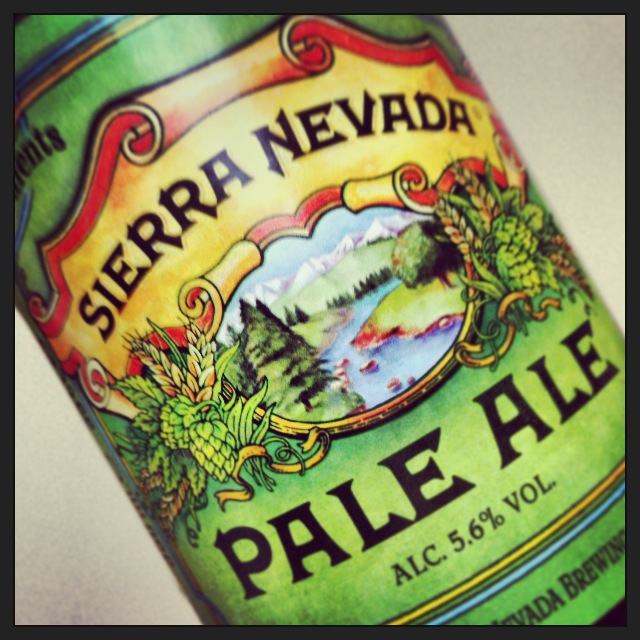
My One Beer combines complexity of taste with moreishness; multidimensional taste reward with just the right amount of alcoholic hit;  a bottle shape I love and a label design I wished I had designed myself. Its presentation invariably fires up my pleasure neurons with a thick, tight white head, and copper colour.  The story of the brewery – from start up to boundary pushing present day;  where it’s from and the appeal of the lifestyle.  In short, it’s got everything. It is Sierra Nevada Pale Ale.

This being the case, it is only fitting to finish in lamentable tribute to the inspiration for this month’s theme…

Three Beers for the Czech-kings under the sky.
Seven for the Belgian-Monks in their Abbeys of stone.
Nine for Bavarian Counts who would their beers lie.
One for Uncle Sam on his Hoppy throne
in the Land of Cali where the craft brewers vie.
One Beer to rule them all.
One Beer to find them,
One Beer to bring them all and in the hoppyness bine them
in the Land of Cali where the craft brewers vie*.

…and, of course, to reserve the right to change my mind next time round.

*JRRT: sorry.

IMG_0554

© David Preston, Beer Tinted Spectacles 2012

Reassuringly bollocks free.

There’s a general murmuring in marketing communities that the latest Stella work from ABI for it’s ‘Cidre’ brand is the dogs bollocks. Taking the basics of a drinks experience and adding a premium feel to every touchpoint., hence ‘Cidre’ not ‘cider’; ‘From the continent’ not ‘…the country’; and of course, served, not in a pint glass, but in a ‘chalice’ (“Chalisssse”). Perhaps it is the DBs, or perhaps Newcastle Brown, ever-so cheekily, have really read it right?