Copper Bottomed

Sometime ago, I wrote a piece about recent efforts by some Czech lager brewers to bring ‘tanked beer’ to these shores. It’s a worthwhile aim: to attempt to deliver absolute authenticity and the ‘brewery fresh’ taste that rocks you on your heels if you drink beer straight from a lagering tank, ideally in a cave or cellar under a Bohemian brewery.

Recap #1: the players. Miller Brands, the UK arm of South African Breweries (SAB) were installing permanent tanks in a number of prime bar locations, and bringing over smaller barrels too, for a ‘from the wood serve’ with which they were ‘going on tour’ – essentially a PR exercise. Budweiser Budvar, without the financial clout of SAB, were cracking on with a slightly different riff, their ‘Krausen’ or yeast beer. Like the tanked PU it was unpasteurised and carefully imported from České Budějovice.

Recap #2: the results. The half-termly report was ‘not a bad start but with much room for improvement’. I tried the Pilsner Urquell from the permanent tanks at The White Horse on Parson’s Green. It looked glorious: served in chunky tankards to a variety of serving specifications. The beer’s famed bitter note were highly pronounced versus the packaged version – but strangely whilst it pleased the eye it did less for the taste buds; I didn’t get the rounded complexity of the unpasteurized PU that I had enjoyed in the Czech Republic. The Budvar on the other hand, here from the The Draft House on Charlotte Street, was the opposite. Looking nothing out of the ordinary, served in unbranded glassware and not forming or retaining its head, it was lively, fresh-tasting and spicy nevertheless – the only issue was that it was still quite close to the bottled beer (which I drank alongside).

Now there’s new news, to use the business parlance, from Budvar UK. The brand has been a bit quiet in recent times; still a fine, fine beer of course, with that lovely creaminess and a palate at the sweeter end for a Bohemian lager, but left a little breathless as wave after wave of new entrants, promising something ever funkier, have entered the market. But here’s the thing, brewing great lager – seemingly, so simple – is fiendishly complex, time-consuming and expensive. UK craft brewers who have set off down this road have realised the considerably higher level of investment needed, and the cash it sucks out of your business – assuming of course that the brewer is lagering their beer for a few weeks. The precious tank space which could be used for something well, quicker, is needed while the lager dozes. On top of this, there’s the unscrupulous cleanliness required, decisions about whether to use modified malt or decoct, a separate yeast bank, it’s never ending.

At the moment, Budvar Tankové Pivo is a trial, at the delightfully bonkers Zigfrid von Underbelly on Hoxton Square. The tanks, rightly, are pride of place; there are two stacked one on top of the other in the main bar area and another one in the cellar-proper. Each holds 10 hectolitres (about 6.5 proper barrels) and like the Crown Jewels, they are displayed behind glass. A nearby sign proudly announces when the next delivery is coming: this is, after all, fresh beer, unpasteurised. It can’t hang about, and initial sales show that it isn’t (currently about a tank a week and rising).

Let’s pause for a moment on what the tanks do to the experience of drinking. They’re copper and as such, have something of a Jules Verne, ‘20,000 Leagues under the Sea’ quality about them. With hand shaped, baffled ends, they’re only lacking a perescope. Copper piping too abounds, torpedo tubes no doubt. The font is copper too; and the beer, rather than being served in a standard tulip or nonic glass is a glass tankard. Everything marks this out as something different, something unusual. The expectation of specialness is copper bottomed, even before you even open your wallet.

Ultimately though, it needs to deliver: and no stone has been left unturned to ensure that the beer is as fresh as a daisy. The logistical complexity alone of getting beer from the lagering tank in České Budějovice, to the serving tank in London is eye watering: bespoke containers, refrigerated transportation; beer filled hoses (the beer goes to waste but ensures sterility): in all, four days of nail biting stress for those involved. It pays off: the beer sparkles with its crisp, gentle and all-natural carbonation – and here’s the clincher – it has that rounded softness, the biscuity base, the light fruity esters, the alcohol warmth – that only an unpasteurised and lagered beer has. The maturation adds the richness, serving it unpasteurised allows you to enjoy it in full.

The plans are for Budvar UK to extend the trial and hopefully roll this out more widely. It won’t (can’t) be something you’ll experience everywhere, it’s just too expensive, too labour intensive. But if you can, it is definitely something worth jumping in your tank to go and experience.

© Beer Tinted Spectacles, 2015

IMG_2998_fotor

Ullage

The back streets of Smethwick are Cash and Carry land. Long horizontals of white mortar shine out from glossy deep red brick terraces, whilst large shop signs of every hue and a hotchpotch of shapes scream out onto the streets. Behind though is the beating heart of Birmingham past and present: small industrial units on streets that hark back to smoky, metal-beating times: Suffrage Street; James Watt Industrial Park, Kelvin Way. Today the heart of another industry beats, that of independent retail, of Asian and African trade and neighbourhoods. True enough, Cash & Carrys’ may not be that inspiring an association with an area, but let’s face it, depending on your interpretation of the reality of those parts, it could be much worse.

In my early years in beer, I worked in the off license sector (or off trade) – the independent retail of alcohol sales. Last week, CGA Strategy, who measure this sort of thing, reported that off trade sales overtook on trade sales for the first time. Still someway off the global norm of 70-80% of the beer market being consumed at home, but getting there slowly. Only twenty years ago though, off trade sales were much smaller, the market immature. The supermarkets sold very little and their range was poor; in fact supply wasn’t brilliant – mostly keg brands canned. It seems incredible today to think that most sales went through the off licenses – either the big ‘specialists’, Thresher, Victoria Wine, Augustus Barnett (all of whom had been the off trade arms of big brewers at some point) – or through independent corner stores. These were supplied by the Cash & Carrys – again, either the big chains like Booker or Nurdin & Peacock, Makro, to independent, more local, operators at the other. The West Midlands had a thriving Cash and Carry trade and the west side of Birmingham: Cape Hill, Winson Green, Smethwick had a profusion of the independents.

They were notorious: scale operators, run like fiefdoms, focused on volume, big deals, trunker* loads of beer coming in and out. And they performed the necessary evil of ‘clearing’ – taking the close to best before stock and shipping it through their network of retailers in double quick time at half the profit.

Given the sheer volume of beery traffic passing in and out of the loading doors, damages were inevitable. Typically, the offending cans or bottles would be removed and the remaining stock repackaged out back to be sold on, sometimes at a discount, often not. Damages – or to give it its butterily correct name – ullage – was a ludicrously lucrative business. The hope was that the brewer would credit them for the whole case, when in reality only one or two cans were damaged; they would then repack and resell the whole lot and effectively, double their money**. Usually, the Cash and Carrys gave the ullage a dedicated area; close to an unused loading bay or tucked out of the way of the key sales area. As you approached, there was the lactic smell of super strength lager turning to vinegar, oil-like spills on the floor, gel like in their viscosity, and beer flies (drosophila melanogaster, or the more common name bugus cerevesiae), who would drift and plummet in acrobatic displays then diving to feast on the sugars which the yeast were planning to consume in turn. It’s the same smell you get in a cellar where less than meticulous handling & cleaning practices are maintained.

Lindemans Framboise
The one that got away.

The back street Cash & Carry images came flashing back to me in an instant the other week, like rapid slide transitions in Powerpoint. We live in an old place, which has a small vault-like brick cellar below the room the dog sleeps in. You may justifiably ask what a bottle of Lindemans Framboise was doing in a fridge at all then, but let’s not get hung up here on the political correctness of beer storage. The point is that, made worse by a cold snap, the fridge temperature dropped and the beer made an escape for freedom. With surreptitious impact: what I found was a bottle essentially in tact: the cork still in; the crown in place, the foil seemingly undisturbed, but a huge plug of ice in the bottle and a spray of pinky-brown aging beery gloop covering the contents and inner sanctum of the fridge.

And my! The smell. Here was a characterful, already complex, heady beer, but given the chance to mature rapidly in contact with a room full of oxygen all for itself and probably some wild cellar yeasts snaffled up for good measure too. Vinegar, champagne, paint thinners or new emulsion perhaps, and fermenting raspberries – lots of fermenting raspberries in an advanced stage, über fruity yet sour and winey too. The memory, in short, of a potential great beer with a dash of Smethwick Cash & Carry.


*The term for a full 38 ton lorry of beer

** On one occasion, being full of youthful integrity, I refused to play ball and had to transport 20 cases of damaged Tennent’s Super cans, some of which were still spraying like a territorial cat through pinhead cracks, back to our depot. My Scirocco may have become The Zone Of The Piss Smelling Fly, but the Principle was worth upholding.

© Beer Tinted Spectacles, 2015

Prizes Schmizes

It seems a rare thing nowadays for a beer not to have won a significant award and be shouting it loud and proud. ‘Winner! Taste of Eastmorland 2001’; ‘Winner! Borchestershire County Show, 1998’ or, actually, much more likely to be global in nature. The clues will be there: little golden gongs on the label, with indecipherable text and maybe a touch of spot varnish or embossing as a token of our pride. ‘Winner of the World Beer Cup, 2007’, or some such ceremony in Chicago dating back to, what, 1899? Forgive me if I come over as a touch cynical but these awards have always seemed like a Crufts ‘Best in Show’ award. Oh, I know they take a lot of effort to achieve, much pulling of hair and many a sleepless night; the equivalent of beery detangling and grooming no doubt, but, at the end of the day, they only really matter to other dog breeders. I own a Bitza* and she’s best in show for me, no matter what the bigwigs at The Kennel Club may say.

The truth is, the sparks that trigger a particular brand of beer to success and acclaim are more than the product alone. Not that having a distinctive product doesn’t help. Far from it in fact: many a GBBF winner has encountered production capacity challenges immediately as a result of winning an CAMRA award. But the slew of beer awards to date have only celebrated the beers – the liquids – not the significant other factors in the weave and weft in any brand’s DNA. Until now.

Screen Shot 2015-01-23 at 16.22.05The Beer Marketing Awards, announced at the end of last year, will celebrate the marketing activity that has changed behaviour and attitudes of drinkers. Because even if you have a jaw-droppingly good beer, without others hearing about it, you might as well whistle in the wind. I remember Michael Jackson, dropping his head slightly and peering at me professorially over his glasses, and telling me (as a marketeer myself – and therefore a sub-species) that he didn’t like the idea of ‘brands’. For him, even using the term ceded too much influence to the marketeer over the brewer. Yet, ironically, what was Michael Jackson himself if not a great brand in the beer world: ‘The Beer Hunter’ tells you everything. Brands are critical, vital. In fact, brands are business. And marketing is their voice.

The Beer Marketing Awards are a step to rebalance the world of beer recognition and to celebrate more than the brewer alone in creating success. Have a look at the website of the competition to see the categories (www.beermarketingawards.co.uk): but be assured of this: this is not just a competition for big companies with big budgets. ‘Big budgets do not great marketing make’ as a former boss of mine used to say (a salesman in fact). Yes, the awards will celebrate traditional advertising, but the truth is in a tightening legislative world, it’s getting harder to make an impactful advert nowadays, and expensive too. So the awards also recognise social media, design, public relations, competitions, sponsorship…even a brewery’s merchandise. Every commercial brewer in other words does marketing; and every commercial brewery is eligible for the competition.

So take a look at the website and post your entry (deadline looming so don’t delay). Who knows, you may be able to feature it on your packaging in what…a hundred years from now?

* You know, ‘bitza’ this and ‘bitza’ that.

Disclaimer: David Preston, a.k.a. Beer Tinted Spectacles, is a judge of the 2014 UK Beer Marketing Awards, and this blog does represent his heartfelt views.

© Beer Tinted Spectacles, 2015

Zealot

the session beer blogging fridayThe Session, a.k.a. Beer Blogging Friday, is an opportunity once a month for beer bloggers from around the world to get together and write from their own unique perspective on a single topic. Each month, a different beer blogger hosts The Session, chooses a topic and creates a round-up listing of all the participants, along with a short pithy critique of each entry (see link, posted to comments in due course). This month’s Session is hosted by Ding at Dings Beer Blog (www.dingsbeerblog.com) and his question is this: ‘What’s your role in the beer scene?’ Are you simply a cog in the commercial machine if you work for a brewery, store or distributor? Are you nothing more than an interested consumer? Are you JUST a consumer? Are you a beer evangelist? Are you a wannabe, beer ‘professional’? Are you a beer writer? All of the above? Some of the above? None of the above? Where do you fit, and how do you see your own role in the beer landscape?

For twenty years I worked in ‘big beer’. Working my way up from a green-gilled management trainee, selling cases of Lamot Pils in Liverpool or Launceston, Tennent’s Gold Bier in Partick or Pencaitland, to a marketing person launching brands or making their adverts to the heady heights of running innovation or sitting on the Board. My role was clear: and it was commercial. To sell more beer, more profitably. To impact the share price in a positive way. To help the business earn bonus.

HaloBut always there was an itch to scratch, a lack of fit. That business was run by accountants. It thought at one point it listened to consumers, at others that it was customer-centric. But it was neither. It was run for the money, nothing more. That’s fine, but it meant that sometimes, beer was actually a loser. Some brands, remarkable in their longevity were actively run down (‘cannibalised’ is the business term) to grow focus brands, often which had less real potential – except for leveraging the money machine further.   And the itch grew itchier. Before the world of work, at University, my knowledge and passion for beer grew. I was never a homebrewer (it never really crossed my mind to try to be honest, I had no role models who did it) but I was interested in beer, both as a drink in itself and as, without sounding naff, a drink of the people. This was the late ‘80s and early ‘90s. Jilly Goulden was expectorating about poncey food on the box and all the focus was going on wine. On exclusivity. On snobbery. On one-upmanship. And it wasn’t for me.

So I became interested in beer and travelled and drank widely. I watched ‘The Beer Hunter’ and I bought the books. But I went to beer cultures too: notably Germany and Belgium and saw what reverence for beer really was. It fired me up.

Then two decades in big beer slowly killed it… yet, not quite. The itch is there and today I scratch it; with abandon, without fear of the need of aqueous cream. I can immerse myself in the world of beer again without any guilt, without any feelings of corporate betrayal. And oooooh. It feels good.   Almost three years ago, on the back of a general desire to write, but not yet having the plot for my novel agreed, I decided to write about beer. More than anything for myself, and for the practice of finding my voice. I blog on other things too – but beer is my first love.

So does that give me a ‘role in beer’? Until the question was posed, I had never given it much thought, and truth be told I am not wholly sure. I have spent my working life in business involved in some way with beer, so I bring a commercial and branding angle to beer that is missing from many craft operations. Perhaps that is my role: but no, I am not trying to be a craft brewing consultant*. Perhaps I am a beer writer, after all I write about beer. But no, in the main I loathe beer reviews and am too critical of my own writing to take it too seriously. But what am I is pro beer. I want all brewers to up their game; to realize that brewing good beer is important. That branding your beers well is just as important. That retailing beer in the right way, serving properly, in the right glass, is important. Because that way more and more discerning adults will be pulled back into beer’s sphere of influence. That can only be a good thing, can’t it? I am, in short, a beer zealot.

* although to continue the  ‘Simon Zealots’ / Jesus Christ Superstar theme, to paraphrase,  “You might as well take it, my rates are good”

© Beer Tinted Spectacles, 2014

Punchy

Last night I went for a run, and, as a beer zealot who recognises the isotonic refuelling benefits and mysto-alchemic properties of beer, decided to have an IPA as my recovery – bottle conditioned, so feisty and full of the effervescent pep that I so badly needed.

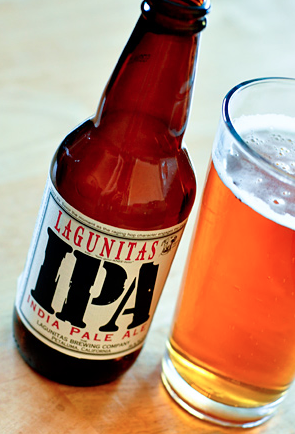
Screen Shot 2014-11-26 at 14.26.21I reached for a Lagunitas IPA, 6.2%, which had been subconsciously put there earlier. A beer that in their words is, “homicidally hopped”. And boy, did I want to murder it. Levering off the crown – Boof! Hop aroma, oily, resinous, wafting out before I even got close, before I even touched the bottle. I poured and sipped in small measures, teasing out a fulsome head (really, it needed no encouragement), sipping and replenishing, sipping and savouring. Beer enthusiasts will know this beer, so let me be brief: it dates back to 1995 when it was launched as a seasonal (I first drank it in the Napa valley in fact), and comes from the fifth biggest US craft brewer: it is spicy, with a bold citrus edge in the aroma and a well balanced sweetness all the way through; for a beer of such beefy strength, there is little evidence of that unbalancing, almost winey, ethanol. In short, here is a top class American IPA, very much of the style, very much of the quality you’d hope for. And good old Adnams bring it to these shores; doubly whammy.

What struck me as I polished the Lagunitas off was how few UK ‘new wave’ craft brewers deliver pale or India Pale beers with such uumph, such attack, such boldness. Oh sure, we treasure balanced drinkability over here, and of course, we serve in larger quantities, but I didn’t struggle to drink this beer. I wasn’t left with that cloying feeling of ‘Woah, boy! Better go easy’. On the contrary, here was an eminently quaffable beer, high on taste, higher on ‘goes down easy’. And ok, I don’t live in a part of the country that is spilling over with top class craft breweries or more to the point, top class independents retailers – it’s down to the supermarket with a bag full of pennies and a bucket load of hope for me – but even so, the brutal truth is, I haven’t yet had a British pale beer brewed with Lagunitas’ level of chutzpah – full stop. They’re either too tame, too listless – or, at the other end – attempting to be so extreme that they lose their point as a beer – overly hopped, overly malted, forgetting that refreshment, drinkability and intrigue are needed too.

Perhaps where we need to focus is back onto the pale ale & IPA styles that we can do brilliantly, with our ingredients – that feels like an opportunity.

© Beer Tinted Spectacles, 2014