With craft brewers driving the beer agenda, it’s taken the big boys some time to get off the cost cutting and efficiency path and start to really innovate again. It’s interesting to watch: whilst craft beers generally focus on taste, flavour, quality, savouring; the big brewers target what they perceive as products that are more sessionable – and therefore for them, more scalable. Fruit is one focus; lower alcohol level another (making use in the UK at least, of that 2.8% duty break) and the third is spirits.
There’s quite a range of beer / spirit fusions now: bourbon flavoured beers (Buddy’s, Dead Crow); rum flavoured beer (Cuvano and Cubanisto, the latter recently launched by ABInbev) and of course, Desperado’s, a tequila flavoured beer. Let me be frank. The majority of these products do nothing for enhancing the reputation of beer, an ancient, agrarian and natural product that is respectful of the grower, the brewer, history and the drinker. These are factory mixed concoctions thrown together in a back street industrial unit, made from any old beer the owner can fix up; not actually containing the spirit in question (Why? duty dear boy, duty), then weasel-worded to sound authentic and enticing to a half cut Friday night drinker who can no longer take pint volume. These are products about profit not responsibility, and with that in mind let me also be clear: many of them will be runaway commercial successes. Mankind likes to be have an easy drinking skinful on the cheap, ‘twas ever thus and it will continue to be. Take Desperados: a sickeningly sweet and cloying Tequila parody that is nonetheless a rip-roaring seller. That’s business, I suppose.
Naming the spirit on the label is an eye-trick. Perfectly legal (when accompanied by the word ‘flavoured’) it is a shortcut; a shortcut to creating a quick mental impression of the flavour expectation and oh! yes; tricking the drinker into thinking it contains the spirit in question. The strange thing in all of this is that it seems perfectly legitimate and possible to investigate using the flavours of spirits to inspire great beers. But why not go at the opportunity with some integrity? Bourbon after all does have rounded honeyish flavours and rich, steeped red fruit notes: barrel aging can give you all of these. Heck, adding some honey or some red fruits could give you that.
And a few brands are now proving this: Innes & Gunn have been barrel aging successfully for a number of years to get these new spirit inspired flavours. More recently I had a bottle of Head In A Hat ‘Gin’ – a 4.1% golden ale which uses gin botanicals from a small South London brewery called Florence (friend of Dillon and Zebedee?). According to the brewery, the botanicals come directly from the still of the City of London Distillery – and certainly those gin botanicals come through. The beer has a subtle flavour, with a clear edge of juniper and definite warmth, with a coating, peppery mouthfeel and aftertaste. And this is most definitely a beer, not a pastiche, with a large, loose head and a hazy butterscotch colour; drinking in fact bigger than its alcoholic strength.
In truth, it was a relief to find it. I remain unconvinced – and a bit troubled to be honest – about these beer / spirit hybrids yet Head In A Hat shows that there is another dimension of subtle flavours from an adjacent world that beer can wrap its arms around. Saying that, there’s also a whole world of hop, malt and yeast flavours to be discovered too – and frankly, I’ll go there first.
Here was a clear case of hidden in plain sight. Indeed, on reflection, the signs couldn’t have been clearer. I remember hearing of exciting new hops from a colleague who was really excited about the potential of new varieties for new beers in our innovation programme. What if we brewed a single hop beer with Nelson Sauvin? Or with Citra? Or maybe a combination of the two – dry hopping with Citra perhaps? It was 2009, yet despite of people wearing their metaphorical day-glo suits near me and waving semaphore flags right in front of my face I didn’t pick up on them. There were other priorities; other pressing matters; the business wasn’t ready for this sort of innovation.
Nature has a tendency to be persistent though and like a weed pushing through cracked mortar in order to reach light and life so these new hops have steadily, surely, forced themselves into my consciousness. And my own re-emergence into the world of artisan beers has made it easier for them to finally hit home.
I’d heard about Oakham Ales through a roundabout source; a cider maker looking for some business advice used them as benchmark for what he regarded as a quality operation. It was their beer ‘Citra’ apparently; that was the tipping point; the point of inflection, the thing that pushed them over the edge towards greatness. My friend Steve mentioned it too: it was a grand beer, which had been surprisingly and pleasingly encountered on the shelves of B&M whilst out on the hunt for stationery and discount fat balls.
Later, I found it, lurking, furtively on the top shelf of a Waitrose. A classic case of impulse purchasing this: I went out of my way to that particular store to get a new brand of fruit tea I had helped develop (Price: £2.89) and left 45 minutes on, fully signed up with a ‘My Waitrose’ card, and an aesthetically pleasing basket of expensive comestibles (Total bill: £24.14). This beer had better be bloody good, I told myself.
And my; it certainly is. For a little brewery from the smallest of counties, this is a mighty beer. It’s a single hop pale ale and pale it truly is; Pilsner-like I’d say. But it’s the aroma that hits you first – lever off the crown and there it is. The beer might be a straw-lemon colour but the smell is grapefruit and gooseberry and it fair races out to greet you. It pours with a lithe, white head that billows to formation and leaves subtle tracery down the glass. And all this sensory overload continues; a swirl of the glass reawakens the aroma; there’s an assertive but balanced bitterness all the way through from foretaste to aftertaste and all the while that pronounced fruitiness: a dryness in the beer that suggests to me brushing against a gooseberry bush when you are picking them; there’s the fruit and that green-leaf character which is so moreish, so appetising.
For once, the hype was right; here is a characterful beer, one that refreshes and rewards, that balances hop intensity with easy drinkability. I won’t miss those signs next time.
“Certain things, they should stay the way they are. You ought to be able to stick them in one of those big glass cases and just leave them alone.” ― J.D. Salinger, The Catcher in the Rye
As my bank of memories grows, so I find myself experiencing moments of involuntary recall. Tiny cues can stir up vivid recollection, just like Marcel Proust and his tea soaked madeleine cake, prompting memories of his aunt’s home during his childhood. Sometimes these are powerful personal memories, connecting me to a time and place – the caw of a crow, an oily chain, or an early evening afterglow behind a stand of trees. More typically they are far more prosaic – and one, bizarrely, concerns rye.
Specifically, it concerns rye bread: not the crusty, spicy loaves you get at a good bakers nowadays, but the German squares; tight plastic packed in brick like solidity. I first really tried them at a friend’s in Stuttgart – her family had pumpernickel every morning as part of the breakfast routine, sliced thinly like crushed soldiers, but topped with hams, cheese or pickles rather than dipped in egg. I liked the routine. I liked the rye bread. Still do, but it doesn’t form part of my rituals except on holiday when I tend to buy it as the most interesting bread on offer. But the rye bread doesn’t take me back to Stuttgart; it takes me back to somewhere further east, the town of Regensburg on the Bavarian Danube. It’s a beautiful UNESCO protected town, mercifully spared from Allied Bombing for the most part. There, a few years back, I stayed for a couple of nights, toured a few breweries and ate local delicacies: Regensburger Würstl, fine but chunky pork sausages, halved lengthways, cooked over charcoal and served with onions and tangy mustard. Dampfnudeln too, soft bread rolls that made a lovely, moist sausage butty and reminded me of Manchester barm cakes but done Bayern style. And all washed down with roggen – rye beer.
I don’t think roggen is a Regensburg thing necessarily – certainly rye is used widely in other beer brewing countries: in fact I remember being on a bit of a wheat beer phase at the time, searching for both hefe- and Dunkelweisses; but the roggen was new to me; in fact it was my first experience of a rye beer at all. So it happened to pass that the roggen, the würstl and the dampfnudeln make up my rye ‘madeleine moment’; a beer garden parallel to the the Danube overgrown by vines and starlight clematis; a warm evening with the smell of charcoal & pork skin, Herr Ober, good food and glisteningly dark glasses of roggen beer.
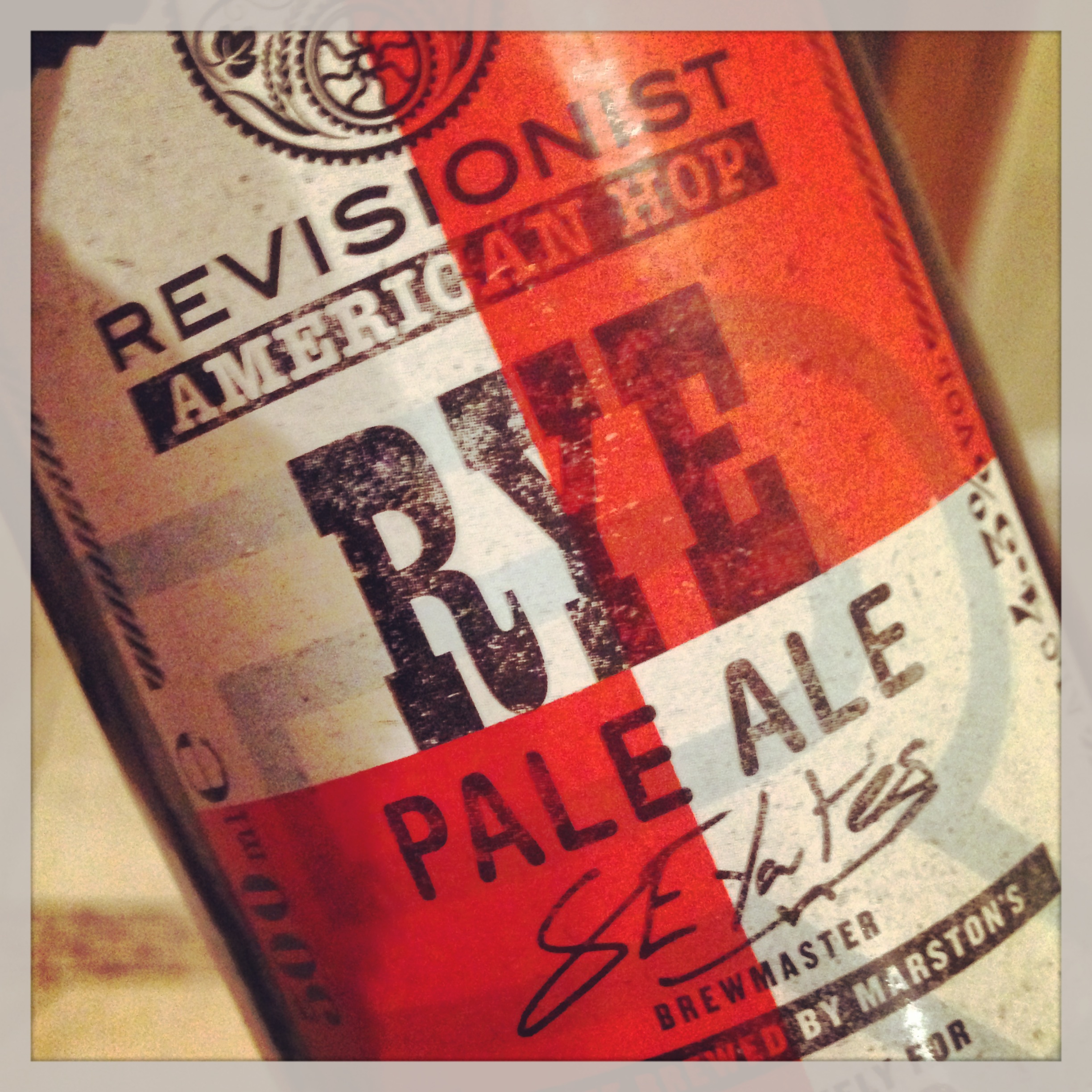
Two recent prompts caused that Danube beer garden to return. One was seeing – and trying – a bottle of the very beer we drank that evening, Thurn und Taxis Roggen. The other was a beer from much closer to home, Marston’s ‘Revisionist’ Rye Pale Ale. Thurn und Taxis was one of the Bavarian Royal breweries, although since I was there, it has ceased its own brewing and contracts out to Paulaner, who in turn, are part of the Heineken / Brau Union combo. Sad that, as the brewery was in a palace and was incredibly picturesque. And sad too that the beer was a shadow of my shadowy memory of it: that memory is of a spicy, bananary, clovey beer (but not a wheat beer) with a thick off-white head and a ruddy luminescence. Today’s version is thinner; less pronounced in every sense, less bold, more…. ordinary; more… brown. I didn’t finish it, for my memory’s sake.
The Revisionist Rye is a different kettle of fish. For a start it’s a top fermenting pale ale; 4.3%, and Marston’s are promoting the hop as much as the rye, including dry hopping with Amarillo and Citra. Yet, in truth, it was something of a disappointment: don’t get me a wrong, it’s a good beer, I enjoyed it. But really, the only touches of rye could be seen in its colour, a slightly more reddy-brown than a pale ale and a faint spiciness (allspice?) – but faint is the word. As you’d expect, the hops shone through, particularly the citra lending the beer a grapefruity edge with a pleasingly mouth-puckering finish. The beer is dry hopped – you could tell from the moment the crown was cracked. But no aroma of rye; no wry smile.
Perhaps my Regensburg beer memory is best left in a glass case after all.
Right at the heart of the debate about what constitutes ‘craft beer’ is a case like Sharp’s brewery. Founded in 1994 on the economic backwater of the north coast of Cornwall, by 2008 it was winning awards for ‘Fast Growth Business of the Year’ and three years later was acquired for £20m. This was a classic case of a brewery working towards a specific exit strategy: in this case the plan being acquisition by another entity. The other entity in this case was Molson Coors, a top 10 global brewer. Questions get raised: do Sharp’s, now that they are part of a multi-national’s brand stable stop being craft beer simply because they have been acquired? Or were they a craft beer in the first place, given that it was widely known what their exit plan was?
Frankly such questions can be a bit tiring, illogical and I’m tempted to duck the question. The reality is though that perhaps, just perhaps, Sharp’s is evidence that some organisational learning has taken place in this particular multi-national. Although some commentators are a little sniffy that Doom Bar is now the country’s (World’s!) biggest cask ale, the truth is that it was on that trajectory before the acquisition – that’s what made it attractive after all. The facts are that more Doom Bar is sold in London than London Pride – yet the beer hasn’t changed. It’s still brewed in Rock; in fact it seems the biggest challenge has been how to increase capacity. This was the pledge that Molson Coors made at the time and three years on, they have stayed true to it.
And Sharp’s continue to brew interesting beers – I was lucky enough to get hold of three of them; one I was keen to try given that last year it was awarded ‘World’s Best Lager’ at the World Brewing Awards. The other two were from the Connoisseur’s Choice series. All bottle conditioned; all brewed with interesting ingredients using interesting processes. Is this not craft brewing then?
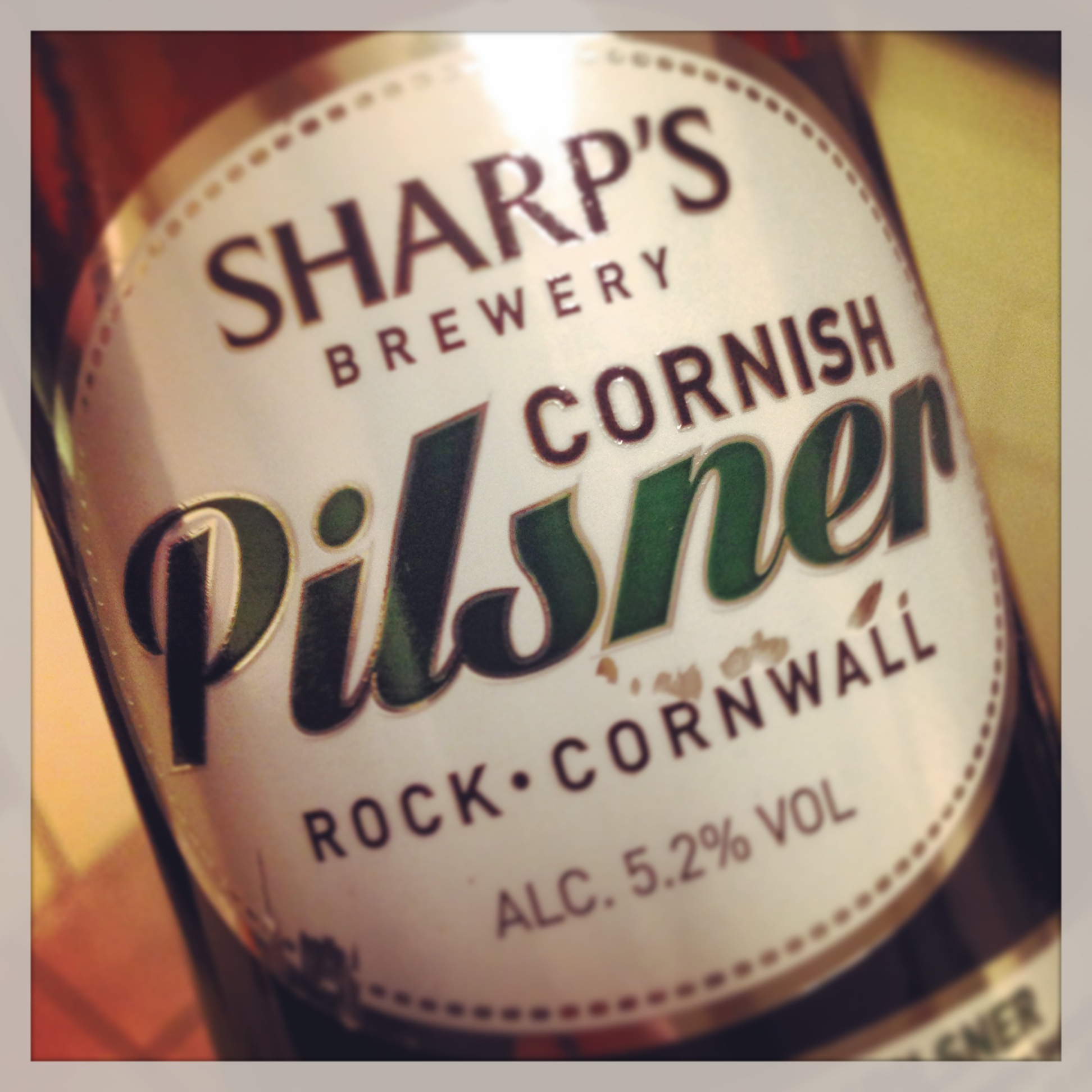
The first, the award winner, is Cornish Pilsner, a 5.2% beer, lagered on Saaz / Zatec hops. It’s also, unusually for a lagered beer, bottled conditioned. What I find surprising is it’s description as a pilsner: unlike classic Czech pilsners it is very blond in colour and couldn’t sustain a head for any length of time; equally unlike a Czech pilsner it has an incredibly agitated, mobile bead of carbonation arising from the beer, a function of the refermentation. And herein lies the issue with expectation management – this is apparently the World’s best lager, yet against that accolade it fell down. It is still a great beer though: much more like a Bavarian Helles, its taste was clean, with a strong malt structure, biscuity with a herbal background and a pronounced yeasty character. I was left unsure about the benefits of bottle conditioning for the beer (especially as I couldn’t really see any yeast) but in no doubt that it’s a fine beer that I’m sure will be a success (that is if they can afford the vessels and space for their lagering tanks given the capacity issues).
Sharp’s Connoisseur’s Choice no. 9; another product of Sharp’s slightly deranged tinkering, in a good way. No.9 is a blend of beers; a ‘6 Vintage Blend’ in fact and at 7.4% a bit cheeky. Displayed here then are the brewers’ affections for Belgian brewing heritage, getting back to techniques which were once everyday over here. This blend has a beautiful colour, somewhere in the spectrum between an old tudor sideboard and a glass of aged burgundy: there’s a definite red hue shining through. And the aroma: without me getting all Jilly Goulden about things, there was a clear smell of beeswax furniture polish – yet the taste was much more what you’d expect; rich, mulled fruits, a slight Christmas cakeness which is warming in the foretaste and had a brief linger in the aftertaste of Aunty Hilda’s sherry. Again, in a good way. A great beer: and definitely for Connoisseurs.
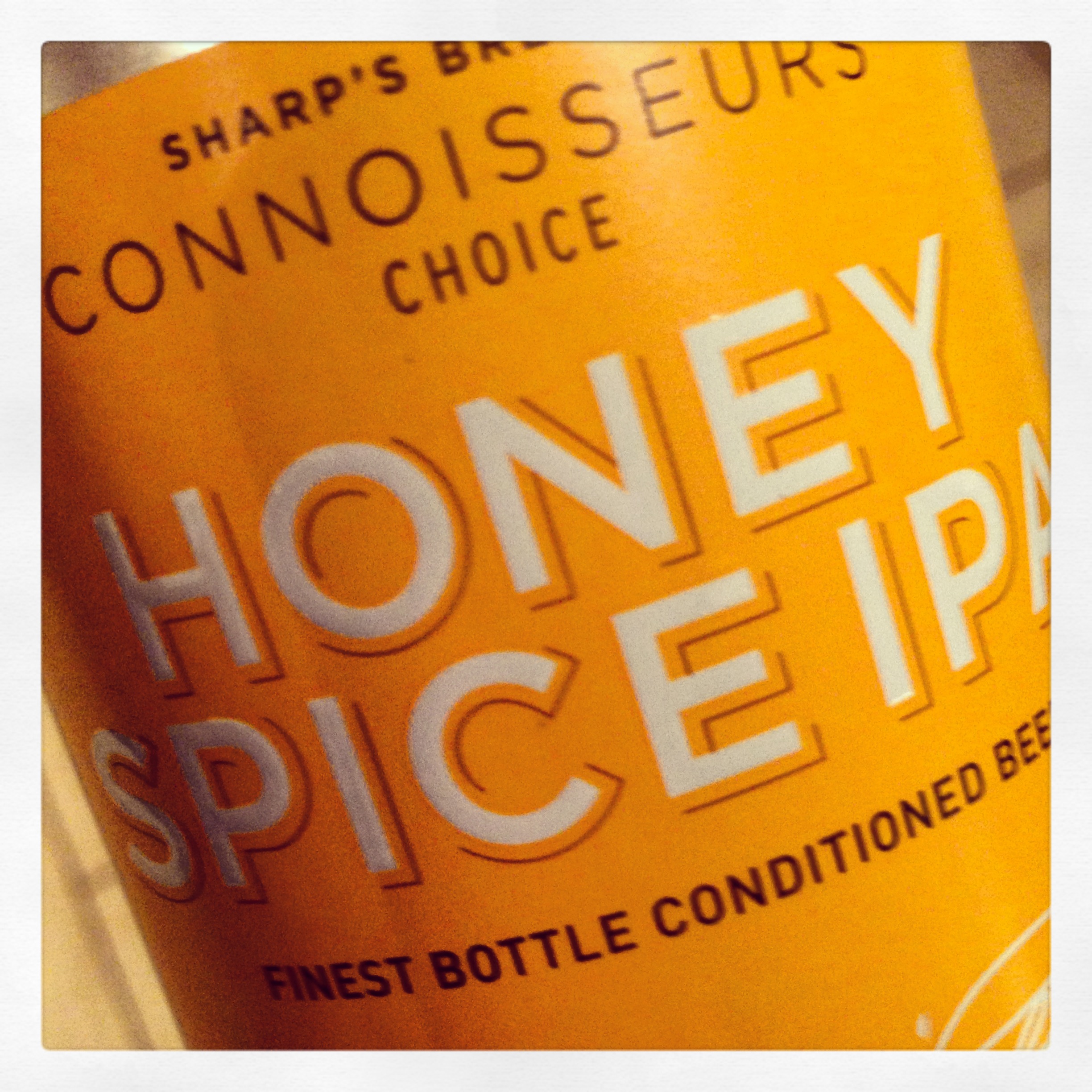
Less so the Honey Spiced IPA though. This was is still a bold 6.5% ABV but more accessible – accessible in that ‘caramel and seasalt’ combo sort of way. In this case, we have honey and black peppercorns. This particular alchemy produced an aroma part expected, part surprising. Expected: a caramel toffee sweetness; unexpected: a clear whiff of gooseberry skins and Swizzels Matlow Tutti-Frutti chews, presumably from the combination of malt and honey sweetness. There’s an amazing depth of flavour too, hop leaf to the fore, then chewy caramels, then the gentle warming from the black pepper and later a mild fizz on the tip of the tongue.
Where this all nets out is to make a bit of a mockery of all the ‘what is craft beer?’ discussion. What I’m after is a healthy brewing world with the big boys investing and supporting interesting beers, leaving space for the start ups and the reputation of beer as a whole on the rise and influencing the Government into taking a grown-up stance to social and financial issues like taxation. Brewing up in Cornwall, we have a little snapshot of how it could be.
That was how ingrained Michael Jackson’s categorisation became within the Tinted Circle in the late 1980’s and early 1990’s. More than CAMRA’s ‘Good Beer Guide’, we felt Jackson’s Pocket Beer guide was diminutive in size yet soaring in scope. The world of beer opened up in front of our very eyes: smoked Bavarian beers; wild yeast fermented beers in a seemingly wilder Belgium; steam beers from California and crisp, rounded pilsners from Czechoslovakia. And it was the star rating system that made it. Jackson getting off the fence, stating his view publicly. It didn’t even feature in the main body of the book. Rather, it was so implicit it was the first words – there, on the frontispiece, above the ISBN number and the dedication to his dad. Here was the key (see photo); the modest table that fuelled my excitement in beer…
A fateful few words at the start of a small book started a personal beer hunt
Jackson was too polite to award ‘no stars’; it was implicit where most beer being brewed back then fell in his eyes. But ‘World Classic’! They had to be found; discovered. And it was a passion rekindled with the publishing of the new Pocket Guide by Stephen Beaumont and Tim Webb.
Thus it was that over Christmas, I spent an idle hour or three reading and re-reading both the new ‘Pocket Beer Guide’ and Jackson’s 1986 original. I was interested to see how the top tier of beer – as the authors saw it – had changed. I totted up all the ‘4 star’ beers (★★★★)* and the ‘3 to 4 star beers’ (★★★->★★★★). Not the ‘3.5 star beers’ though – I only wanted beers that had attained the top rank, even if they were a little inconsistent either by batch or over time. This involved reading the books a couple of times over – no hardship, apart for the long suffering Mrs Tinted. For those interested in these things, the table is set out below in the Appendix (get me!). Of course, you can cut the findings any number of ways, but here are the conclusions I drew:
Time is no respecter of reputation. Budweiser Budvar, Pilsner Urquell, Hofbräuhaus Märzen, Duvel, Rodenbach, Chimay Blue, Orval, Marston’s Pedigree, Guinness Foreign Extra Stout: all top tier beers in 1986; all beers that have influenced a generation of brewers, drinkers and writers. None rated as such today. Justified? Personally, Budweiser Budvar would still make the grade for me as it continues to display the multi-layered flavour, textured body, natural sparkle and richness of a beautifully lagered Bohemian beer; Pilsner Urquell not – still a great beer, but one that has lost some of that same character that Budvar has retained. Marston’s Pedigree? Would I have ever rated it is as a 4 star beer? Likely not – when I moved to Staffordshire in 1991 it was, like today, too inconsistent. Orval – still does it for me, but I know the tweaks in its brewing process would count it out for many.
Really, it’s churlish to argue though: the tide is rising. Just look at a small selection of the 4 star beers today: Drie Fonteinen Vintage (a lambic blender, not even brewer in 1986); Mikkeler Beer Geek Brunch Weasel, Russian River’s Pliny The Elder, Le Baladin’s Xyauyù… and these are just the ones with the bizarre and unpronounceable names. Of course you may disagree with the authors’ choice: but you can’t argue that the standard has risen dramatically; the sheer sweep and vista of beer has broadened almost beyond recognition. Challenge your preconceptions; challenge everything: that is the message.
Whither drinkability? When working in big beer, I would often hear the refrain from brewers that ‘the problem with all these craft beers is that most are undrinkable’; most have so much ‘C’ hop that they ‘all taste the same’. The converse if you like of what small, artisanal brewers lay at the door of the big brewers: all their beer is meek, tasteless and unbalanced by too little bitterness or too much sweetness in order to appeal to the ‘mass market palate’, if such a thing exists. Yet, as mentioned in Part 1, one conclusion is ragingly clear: if you want a characterful beer – one to challenge, surprise; shock, or perhaps to lay down and age – a genuine ‘big beer’ if you will – then you need to ‘go small’. My old company, Molson Coors, has a couple of ‘big beers’ in its portfolio – one, a barley wine called ‘P2’ is lucky if it is occasionally brewed in the Museum Brewery in Burton upon Trent. I certainly never see it on sale outside a couple of places**. And Molson Coors are better than most (consider Creemore Springs; White Shield; Barmen Pilsner).
It does beg a question about the impact of beer writers though: there is a tendency to class these ‘big beers’ as ‘better beers’. And this trend was just as prevalent in Jackson’s Pocket Beer Book as in Beaumont and Webb’s recent Pocket Guide. In 1986 for example, 15 of the 67 top tier beers were Stouts (generally Imperial Stouts at that) or Barley Wines: that’s 23%. Rounding up, I reckon that Stout and Barley Wine has about 1% share of the global beer market – a little more in some countries of course. In 2013, only 4 of the 50 top tier beers were Stouts or Barley Wines (8%) but many others were ‘extreme beers’ – Samuel Adams ‘Utopias’ being a case in point.
So whither drinkability? It’s there of course – but the nature of drinkability is being rediscovered by small brewers and drinkers. All great beverages have balance: take roast and ground coffee. The best examples have a chocolately roast character with a raisiny balancing sweetness. Or even blended tea: take a well distributed brand like ‘Yorkshire Gold’, which is more slowly fermented and has a bigger cut – the end result, a cleaner green leaf character, a better colour and more tannin balance giving delightful drinkability. So it is with beer: removing bitterness or negating hop character doesn’t enhance drinkability, it actually makes it worse – the beer becomes cloying and rather than drinking it, you have to ‘chugg’ it, a phrase which always has an unpleasant edge of fight about it. And in Beaumont and Webb’s Guide, some amazing, drinkably moreish beers are there: many are ‘above average’ and many are ‘worth seeking out’ or better.
A love story Reading Jackson’s 1986 book again, there’s a different impression than when I read it for the first time (in 1989). Back then, everything was optimistic: look at this amazing world of beer! Now, it’s clear that it was a world in danger, something I came to realise after I started working for a brewery which had 13 breweries (in the UK) when I joined it and three by the time I left. The 1990s was a time of consumption growth and style decline. Jackson wasn’t just writing about the beer world he loved. He was trying to save it. Perhaps he realised this, perhaps he didn’t: I only met him twice and didn’t have the perspicacity to ask. Love it he did though; and perhaps this led to some unintentional biases. Germany and Belgium, with so many unique styles get the most top scoring beers – out of 10 Belgian beers for example, 8 are 4 stars. The UK and Ireland seem to enjoy a disproportionate number of the top tiers: Mackeson Stout is judged a 4 star beer chiefly because it is a milk stout; Draught Guinness 3 to 4 stars because it is, well Draught Guinness. In comparison, the more recent edition is a little more balanced; helped in part by having more ‘consultants’ behind the scenes the authors could call on. There’s great diversity of beer style and greater geographic diversity too. The reality is that today there are not only more breweries brewing different stuff, but more beer writers popularising it too. There can be no better testament to Jackson’s work.
The second wave. There are questions of geography. Critics of Jackson’s work question the seeming bias in approach: starting with Czechoslovakia, soon moving through Germany, Belgium and the United Kingdom. France gets one page. Latin America just over one. Asia just under two. “It’s a First World bias”, they said. To me he called it as he saw it. At the time of writing, Czech breweries were effectively frozen in aspic; Germany was still a country of fragmented independents and the U.S. scene was just entering lift off phase. Yet Beaumont and Webb have been criticised too, starting with Belgium, Germany and the UK. “First World bias”? No. The reality is this: along with the U.S. these four countries, all widely different in market shape, are the craft brewing leaders. Half of the top tier beers are from Belgium, Germany and the UK. Add in the U.S. and it moves up to 70%. It feels right; it feels likes it is reflecting the world of beer as it is today.
And positively, it is a world changing rapidly. Scandinavia stands out: all the countries there restricted by punitive alcohol laws even today, yet nonetheless there has been a flourishing of breweries, brewing and interest in beer. Likewise the Netherlands, which seems to be picking up on its neighbour’s creative beery fertility. France too, which although it gets no top tier beers is very much on the up. Beyond Europe, the story is just as true: burgeoning interest throughout central and Latin America, parts of Asia, Australasia – to mention a just a few. Only Africa feels like it is sleeping.
There’s the question of bias in my selection too: it would also be worthwhile to look at 3.5 star beers – all incredible beers – a category that Jackson didn’t use but is used in the new guide. Some countries are overflowing with them: the U.S., Japan, France – many more besides. This perhaps reveals a truer picture of the underlying health of beer. These are the likely second wave of leading beer cultures in the next generation.
All in all: 3000 beers in one small book from who knows how many? If you want a measure of the growing health of beer around the world today, well, pocket-sized or not, you can draw your own conclusions from that.
* See the effect of showing the stars? This for me was the power of the system – not only reading about a certain beer but seeing the stars break up the page; extend the length of the beer, that was its power: for example,
Anchor Brewing Steam Beer (★★★★) or Worthington White Shield (★★★->★★★★)
** One: the Museum Shop. Two: the Molson Coors Staff Shop (which is open to the public)
Appendix: The ‘Top Table’: 4 star beers, 1986 – 2013 (note the table is giving me some technical trouble – if you can’t see it, drop me a line at david@beertintedspectacles.com and I’ll ping it over to you)

 There’s quite a range of beer / spirit fusions now: bourbon flavoured beers (Buddy’s, Dead Crow); rum flavoured beer (Cuvano and Cubanisto, the latter recently launched by ABInbev) and of course, Desperado’s, a tequila flavoured beer. Let me be frank. The majority of these products do nothing for enhancing the reputation of beer, an ancient, agrarian and natural product that is respectful of the grower, the brewer, history and the drinker. These are factory mixed concoctions thrown together in a back street industrial unit, made from any old beer the owner can fix up; not actually containing the spirit in question (Why? duty dear boy, duty), then weasel-worded to sound authentic and enticing to a half cut Friday night drinker who can no longer take pint volume. These are products about profit not responsibility, and with that in mind let me also be clear: many of them will be runaway commercial successes. Mankind likes to be have an easy drinking skinful on the cheap, ‘twas ever thus and it will continue to be. Take Desperados: a sickeningly sweet and cloying Tequila parody that is nonetheless a rip-roaring seller. That’s business, I suppose.
 And a few brands are now proving this: Innes & Gunn have been barrel aging successfully for a number of years to get these new spirit inspired flavours. More recently I had a bottle of Head In A Hat ‘Gin’ – a 4.1% golden ale which uses gin botanicals from a small South London brewery called Florence (friend of Dillon and Zebedee?). According to the brewery, the botanicals come directly from the still of the City of London Distillery – and certainly those gin botanicals come through. The beer has a subtle flavour, with a clear edge of juniper and definite warmth, with a coating, peppery mouthfeel and aftertaste. And this is most definitely a beer, not a pastiche, with a large, loose head and a hazy butterscotch colour; drinking in fact bigger than its alcoholic strength.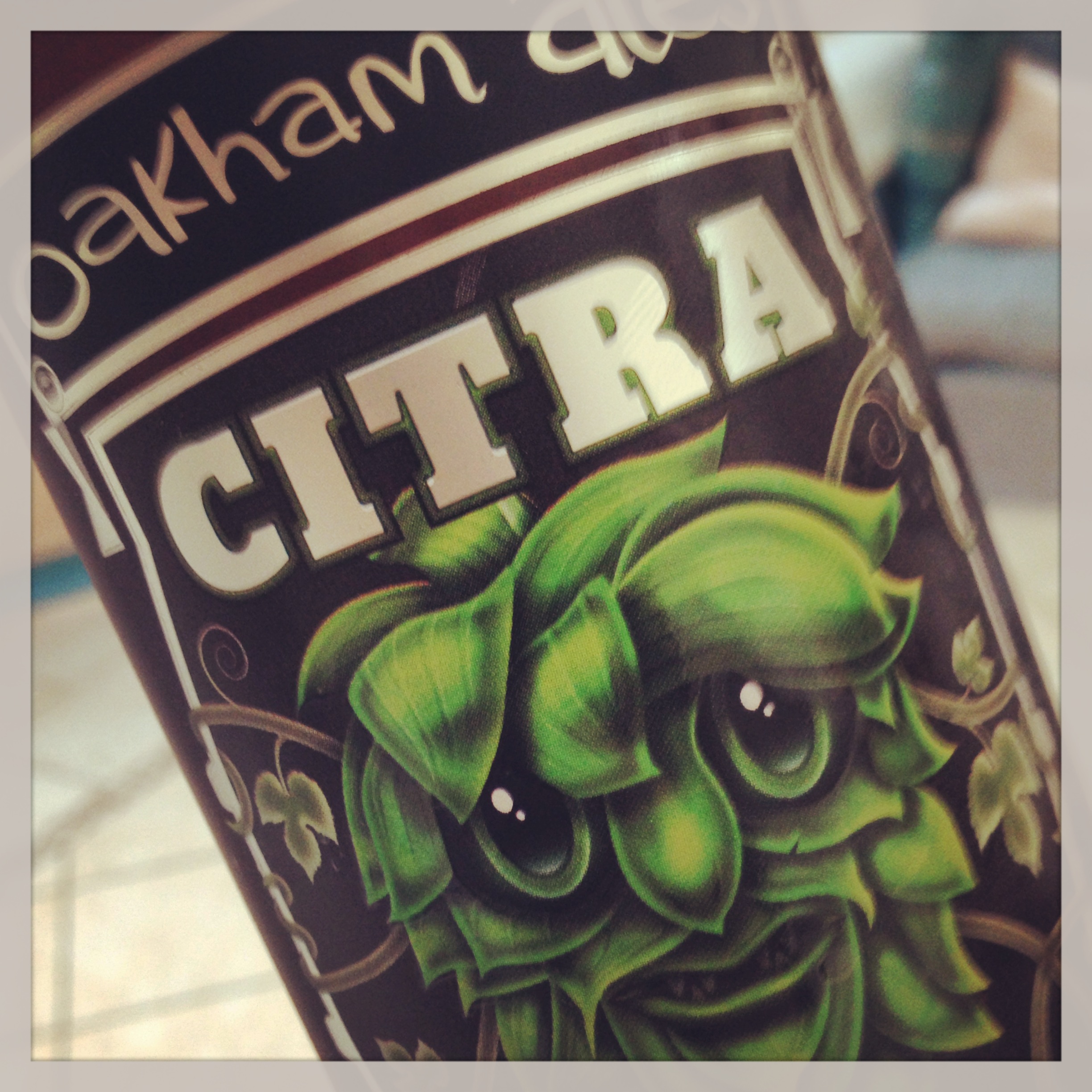


 Beer Tinted Spectacles