
50 Shades of Dray

It had clearly become too much for my long-suffering wife. In a delicate eruption of frustration one evening last week she pointedly accused me of watching only food programmes on TV. I can accept that some, small minded individuals cannot appreciate nor accept ‘Pointless’ as the true visual art form that it is.   Yet as always I had to reluctantly admit that there was more than a grain of truth in her accusation. In fact of late, the truth was not a grain but a large soon-to-be-double-decocted mash full, triggered in this case by a monster session of ‘Great British Food Revival’ which I had put on the Sky+ and inevitably, therefore, was watching en masse, putting enormous pressure on her weekly Soap schedule as I fought to catch up in any 5 minute gap that presented itself.

The basic premise of the programme is this; like our canal network in the ‘70s, some ‘great’ ‘British’ foods, are endangered, not through over hunting but through lack of use.  From brown shrimps to asparagus, cured ham to Cheddar (of the proper, West Country variety, natch), from Aylesbury Duck to real ale, unless we change our eating and shopping ways then these fine fares, which we all ‘enjoyed round the table of childhood’ apparently, will be gone forever.

Alas, some of the motifs of the series are weakened by stereotype and bombastic language: “Go on!”, you are urged in each programme, “Just think about the crap you are putting in your basket (Idiot! Charlatan!) and buy the proper stuff”.   It’s well meant; undoubtedly true to a large degree; and I have no qualms at all about raising the profile of some of these high quality products and the producers who fight to save them and make a living.  And yes, you did read that right, real ale was on the list.

Which was funny.  Because if there’s one Great British food (and I think on both measures this counts) that is saving itself then cask ale would be there.  Credit to CAMRA 40 years ago, and credit to the countless numbers of entrepreneurs, home brewers, retired professional brewers, and beer lovers from all walks of life who have had the balls to start a brewery.  But there’s the (*cough!* *cough!*) …rub.   The premise of the episode on real ale was mostly about the balls and not the beer.  That somehow, it was the industrialisation of beer production, and the replacement of the brewing art by employed men, not home-making ale wives or brewsters, that accounted for real ale’s decline. Not shit quality in pubs, total lack of focus by brewers big and small and the global change in tastes towards pale beers then?
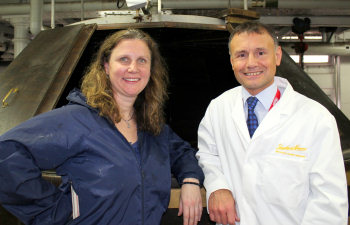
hartnett
Angela Hartnett. On the left. Obviously.

And It wasn’t helped by Angela Hartnett.  Clearly, she’s well rated as a chef – whilst I have not dined at one her establishments myself, all this celebrity froth must be for something. But unfortunately she came across as just a touch patronising, actually looking down her nose at people, an apparent haughtiness aimed even at those that she was endeavouring to champion. Annoying really, as it was clear that she has a fair bit of beery knowledge and can use her platform to champion the case for beer.  And. She didn’t venture out of the south east; but that’s just the regional chip butty on my shoulder, so let’s say no more about it. But it’s chips ‘n’ gravy every time, if you’re asking, and  feel free to pop a bit of stout in the gravy for that whole ‘beer and food’ extravaganza if it makes you feel better.

Yet scratch all the criticism. At the end of the day, the angle she was driving down was interesting, borne out of yet more grains of truth; and unlike the previously impoverished attempts at beer programming on the BBC, was relatively balanced¹. Specifically, the role of women in relation to ale has weakened, and extending the ‘cult of the brewer’ to include female brewers is a must if we want ladies to sit up and take notice, not just men.  Getting women to suspend disbelief and try great beers, not just cask beers, is an industry wide action.  Getting the BBPA or other august bodies to promote the fact that ‘beer = lager, ale, lambic’ and not just ‘beer = bitter’ is a pretty basic cornerstone of knowledge that we haven’t yet established. Getting over irrational connections to the pint, and stretching out our arms to welcome in other measures is a must too, heretical though it may be to say it.  But most importantly, getting over the fact that beers ‘for women’ don’t have to be flavoured light beer (or worse) will be the first major victory.  At the end of the day, beer has always been more of a blokes’ drink.  And you know what, that’s OK.  Us men should stop wearing hair shirts of guilty penitence and flagellating ourselves outside the Rose & Crown.  Change nothing about beer today and there are still huge numbers of occasions when women would happily pick up a beer when they’re not now. There are plenty of beers today that hold appeal to both genders – from fresh, cask draught beer at the one end, to Mexican beers and Tequila beers at the other; from sweeter, mild beers to deep brown and alcoholic Italian ones – it’s the context around it; the machismo; the ‘half’ culture we need to break down.  And at the end of the day, I may drink a glass of rosé wine from time to time too without needing a ‘rosé for men’ initiative from the wine producers.

Yet scratch all the criticism. At the end of the day, the angle she was driving down was interesting, borne out of yet more grains of truth; and unlike the previously impoverished attempts at beer programming on the BBC, was relatively balanced¹. Specifically, the role of women in relation to ale has weakened, and extending the ‘cult of the brewer’ to include female brewers is a must if we want ladies to sit up and take notice, not just men.  Getting women to suspend disbelief and try great beers, not just cask beers, is an industry wide action.  Getting the BBPA or other august bodies to promote the fact that ‘beer = lager, ale, lambic’ and not just ‘beer = bitter’ is a pretty basic cornerstone of knowledge that we haven’t yet established. Getting over irrational connections to the pint, and stretching out our arms to welcome in other measures is a must too, heretical though it may be to say it.  But most importantly, getting over the fact that beers ‘for women’ don’t have to be flavoured light beer (or worse) will be the first major victory.  At the end of the day, beer has always been more of a blokes’ drink.  And you know what, that’s OK.  Us men should stop wearing hair shirts of guilty penitence and flagellating ourselves outside the Rose & Crown.  Change nothing about beer today and there are still huge numbers of occasions when women would happily pick up a beer when they’re not now. There are plenty of beers today that hold appeal to both genders – from fresh, cask draught beer at the one end, to Mexican beers and Tequila beers at the other; from sweeter, mild beers to deep brown and alcoholic Italian ones – it’s the context around it; the machismo; the ‘half’ culture we need to break down.  And at the end of the day, I may drink a glass of rosé wine from time to time too without needing a ‘rosé for men’ initiative from the wine producers.

None of that’s the point though.  The real point is this:  if we really want to ‘revive’ real ale, we can’t just focus on women.  The male ‘lager generation’, growing up with exciting lager as a reaction to the drink of their forebears, are now in their 30’s and 40’s and need to be enticed back to drink cask more regularly.  Young adults prioritise their mobile subscription above food and rent, but we need to bring them on side too – men and women.  Our ever-ageing population need to be encouraged to try too, especially if the memories of the ropey stuff from a generation ago hold any truth. If real ale is going to really revive, then it needs broad appeal, women and men, young and old, big brewers and small brewers, national retailers and independents getting behind it.  The Great British Food Revival might help, but it’ll need to broaden its focus to do so.

¹ Oz Clarke and James May anybody? They should sack the Director General for that.

© David Preston, Beer Tinted Spectacles, November 2012

“I’m dreaming, on a jet plane…”

In the spirit of Radio 5 Live presenters who like to make awkward and apparently unlinked segues between pieces, here’s mine. Rod Stewart: sensationally weeps after Celtic beat Barcelona in an otherwise dull football match¹, although he has now declared himself “silly” for giving in to such emotional soppiness. Which are the beers you would “Dream about on a jet plane” (or in my particular case, ‘Virgin Train’).  Here are my contenders:

Sierra Nevada Pale Ale, which, after naming as my “One Beer to rule them all” in a recent post, would be rather remiss of me to leave off the list.  It is naturally a beautifully brewed, versatile, flavoursome and aromatic Californian beer.  It is also the one I genuinely think most about on my Friday nights – the most hallowed of all beer occasions.

Windsor & Eton Conqueror:  in my book, not a session beer, yet the whole concept of dark beers that don’t taste roasted or charred is intriguing.  Conqueror manages this – a beguilingly dark beer, with a fromage frais coloured head and only a lightly roasted note which you pick up in the sides of your mouth. So a burly beer but one which still allows the hop leaf character to show through – too much  so in some of their other beers, but judged nicely here.

Menabrea Blonda: someone who I used to work with would choke on her cornflakes knowing I put this beer on my list.  Brewed in picturesque Biella in the Piedmont region in Italy, the beer itself is a fairly ordinary pale lager.  But it’s the associations that swing it for me – a great match for Friday night pizza, a bar in downtown Milan, the brewery nestled up a tight street in the foothills of the Alps.  Shallow I know, but I can live with it.

St Austell Tribute: something has happened down in Cornwall.  I used to live in Devon and my recollection of St Austell (company not place, although it could have described both) was ‘good pubs, dodgy beer’.  And it was all acronyms like ‘St Austell HSB’ or ‘Bodmin PMT’ that sort of thing.  Perhaps it was Sharps.  Doom Bar taking off and being bought for nigh on £20 mill must have woken up the Cornish to their terroir as there are some cracking beers emerging from west of the Tamar now.  Tribute makes the list – I can get it in my neck of the woods, and it’s a drinker, but Betty Stogs would be on it too if it was more available.

Schneider Weisse: this is the daddy of the Bavarian wheat beers for me.  Erdinger is a little too clovey, a little too texturally thin and a touch too ethanolly in taste for me. Schneider though, nails it.  In decent distribution now in the UK too, which is handy.

Jennings Cumberland Ale:  another associative beer for me – this one is the Fox and Hounds in Threlkeld, the slopes of Blencathra looming behind. Or the Old Dungeon Ghyll in Langdale. Supping slow pints after a day getting lost on Crinkle Crags (again).

Goose Island IPA – Chicago, 1999.  I had been in the US studying for my MBA international assignment and stayed over to meet my brother who was living in the US back then.  He flew to meet me in the windy city and we had 48 hours of tourist highlights.  These included a ‘Half Rack of Ribs’ (note: a half rack, between us) taken I think from a white rhino in the Anchor Chop House. And a deep dish pizza in Pizzeria Uno. An 8” being enough stodge for 3.  But hell, the beer was the revelation.  Goose Island beers in what we thought would be our crappy ‘Hospitality Inn’ bar, but turned out to be a drinkers’ honey pot. Glasses of IPA and Honkers: untouchable.

¹Football fans please forgive me. I did not watch this match nor any other.  Ultimately, it’s lots of grown adults getting all het up about kicking a pig’s bladder.

© David Preston, Beer Tinted Spectacles, November 2012

The Session #69: The Perfect Beer World

the session beer blogging friday“The grass is always greener on the other side”, so sang Glaswegian post-Britpop crooners, Travis; “the neighbour’s got a car that you wanna drive”.

Dear old Fran Healy, where are they now?  Mind you, it would be easy to agree with his sentiment when considering this month’s blog topic – the perfect beer world.  For UK readers, it could be like the latest British Gas adverts – idyllic & psychedelic pints of frothy ale, always full, never drunk, in carefree orbit around our mini planets. But really. Where will it take us this navel gazing at a Beer utopia? Frankly I don’t see any positive value in that exercise – so in true politician’s style I shall answer the question my own way. And it’s still a good angle because the trials and tribulations of life are written into the weft and weave of beer itself.

The lesson of time immemorial.  From fantasy worlds like Star Wars or Harry Potter; to the real world –the motivations are the same.  Good versus evil;  failing, getting up and trying again, or just staying down. The big guy vs the little guy. Of man and woman, race and religion, tribe or creed.  And it’s all here in ‘Beer – The Board Game’¹.  Let’s consider the United Kingdom as said board game to illustrate.

The playing surface plots international brewer against start up micro; of wholesaler against cash and carry; of national pub chain against a family run independent pub; of government policy against pressure group set against a three dimensional backdrop of street scenes inspired by market towns the country over. And we have our equivalent of  ‘Chance’ cards?  The rise of teetotalism (‘Go To Jail. Do Not Stop at The Red Lion’); the growth of non-alcoholic drinks, coffee in particular (‘Advance to Starbucks. Lose 5% market share’); the media stoking the flames of ‘binge Britain’ or neo Prohibitionists in the US (‘The local authority orders you to clean up the vomit. Lose 2% market share’).  Oh, and good ones too, like (‘Cask Beer Reports sector in growth by 2%.  Collect 3 free beer tokens’).

But this is a board game: players will win and players will lose.  If you work for Waverley TBS, my genuine commiserations; if you work for Punch – your business model doesn’t seem to be working fellas, maybe take a look at it again.  The government, with its incessant and anti-competitive above inflation duty rises… well they are doing the equivalent of perpetually building hotels on Park Lane – but one day the property bubble will burst and the rents won’t come in.

Beer is playing out the game. From some angles it seems precarious – per capita consumption in western markets is falling…but in eastern, emerging markets it is growing.  The inexorable rise of pale lager is being challenged: indigenous and new beers are appearing again, and like life, the fun is in the hunt, in taking part.    Elsewhere spirits are back in growth or the growth in cider threatens ‘the pint’.  They are players in the game and they have every right to try and win. Pubs are closing at an alarming rate, but some of the best bars ever are opening up and down these islands.  Supermarkets are slashing the price of beer…. but they are dedicating ever more space to speciality ales and lagers.   No, the perfect beer world is here warts and all, best that we see the game board, get stuck in and plan our moves ahead.

¹ Don’t even think it. I got there first: ‘Beer – The Board Game’© Preston Enterprises, 2011


Beer gameOh, hang on……….damn!!


© David Preston, Beer Tinted Spectacles, November 2012

Capital Idea

1989 was an auspicious year. First year at Uni and loving the new life away, it was a time of tremendous discovery – about myself and about life in general – much of it quite mundane, like how to actually make some food. It was also the start of my real years of beer discovery – living in the south west, enjoying pubs like the Drewe Arms at Drewsteignton, The Nobody Inn at Doddiscombleigh, The Warren House Inn right in the middle of Dartmoor and the pubs by the river and canal in Exeter – the Double Locks, The Turf and The Bridge in Topsham.

Against this rural setting of beer swigging idyllic yokels, three of us made a trip during a holiday to Burton upon Trent. Rumour had it, this was the ‘home of British brewing’ but we knew little of it truth be told. There were breweries, there were pubs and it wasn’t that long a drive from our home town in the north west. My brother, Wilko and I made the trip. We tossed for designated driver, but we planned a long enough day trip to allow for a couple of guilt free pints early doors.  The details are unimportant – we visited the Bass Museum, The Burton Bridge Brewery, the now defunct Thomas Sykes brew pub in the grounds of the recently close Everards brewery and otherwise took in the ambience of the town. The ambience being rough round the edges and distinctly whiffy, with the sharp tang of Marmite, meat processing, coffee from a nearby Nestle factory and beer all mixing together to form an aroma that gagged in the throat and flared your nostrils wide as they flapped on autopilot attempting to beat back the nasal assault.

Twenty or so years on the town has changed a little.  Few nasty niffs today but still the sense of brewing nobility; in fact a sign outside Molson Coors (then Bass) is supported by the words ‘Burton on Trent: World Brewing Capital’.  Which got me wondering: because let’s face it. It isn’t is it?  It was, sure; and yes, there’s no denying a lot of beer is produced each year across the different breweries in the town, but the truth is, this innocuous phrase is puffery, a product of our heritage mentality.  It’s so easy to revere the past above all else and as our Primary Industry – manufacturing – declines, so our Quaternary Industry – Nostalgia – booms.

What is a ‘capital’?  What do you need?  Power is one:  government, authority, bureaucracy.  Culture another – museums, art, music. Industry – or business power, not necessarily the manufacturing.  Creativity, influence…  collisions that throw off opportunities, possibilities.  Burton as a place of brewing influence had these once. Not today.  You can level the same at other brewing ‘capitals’ – Milwaukee; Berlin; St Louis.

Today it seems there’s emerging a new array of brewing hearths – cities, towns, regions, that can lay claim to the title of ‘world brewing capital’.  The strongest for me is the west coast USA – from San Diego in the south of California up through the sequoias to Portland, Oregon and beyond. Brewers united by being unfettered by ‘rules’ of the past;  pushing at the edges and in some cases long-jumping into a new space altogether.  And these aren’t just micros here – Widmer, Sierra Nevada, Anchor, Stone – all have scale – big enough I’m sure to be on the radar as potential acquisition targets for the global brewing concerns.  Only here, I would contend is there a culture of experimentation, trial, listen, tweak, improve.

Watch for the future, my vote would have to go to Italy. Craft brewed beer is about 2% of the market in Italy but it is growing in double figures year on year – with again, the spirit of curiosity, of discovery driving it forward – free from a burdensome legacy assisting a vibrant brewing scene. So too in parts of Scandinavia where brewers, fuelled in part by a healthy food movement are beginning to push into rediscovering and experimenting with indigenous raw materials, styles and ingredients.

The old capitals, Belgium, Germany (Munich in particular) and the Czech Republic are on a watching brief.  Belgium in particular has always had a culture of inventiveness but it remains to be seen if the domination by ABI and Heineken of the local brewing scene will create a market structure that stifles or creates the next wave. Likewise Czech, with so many of the big brands in the hands of multinationals and an industry structure whereby water is more profitable than beer, signals warnings for the future. Consolidation, focus, scale will be the watch words – the space for small scale, inventive brewers will be there to take.

Where does that leave Blighty?  Well, we seem to have come full circle. The big brewers and big retailers have managed to fight over the train set and break it.  The flair, the Heath-Robinson Garden Shedness, has passed elsewhere.  Far from being concentrated in one town, inventive brewing is scattered again across our towns, cities and villages.   Burton’s particular challenge is to grab this mantle back – but even if it doesn’t, the future is beginning to look bright again.

© David Preston, Beer Tinted Spectacles, October 2012

Brass balls and bar humbuggishness

What is it that makes up the right ambience, feel, vibe, in a bar or pub?  It’s one of those things I imagine to be quite intangible, but I wonder whether that’s really true…  I write this waiting for a meeting in Farringdon, so rather than buy an expensive and disappointing coffee in a chain, I’m sitting in the diner-cum-style bar*, ‘Smiths’ of Smithfield.

This bar is at least 10 years old, and it hasn’t changed substantially in that time.  I know this because a Dutch man with a deeply glottal, spittle-projecting name told me about it. Phonetically, Herrrrrt ten Karrrrrrte was aghast that I wasn’t aware of this bar, and that it was a stockist of the beer that we shared a mutual commercial interest in.  It turns out that Herrrrrrrt had discovered it on a long weekend break from his home in Holland; what had started with the intention of a romantic break of discovery, museums, long walks in royal parks with his partner, hadn’t got much past an alcoholic breakfast at Smiths, which turned into a lunch and eventually into high tea, all fuelled by the rich and distinctive taste of Grolsch.

It’s a formula that has been much aped now, but this bar is still a bit of a ‘Daddy’. Industrial chic is probably the term – the old metal pillars treated with Hammerite, holding up huge spans of pitch pine; metal ventilation ducts all New York loft style; exposed concrete, roughly set, and railway station touches like a rotary display board that in any other place would announce arrivals or departures…here it announces house blend breakfast smoothies. The ‘innards’ are ‘out’ards’ so to speak, like those de-skinned anatomy models doctors use. It’s not, in short, the place where a couple of decades ago you would have dreamed of serving food and beer from, and for that very reason, it was, and is, a triumph.

IMG_1898
‘Smiths’ of Smithfield. Raffishly Post modern neo-iconclastic industrial chicishness. A bit.

‘Triumph’ – yes, I admit it’s a subjective statement; but sitting in a full bar at 9am on a Thursday seems like a good barometer to me. People working in the leisure trade tend to bang on about two things (a) ‘woe are us’ our pubs are closing, and (b) the saviour is serving food.  Both fill me with ire. Mitchells & Butler’s do a total disservice to their (acquired) pub legacy by declaring themselves ‘agnostic’ about beer and now planting their flag very pointedly in ‘restaurant group’ terra firma.  This is missing the point, pretty widely.  Because what makes these places successful is the guest being able to decode what the bar is about.  Perversely enough, M&B do this pretty well with their ‘unbranded’ brand, Castle – essentially a series of draught focused bars, that stock a combination of more unusual and eclectic draught beers, ciders and spirits. They serve food but the orientation is drinking.  Likewise, a Toby Carvey serves beer, but you know that really it’s a mid price restaurant, or a Vintage Inn, whether we may decry it or not, does feel like a pub (the focus is on the bar as you enter).  It’s just that their focus will be on food in the future.  In an different orbit, a chap I know has a ‘formula’ for his drinking pubs: they are oak-led (floorboards, bar, chairs, tables); the cask pumps are the entire focus of the bar; it’s smart old brewery memorabilia and a lit fire. ‘Smiths’ is successful because its food and drinking is so seamlessly integrated in the way that some of the great North American ‘casual dining’ bars are. I remember going to ‘The Keg’ in suburban Toronto once, where there was a guest list of beers, local beers on draft (sic), beer and food pairings, and a ‘special’, cooked with beer.  A great beer bar in any other name, but the food was totally integrated and, I’m led to believe, that ‘The Keg’ is pretty typical.  ‘Smiths’ does this effortlessly too…in the mornings and at lunch, it’s an American diner, London style. But come the evenings, you move upstairs for food and downstairs becomes the hub.

There’s a big part of me that agrees and sympathises with the plight of the British pub, now being sponsored by CAMRA.  For me, it’s a particular concern in smaller communities, and where other facilities have closed or been axed over time. But there’s another voice too – that of inevitability and innovation.  Great, inspiring, successful bars and pubs are floating to the top – those that don’t innovate, don’t inspire drinkers to visit, well, they will fail.  That’s competition folks. The key is to take the time to learn the lessons of success and strap on the big brass balls to do something about it.  Complaining about our fate will not get us anywhere.

*’Style’ bar…sorry about that. It’s like saying ‘Cool’ Bar. The very act of calling it that proclaims as deeply uncool, and hence unstylish.  Although in this case, it is.

© David Preston, Beer Tinted Spectacles 2012