
Lager, Part 7: The Dark Side

A long time ago, in a brewing region far, far away… a shadowy, cobweb filled, ancient brewhouse. Thick oak beams, knicked and pocked by the barrel hoops, rivets and clevises of time.  A guttering, rasping sound disturbs the peace, as two beers struggle for supremacy in an imaginary fight to the death; one magnificently dark, white crowned, resplendently attired in an oak-staved, bulging and lidded wooden stein: Dunkel Vader. He towers imperiously over a smaller, golden lagered beer, shimmering as a diaphanous, dust-speckled shaft of light struggles to peak through an upper window: Blondwalker.  Spiders, undisturbed for many a year, scuttle away, dancing fearfully in quickstep on pin-point feet along the wooden beams into the rafters. Wild, airborne yeasts disturbed, use the gentle thermals to waftily escape through slatted brewery vents. Dunkel Vader speaks. ‘It is useless to resist. Don’t let yourself be destroyed as pale ale did!’    His tones are deliberate now, malevolent. ‘You do not realise your potential…join me and we will end this destructive conflict and bring order to the beeriverse’.

Stooping low, quivering on the edge of falling, Blondwalker musters all his defiance: ‘I’ll never join you!’
But the dark beer looms larger now, pushing his foe closer to the brink: ‘If only you knew the power of the dark side.  Your brew master did not tell you everything about your father.’  Blondwalker spat in retort, ‘He told me enough! He told me you killed him!’

‘No!’ rasped the dark beer furiously, ‘No!  I am your father, I am the original lagered beer…!’

Prague, Bohemia. 1992.  The return leg of a spoon shaped journey through Germany, across the black-forested borderlands to Prague; then down to Bavaria – Passau, Munich, Regensburg – and back round and up, to half-timbered, medieval Bamberg, before heading back home along the spoon handle to Calais and Blighty beyond.  For my brother and I it was a journey inspired by the Michael Jackson’s television series, to discover our own beers, and guided by the Beer Hunter’s pocket sized ‘International Beer Guide’.  We knew of course that many had trodden this path before, but that didn’t lessen the journey; didn’t erode our sense of adventure; didn’t end the hope of finding virgin territory. 

Great beer was the goal of that trip: and proper, lagered beer was the supreme discovery* – not what we were accustomed to at home  – but a family of beers as broad and at times as shocking in flavour, as varied in texture, as distinct in appearance and strength as were the ales of the British Isles.
IMG_0508
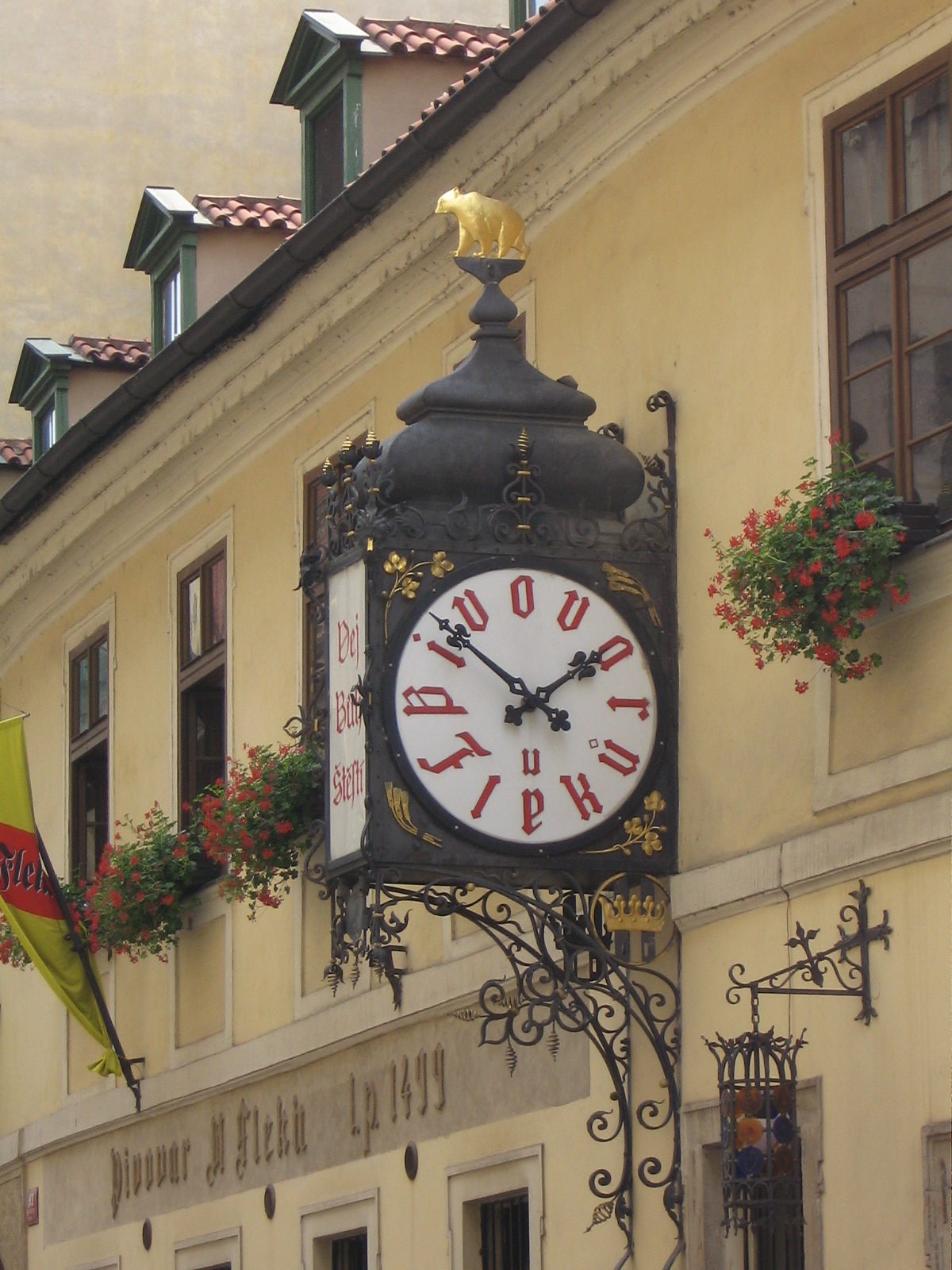
U Fleku


Back then, discovering that the first lagered beers were dark was a revelation.  That they preceded, sired, what we now know as pale lager seemed unimaginable. But dark they were, these dunkel beers.  In Prague, we drank in U Fleků, where then, as now, only one beer was sold: Tmavý Ležák. A lagered beer, but one as dark as liquorice with a tea-stain white head poured directly from a bulging copper vat above the bar, itself fed straight from the brewery above it. We supped it down with a thick, oniony goulash and ever-expanding dumplings in a dark-wood lined room, as dark indeed as the beer we drank. We became impervious to the cold outside.


Augustinerbrau Dunkel

Munich, West Germany, 1992. Days later, in the Bavarian capital, we drank early morning in the stone vaulted Augustiner Hof a crisp, beautifully structured helles and a beguiling dark lager – a dunkel bier.  Not black like stout; rather, if held up to the light it was brown like rye bread, softening to the edges and topped with a contrasting white head, deep, thick, pillowy.  We drank it with Weisswurst, delicate, steamed veal sausages, but the dunkel bier did not overpower or spoil; rather it contrasted, chaperoned, augmented.

Bamberg, Franconia, 1992. Further north, in the legendary land of the Franks, we stayed in Bamberg in a beautiful gasthof near to the river. We walked up to the square-setted market place and dived unwittingly pell-mell into the maze of snickets tracing the ancient town plan.  In the end, Klosterbräu found us: a lovely wood-lined snug and a fug of conversations from hundreds of years lining the ceiling.

klosterbrau schwarzla

We drank beers; the Schwärzla another dark, lagered beer, blacker now as you’d expect from its name, but no astringency or bite that you might presume from a dark beer; no fight; just a soft yet rewarding crispness and enveloping, savouring, mouthfeel.  Later that day we allowed our taste buds to be assaulted at the Heller brewery – brewers of rauchbier. Aecht Schlenkerla Rauchbier is sensory overload with smoked sausage, wood fires and a nip of burnt beer flavour, but a dark lager all the same, just containing a proportion of smoked malt in the grist bill.

Lord John Russell, Marchmont Street, London, 6th July 2006. A sighting so rare, twitchers began to descend on the place. A Czech dark lager, on tap: Budweiser Budvar Dark or Tmavý Ležák. I remember it as rich, complex, yet by now unsurprisingly moreish. IMG_0876Years later I buy a bottle to rekindle that day: a coffee cake head with tight bubbles protecting a molasses brown beer with a soft, rounded mouthfeel and a clear espresso character, both in aroma and taste.  A spirited but tight carbonation revealing the truth – that this, despite the darkness is a lagered beer. Moments later we celebrated with strangers as London won its Olympic bid. The day after, we mourned.

Today.   Despite the lineage, where today are the original lagers? Occasional dark lagers grace our shelves, only to be revealed as caramel emboldened imposters.  Few, true dark lagered beers make it to our shores; few true, dark lagered beers are being brewed in our craft beer revival.  Is it an expectation of a challenging taste? Is it an expectation of chewy texture and lack of refreshment?  Are dark lagers simply too counter-intuitive for today’s sensibilities?  Whatever the reason, the truth is that out of the dark came the light.  And it’s time to embrace our dark sides again.

* Being pedantic is important on this topic: see http://www.beertintedspectacles.com/lager-part-3-lager-is-as-lager-does/

© Beer Tinted Spectacles, 2014
Lager, Part VI: Bring In The Tanks

There is no more powerful, evocative and sought after beer idyll as “drinking lager fresh from the lagering tank”.  It is beer perfection exemplified. It is a notion so laden with positive association that it has reached almost mythic proportions. Here we have it: beer as beer should be; beer in the state that the brewer themselves would want you to enjoy it.  Beer that is fresh; is still conditioning; is so lively with natural carbonation; so ever-so-slightly hazy:  is alive. Beer with a gushing, foaming head so unctuously thick, so heavenly white, so unfailingly deep, so velvety creamy that you will think all your Movembers have arrived at once. This is state of grace filled with nostalgia, pining and distant hope, for it is a dying art.

I consider myself lucky enough to have drunk beer from the lagering tank three times: twice in the Czech Republic, once in the U.S. The first time was in the cavernous lagering mines under the streets of Prague, the tanks of Pražské Pivovary, the tanks of Staropramen. It is no overstatement to say that few times in my life have I been speechless with awe, wonder and reverence.  It was truly a near religious experience;  to step down the slippery steps, becoming ever damper, ever cooler, ever gloomier. The Cold War flicker of a lone fluorescent tube our only company. Footsteps bouncing, echoing from the stone floor and low-vaulted ceiling.  And then, turning the corner;  row upon row of enormous white lagering tanks stretching off into successive vaults. Countless tanks, endless caverns, dedicated to beer worship; floating, seemingly like innumerable whales, gently swimming below the surface.  Each tank delicately coated in a thin, glittering layer of condensation. Each tank slashed with the rough chalk marks showing when it was filled, tested, and when it will be ready to broach.

The second time years later was a similar, but further to the north west in the hop growing area of Žatec; again, rank upon rank of lagering tanks, slightly worse for wear, revealing the more straitened financial situation of this brewery compared with those in Prague where the streets are paved with Stag-Do Gold. But it was equally charming, equally moving – knowing that a brewer was dedicated to the considerable investment in time and expense of lagering their beer properly. Knowing that a brewer was still determined to sell proper lagered beer with the roundness and softness of palate that no short cuts can match.

The final time was modestly different, sampling different beers from the Sandlot micro-brewery under the Colorado Rockies baseball stadium at Coors Field. A few were sampled that evening, from a well known wheat ale, to a caramelly amber ale, but the Barman Pilsner was the highlight.  It sprinted through the pig tail into the glass, seething and swirling as it went, displaying that rounded, full character that I had tasted before. From a cellar in Colorado echoes of Bohemia could be heard.

No surprise then that lager brewers are trying to find ways to export – figuratively and literally – this state of lager grace to build their brand and reputation. It’s a drum a few of us have been beating for some time and now the reverberations are being heard.  Perhaps it is a case of necessity being the mother of invention as two very famous lager brewers are at the vanguard: Budweiser Budvar and Pilsner Urquell (PU).  Both have been struggling for traction in the UK in recent years – Budvar to grow their franchise, PU to gain a sustainable market foothold here.

I tracked down PU first, eventually making it to a long overdue visit to the White Horse on Parson’s Green. Unsurprisingly, given the justified reputation of this pub as a leading voice in the beer revolution,  SAB Miller, the owners of PU, have chosen the White Horse to invest in; a tank has been fitted in the pub cellar purely for unfiltered PU.

Beer tanks are old school. When I joined Bass, in my first few weeks I did a trade visit up to a working men’s club in Sheffield. It was a Stones’ club. At the time, Stones was Sheffield. And Sheffield steel meant huge pubs, huge men drinking huge quantities. So out back was a beer tank; the capacity I can’t recall, but it was a big as a farmer’s grain silo, pitched on its side. There was a glass gauge that allowed you to see the beer level: I watched  in naive excitement and not a little terror seeing the level of the beer gauge drop as I stared at it. The beer was the freshest you will taste on these shores: cellar cold, with a crisp, hop bite and thick Yorkshire head sitting on top.  It never hit the sides. Yet, not long after, the tanks were gone; the cost to maintain being the argument, financial as always.

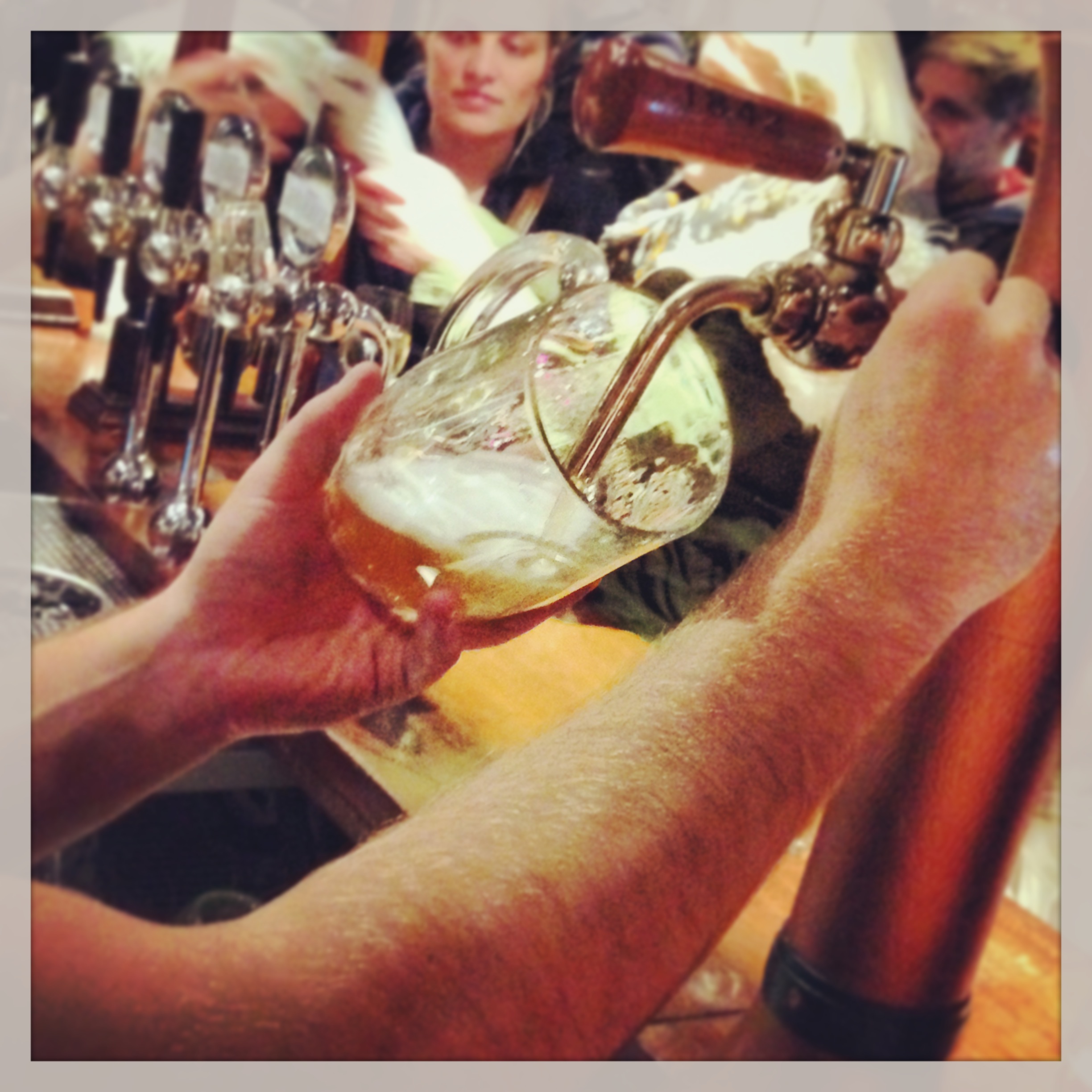
IMG_0627And as so often is the way, the circle comes around.  For now, in an act of post industrial irony, the beer tank has been gentrified – and the Sloany Pony is Exhibit A.  The PU was popular too, served from a Czech twin valve font, where you open the first valve fully first, then adjust the second valve as it flows to perfect the head. The glassware was the Czech equivalent of a dimple: another circle coming back round.  The most notable feature was the aroma. It was grassy and fresh before the head was broken. The pour was a delight and I didn’t complain when it the beer was slightly below the line because the proportions were right. The first sip was another delight, drinking through that head; breathing in the beer before it touched my taste buds. To taste: there was still the assertive hop forward character you expect from PU – if anything more assertively bitter than pasteurised stock. But the aftertaste was markedly more bitter yet, in fact a touch astringent – the opposite of what I had expected.  I struggled through it however…

Budweiser Budvar are taking a different approach. Their ‘Yeast Beer’ heads over in kegs filled from the lagering tanks. It means distribution has to be strictly controlled and the beer IMG_0669needs to be consumed within a week.  I found it in the Draft House on Charlotte Street, London: in fact, I only just found it. There was nothing on the font plaque to indicate it was different from the normal Budvar; no distinct glassware to justify the premium being paid. There was nothing in short, to support the beer idyll of “lager fresh from the lagering tank”.  Shame that.   Unlike the PU, the Budvar Yeast beer was markedly cloudy; as if it had received a little shot of yeast at the pour. And it too, wasn’t hugely different from bottled Budvar, but in this instance was softer, more gentle on the tongue and without the pronounced ethanol note you find in the bottle version.   Other clues were there too: a series of lacey white tide marks left as you drank it; a fuller, yet still delicate aroma.

The experiment for me is achieving mixed results: the reason fresh, lager tank beer is so evocative is because of its rarity.  You’ve got to want to try it; you’ve got to want to make that trip; you’ve got to want to hunt it down. But it’s hard yards – of course it is, otherwise everyone would do it. And the links in the chain are fragile. A fancy pour awry here; an overly foamy pint there; the wrong tap marker here; an unbranded glass there…  and the whole house of cards falls.  The tanks may be back, but the big guns haven’t nailed it just yet.

© Beer Tinted Spectacles, 2013

Lager, Part V. A whack on the side of the head ¹

A series of fortunate events got this blog started. First there was intent: I wanted to write but successive ideas for book plots all fizzled out or went up cul-de-sacs. Second, there was a deliberately provocative and ill informed piece on the BBC website about lager-fuelled louts. Third, there was the growth of craft and cask beer and the correlating decline in the regard for lagered beer. Three pieces emerged from the initial Tinted pen on lager, which prompted, and still do, many comments and questions when I see people – some surprised about lager, others welcoming another voice to the side of ensuring a great style of beer doesn’t become demonised.

Demonised perhaps, but not by most drinkers. And from what I can see, reports of the untimely death of lager have been greatly exaggerated. Yet equally, the momentum of creativity, ingenuity and desire to brew great lagers in the UK is thin.  Standing back, looking at my own drinking choices, there’s a clear pattern – American Pale Ale and IPA predominate at home; English pale ales are the favourite out and about.  In the Tinted Household, the hegemony of lager has passed and the move to the dark(er) side completed with unswerving ease.

Until last Friday night. Oooh, I don’t know, I just had the taste for something clean, yet rewarding with my Friday night Pizza, and only a lagered beer would do. Besides, a couple of four packs of Pilsner Urquell and Budweiser Budvar were in near-cryogenic preparation in the downstairs beer fridge. Delay was futile. Broaching could not be resisted any longer.

Early adopters of the Tinted musings may recall my first experience of Plzeň. At the border, the Czech border guards, in an act of post WWII solidarity, waved us past a fuming row of German drivers as we gunned the Bentley* through the crossing, nonchalantly waving our passports*.  I shall refrain from repeating it, suffice it to say, Plzen was eye opening. Bear in mind the iron curtain had fallen only a year before – men, the spit of the good soldier Švejk, walked the streets.  Rounded, head-scarfed women accompanied them. But the beer, by God – by rights, the original pilsner.  Deep bronze, brooding, biting. Still, back then, conditioned in pitch-lined barrels. Since then: acquisition, turmoil, struggle.  For struggle it has been: SAB have struggled to find its edge; struggled to comprehend why this beer of all beers, rarely gained traction in markets it was exported into.  The bitterness? The name? The lack of marketing funds? Internal priorities?

I like Pilsner Urquell though, and I think SAB are doing a good job – because, on most aspects of the brand, they’re not meddling too much.  Don’t get me wrong – the beer has changed. It’s a little thinner than of old, a touch paler and noticeably less forthright in the aftertaste. But it’s still a cracking beer and behind it there seems to be a mindset of stewarding the brand, not fiddling – there seems to be some respect. The bottle is a design triumph and feels timeless; the glassware is the classiest in the SAB range, rightly so.  The font looks authentic.  The advertising is copy heavy and interesting (what little there is).

And then last Friday, I rediscovered the fundamental reason behind why lagered beer dominates in the world, like a second whack on the side of the head. After almost two years of eschewing lager, I drank one after another. Not mindlessly, but willingly.  The first was a delight – cutting through the palate, refreshing right across the taste range from foretaste to aftertaste.  One wasn’t enough… I levered the crown off the second on autopilot before it too sunk without trace. I switched to Budvar and the same happened again, two more bottles of delightfully rewarding refreshment.

Oh, I know. I won’t make the shortlist of the Market Research Society’s Award for Insight Excellence with this observation. And I’m not turning my back on the majesty of the Pale Ale Counter Reformation, for many of those beers combine the same enticing drinkability, flavour reward and refreshment.  Yet, there was something about returning to the fold that conjured up what it must have been like in Bohemia and Bavaria in the 1840s and 1850s.  Never having seen a beer that was as clear, radiant, golden and refreshing. No wonder it was embraced with such relish and rightly deserves its place in the beer pantheon – and your repertoire – of today.

¹ with apologies to Roger von Oech

* some elements of this story were, and remain, fictitious, although the general thrust and plot is entirely factual. Honest, guv, ask my brother.

©Beer Tinted Spectacles, 2013

Gezelligmütlichness – and a solution for pan European harmony.

We sat at a rough hewn, oak table that runs twenty feet in either direction, topped with light blue and white diamond table cloths. To my left and right, drinking companions who have accompanied me here, to this shrine, in a battered, white Fiesta. Opposite, an elderly gentleman – possibly in his ‘80s but it’s difficult to pinpoint – unremarkable except for his deeply wrinkled face, crinkled embroidered collar on a brilliant white shirt, a velvet green bridle across his chest slightly shrouded below his waistcoat, and on his head a small, mole brown feathered trilby.  His drinking companions are similarly attired.  In moments the new world meets the old – jeans clad English lads in a social stand-off with three gentlemen from an earlier age.

Three huge, monster, glasses – they must be all of two pints¹of beer are placed in front of us, and, as if a switch has been flicked, the elderly gent in the middle fixes me directly with his gaze, stands up, proudly slapping his black lederhosen, raises his similarly mammoth glass of glistening, bronze beer, smiles and duels me with a toast:

“Der Gemütlichkeit!”

Moments later, at the far end of the tent – far enough to appear like footballers viewed from the back of the North Stand – a deep, reverberating string of notes wobbles over to us, ‘Ummm Ummm Um Um Um Paaaah!’  Recently arrived puzzled tourists like me scan around nervously as everyone rises, lifts their glasses and starts to sing: “Ein Prosit, Ein Prosit….”

Spin on a few years. A business trip to the southern Netherlands, near Maastricht, down in the pointy bit on the map. We’re touring a brewery with a view to importing one of their beers. The brewery is almost pastoral – verdant green hills, shapely oaks, ash and poplar trees shape in the  immediate hinterland – the word ‘bucolic’ was made for this. The brewery itself faces directly onto the road, barn like in appearance, with large, triple hinged wooden doors hiding the shining, modern set-up within. At lunch we break to a small bar just round the corner from the brewery and enjoy a bowl of waterzooi – this being with welly-wanging distance of Belgium after all – and a Summer wheat beer.  In this part of Holland, speaking English is less common than further north; nonetheless our brewery guide – a Brewster no less, raises her glass and gently says,

“Ah thies is soo gezellig”

I looked it up. Gezellig?  Gezellig? I hear it a lot but no one can translate it. The Dutch being proud in fact that ‘Gezelligheid’( with the gargling ‘z’) You have no word for it in English’.   I did the same with Gemütlichkeit , although knowing a bit of German I was aware the story was similar.  How come in English – English of all languages – with a vocabulary more extensive (and growing faster) than either German or Dutch – how come we don’t have a translation?   And as they are so central to the beer situation, this only made it worse.  Our beer culture is rich too – surely we can translate these words?  If only to reduce the lexicological one-upmanship

The Wikimeister was the first point of call. Gemütlichkeit being ‘an environment or state of mind that conduces a cheerful mood and peace of mind with connotation of a notion of belonging and social acceptance.  And apparently the Nordic countries, many of the Balkans all have a similar word. In Russia their word, yιom, “carries almost identical connotations”.  As for Gezelligheid ‘depending on context, can be convivial, cosy, fun, quaint but can also connote belonging, time spent with loved ones….or general togetherness”.   I understand these words.  I get them wholly. The emotional connotations make absolute sense to me, yet, yet… we don’t have a word. I struggle to express that familiar sensation in our language. They are either too lacking in nuance (like convivial) or else you need a phrase and that’s cheating.

But I want to be able to express this word.  I reckon that it’s a bit of gezelligmütlichness that we Brits could do with. Because just as we may not be able to translate these words, so our neighbourly continental languages don’t have an expression for our way of drinking and what that means, how that feels for us. And no, I don’t mean getting lashed on a dozen pints, but rather that fuzzy, somewhere in-the-middle drinking that’s two too many to count as a ‘quick pint’ and two too few to constitute a ‘sesh’.  That’s where the spark plugs fire without sparks flying and causing a raging inferno. It’s the sort of occasion, with your friends, that you could easily do a couple of times a week and still function the next day, without feeling piously or piteously out of it.

There’s a more serious need too. Put to one side our current economic difficulties, the perception amongst politicians and legislators of the effects of beer, and alcohol, on how ‘we’ drink is still stuck in a different age.  ‘Minimum Pricing’;’Alcohol Harm Reduction Strategy’, talk of advertising bans, sponsorship bans, self regulation vs legislation – these are warning signs that the chasm of understanding between those in power and those who want to enjoy a relaxing couple of three pints exists and is a threat.  And it is a threat – to think, as I read in a quality daily recently for example, that minimum pricing in the off trade will lead to people going back to pubs again is folly.  We need to put gezlligmütlichness at the heart of a positive political agenda for beer – supporting not just good pubs, but encouraging bars and restaurants to serve a decent lower alcohol drinks range (beer) as well as a decent wine list  – and putting a new way of drinking, a little, often and good quality at the heart of licensing, rather than simply demonising supermarkets from stacking it high and selling it cheap.

In an earlier blog you may recall the journey my brother and I made to Czechoslovakia and Franconia just after the fall of the Iron Curtain.  Mere sprats we were, still on a hideously giggly voyage of beer discovery – it could have been one long trip of drunken debauchery and leery British embarrassment on the continent.  Yet one night, we sat in a wood clad bar drinking dark lager and Dunkel, having a conversation with the locals yet utterly unable to converse in their language.  And then, to paraphrase the Good Soldier Svejk, ‘it did happen to us that we drank one beer after another’…modestly so I like to think.  Of course, we’ll never meet those chaps again, but for all talk of ephemeral European Harmony, legislated by endless Treaties, perhaps it would be more constructive to just share a few beers and enjoy some gezelligmütlichness.

¹In fact, it turns out to be a 2 litre glass – or ‘mass’ which in German feels almost onomatopoeic.

© David Preston, Beer Tinted Spectacles. Originally posted on Posterous, May 2012

Lager, Part 4. Decoction Concoction.

I was lucky enough a while back to see a Bohemian lager being brewed the original way. By original, I mean the way the pioneers of the 1840s to 1870s did it in breweries throughout Bohemia, and later across Europe and beyond.

The story of how Josef Grol, a Bavarian brewmaster, took the lagering process of his native land and fused it with paler malts, which had in turn been inspired by English brewers, is well known. Less well known, but just as important a catalyst was the burgeoning Bohemian glass and crystal industry. This was pivotal for the brewers… it meant there was no place to hide when it came to the clarity, brightness and transparency of the finished beer. Suddenly, not only was taste important, so was presentation. And presentation was about a combination of factors of which the brilliance of the beer was just one. So too was the head which, as legend would have it, should be strong enough to support a coin of the Austro-Hungarian Realm.

The question that Grol and his contemporaries wrestled with of course was not just one of lagering, or the right grist bill. The question of mashing was central. How best to coax the brewing sugars from the malt, particularly at a time of imprecise science.  Most brewing nations used a version of an infusion mash – that most associated with British ales today.  Think tea – pour the hot brewing liquor over the malt, stir and pour.   Add sugar to taste. I don’t think it’s quite as simple or as blunt as this but you get the idea.

What the Bohemian brewers experimented with was perfecting a different way, what we today call a decoction mashing regime. I love the word decoction, it has that slightly naughty yet unctuous overtone to it that only brewing could throw up. But what is a decoction mash and where did it come from? And more importantly what are the benefits?

Without truly understanding the complex science behind it (something I can sympathise with), the Bohemians knew that the thicker, more viscous wort from the first runnings produced the ‘best’ beer – by that they knew it led to a vigourous initial fermentation.  But the delicate Moravian barley gave a malt capable of beers of greater complexity – the question was how to obtain them, whilst not getting more undesirable flavour compounds too?   Decoction came about through a process of trial and error, but essentially – involved removing a portion of the wort (normally from a specific part of the mash) to a separate copper, raising it’s temperature to get at the brewing sugars, and then introducing it back into the main body of the mash.  Then repeating at different temperatures, sometimes up to three times (a ‘triple decoction’ mash).  It was (and is) as you can imagine a time and cost intensive process requiring considerable skill too – all good reasons to find a quicker, cheaper and less labour intensive process to replace it with.

This is all very interesting of course if you are into the romance of beer, yet commercially it is another part of the classic Bohemian brewing method that many brewers (unsurprisingly perhaps) and sadly including Czechs amongst their number, have abandoned for more ‘economic’ – and efficient – methods (normally some version of a temperature controlled mash). It’s also claimed, with modern breeding of barley that today’s strains of malts do not need the subtle, time intensive and somewhat alchemical machinations of a decoction process.

I am not convinced.  My criteria is not a lens of nostalgia, nor science, but one of mouthfeel, of taste, of having experienced the beguiling complexity of beers decocted and lagered properly and in some cases witnessing how particular beers have changed over time.

Alas, sadly, it is all rather academic. Perhaps for most drinkers or licensees, the real common denominator between beers is the price paid. As I write, I’ve just heard that a major brewer has purchased Staropramen for $3.5billion. To be clear, this isn’t just the price for that brand but 8 or 9 breweries and some market share, but even so, $3.5billion is a significant sum for a beer that is a shadow of its former self.

My Staropramen story in brief weaves it’s way into one of the proudest periods in my career and most enjoyable. 12 years ago, I took over the management of Staropramen at Bass Brewers. I had been involved when Bass first acquired Prague Breweries in launching the brand in to the off trade. In those days our first concern was helping people pronounce it – something of course not needed as drinkers were keen to discover and experiment and play. Later though, when I started running the whole show it was a different set of problems. Essentially, we needed to build a strong pub base for the beer and stop all discounting of the brand in the off trade. Sounds easy but the plan would see the brand haemorrhaging volume initially.   As part of the project, I made a number of trips to the Staropramen brewery in Smichov, Prague. My! Here was a cathedral to brewing lagered beer. The ‘new’ set of lagering tanks dated from just after WW2, and stretched in a vast array for a third of a mile under the city. The damp air, with the slight vinous smell of alcohol, was a joy.  The 12˚ ležak beer (the one exported to many markets including the UK) was a joy too, it enjoyed a double decoction and lengthy lagering.  3 years later we had re-established the base business of the brand, orientated it back to an pub based brand again and were enjoying healthy growth. Rightly too we were getting a lot of praise for the beer itself.

Fast forward through 12 years. Staropramen was bought by Interbrew in 2002 who soon lost focus (amongst other hair-brained schemes they had in buying Prague Breweries was introducing Stella Artois to Prague for the tourists…my observation was that the tourists were coming for the awesome Czech beer that was cheaper than water).  The purchase sadly coincided with the Vltava river flooding, inundating the lagering cellars at the Smichov brewery and giving them an excuse to move production to the Branik brewery on the edge of the city.  Whilst this happened, production for the UK was moved to Salmesbury. Yep, that’s Salmesbury in Lancashire.  Not known for its decoction coppers that brewery, and strangely enough the beer took a huge decline in character.  I know this because in a bar one evening, six of us did a blind taste test between Staropramen and Castlemaine XXXX …..I don’t need to tell you which one won do I? (Much to our shame)*.

Let’s sincerely hope that Staropramen’s new owners don’t see lagering the beer and using decoction mashing as a strange, alchemical process but return it to its rightful place as a great Bohemian beer again. For decoction isn’t a fanciful, wasteful brewing concoction. The discoveries of the Bohemian brewers of the late nineteenth century are just as relevant in the twenty first. Clarity, depth, rounded multi-dimensional mouthfeel and a rich, compact head that laces like the best cask ales…they’re something worth preserving as our legacy for future beer drinkers.

*The beer is brewed back in Prague today and has regained some of its character.  For completeness, I tasted a bottle recently and noted good head formation and retention, a mild malty / sweetcorn foretaste but an over dominance of alcoholic esters and little aftertaste.  Not a bad beer by any means, just not a real Bohemian pilsner any more.

© David Preston, Beer Tinted Spectacles. Originally posted on Posterous, April 2012