Cigars, Keys and Panhandles

If I had to draw a brewery hot spot map of the U.S., it would glow red around Chicago; it would burn with fiery hues in a stretch from San Diego up through California, and the top left, Portland, up into Washington State would light up the rainy night sky with its incandescence. And of course, for fear of upsetting anyone Stateside, it would be peppered with spots of orange and red just like the holes surrounding my dartboard; peppered from Alaska, Hawaii and right across to the Atlantic seaboard. Except for Florida.

What Florida is known for is a state that grows citrus fruit (somewhat erroneously, it’s predominantly a cattle grazing State nowadays), welcomes Canadians for their Winter hibernation, has a world class theme park in a swamp, a rocket base and has an incredible coastline with an enceinte of beautiful Keys, home to Manatee, ‘gaters, everglades and the Lesser Spotted Key Lime Pie. But beer? No, non, ni.

Why? Why did I believe this? And why have I changed my view? Well, just a few short years ago, I combined a business trip with a holiday to the state. The craft beer range in the supermarkets were slight; internet search engines for ‘Craft beer Florida’ or ‘Florida microbrewers’ broadly drew a blank. It seemed that The Sunshine State was still in love with sunshine lagers designed for hydration and slaking thirsts, not offering character or uniqueness. On my particular travels, I found one brewpub, located in a characterful building, but on checking it a few years later, found it was closed.

Hit the fast forward button and zip through the last five years. Select Genesis’ ‘Supper’s Ready’ from Spotify* and scroll through to 12’ 27”, blow your whistle and shout, “All change!”

The first difference: the snack and drinks trucks around the Disney Parks. Yes, they’re still selling plastic beakers of Bud Light. But they’re also selling Sam Adams Summer Ale. Think what you like about Jim Koch, but that feels like a mighty beachhead to me. And then there’s the selection of craft beers in C stores and supermarkets, which I wrote about in a recent post – you can’t miss it. Craft beer is reaching maturity too – or at least it’s now a dominant trend you can’t ignore rather than something that’s emerging. People are getting excited and on board. And more particularly, Floridians are getting excited and on board.

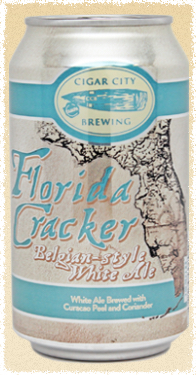
florida cracker_FotorAnd so it came to pass then that we ended up in a friend’s swimming pool, cooling down after a day kayaking drinking cans of Cigar City Brewing’s Florida Cracker. I liked this beer very much: it was a Belgian style ale, brewed in the American way; some unmalted wheat, curacao orange peel, coriander and according to their web page, a Saison yeast. It was a blissful combination after a hot day; characterful yet refreshing; reasonable pokey in alcohol (5.5%ABV) yet hopelessly drinkable. The brewery was in nearby Tampa and from the range that I saw, and the fact that the locals I spoke to knew of it, bodes well.

Just to the south of Tampa is circus country; Sarasota is where The Ringling Brothers circus had their base, provenance which lends its inspiration to Big Top Brewing Company and many of their brands. I got some Circus City IPA – a feisty, hop-forward beer. And again, in cans – this time packaged on a mobile canning line; the can being stickered (nicely done) rather than printed – an additional help to the would-be brewer. There are more: I liked the look of Fat Point in Fort Myers too but couldn’t make it down there; further south there’s a brewery on the beach in Naples. In fact, poking the wasps’ nest found me stumbling upon the site of the Florida Brewer’s Guild. Take a look. Little breweries popping up everywhere. Soon the map of Florida will be painted red.

*Other music providers are available. Oh, and it’s from ‘Foxtrot’, 1973.

© David Preston, http://www.beertintedspectacles.com, June 2015

Never meet your hero

There’s all sorts of cod advice on the internet about why you shouldn’t meet your heroes. A motif of this revolves around the fact that your hero isn’t in fact some 2 x 6-packed Hercules-cum-Adonis with the intellect of Stephen Hawking and simply oozing pheromone-rich, indescribably alluring charisma out of every unblemished pore. In fact, they are likely to be quite human. One eye slightly higher than the other, one ear slightly lower than the other, a troublesome, unspoken wart, hairy nostrils and perhaps a small holiday tattoo to unrequited love on the nape of the neck, just behind their ear.

Generally, I attempt to avoid hero-worship if I can help it and possessed of sufficient rationality, this doesn’t tend to be a problem. Where I do have some hero-magnetism is with underdogs: Damon Hill was one, but he also had a very stylish racing helmet, which counted double. Irreverence and authenticity helps too: my daughters and I met Bradley Wiggins in a queue at Manchester Airport once; he was perfectly down to earth and back then, not as famous as he is now (this being a few months before winning the Tour de France and Olympic Gold); but, although we have an ‘in’ joke when we see him on TV, we also recognise he’s just a family guy who is particularly good at his job and also particularly apt at speaking his mind. But heroes? Real heroes – I could count them on the fingers of one hand with a digit to spare.

Plucky underdogs, irreverent and authentic. Well, there’s a better definition of craft beer than I’ve seen hithero. And musing on this, I realised that I do have more heroes than I admit to myself. They’re just not human; they’re of the malty and hoppy variety. Ultimately, there is a whole generation of brewers who, in my lifetime, have saved beer from a uniformly bland future. Many of them are U.S. stories, and as such, brands that are hard to find on our shores. I found two on my recent trip Stateside: beers which, to a craft beer enthusiast, and possibly those living near a good retailer (probably in London) will be familiar: Dogfish Head 60 Minute and 90 Minute IPA.

The story of the company’s genesis is written up in a part-autobiographical / part-business text by its founder, Sam Calgione, an affable and slightly languid New Englander. He’s also familiar to many more (albeit also on the subject of beer) through the company being featured on Brew Masters on Discovery Channel (2010). Sam, like many of company founders like to tell the tale of his distinctive ales as widely as he can and it’s worth tuning into some of his TEDx lectures, particularly on those that tell of the story of some of his beers and how they came about.  At the core of Dogfish Head beers is a central thought: ‘off-centric ales for off-centric people’.   There, in the credo of the brewery, is a manifesto that says: ‘we will play round the edges’. It says, ‘You don’t consider yourself mainstream; you’re an individual. So are we’. And that becomes the product brief: Dogfish Head beers must be different – different, not just from Big Beer, but different too from many other craft brewers. Hence: Midas Touch Golden Elixir, based on a recipe dating back before, well, before Last of The Summer Wine for sure (actually it purports to be inspired from a recipe from the 8th century BC and contains Yellow Muscat Grapes – Compo would be proud). Or Pangaea, which is brewed with an ingredient from each continent, including some Antarctic water. Or Noble Rot, a Saison, brewed with malt and grapes, the grapes being infected with botrytis for that Chateau d’Yquiem touch.

Now, if you’re a Big Beer player, you must compete in pale lager: Carling; Carlsberg, Heineken, Moretti, Jupiler, Asahi, Tsingtao, Bintang, Castlemaine, Molson, Corona, Quilmes. Similar build, similar personality, different clothes. If you’re a craft brewer, then you need to compete in IPA – well, pale and India Pale certainly. This was the challenge faced by Sam Calagione and the Dogfish Head team in the early 2000s. They’d crunched the numbers. They were pondering how to ensure the brewery remained full, and full with beers true to them. They needed an IPA. But how to do IPA the Dogfish way, the off-centred way?

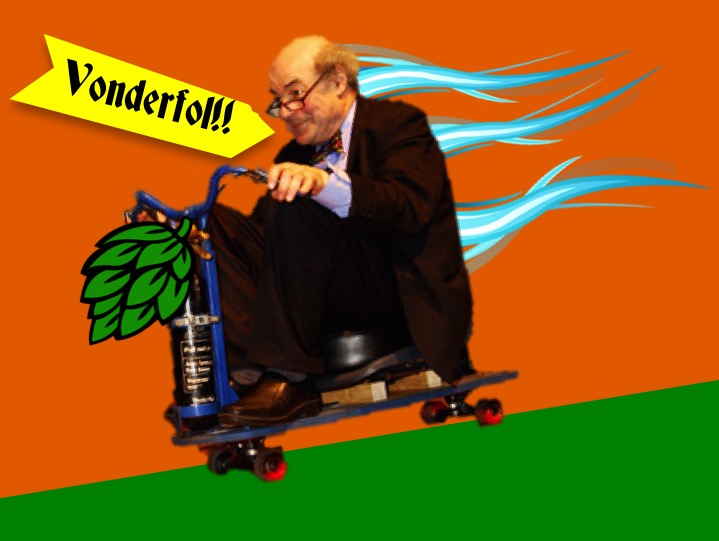
Heinz WolffThe answer ultimately, was to deploy an elaborate, Great Egg Race contraption to make small additions of hops every minute for the length of the boil: for 60 minutes, 90 minutes, 120 minutes; in my head I have my old chemistry classes in mind; vertical pipettes mounted above a steaming copper; Professor Heinz Wolff gently adding ze hops all ze time. Vonderfol! Don’t spoil it for me.

But anyway, there they were, two of them at least, on the shelf in Publix in uptown Sarasota. Six packs and singles of 60 and 90 Minute IPA. I’ll be honest, time actually did slow; I handled them cautiously, reverently, gently. I think I might have stroked one, and purred, ever so quietly. And then this strange thing happened: I got them back to the condo, chilled them down, but I couldn’t open them. I mean, what if, just supposing, it turns out to be, well, just a quite ordinary, no doubt tasty, but still, quite ordinary IPA. What if, all the hyperbole was just that? Mere hot air, evaporating away like the steam from a copper boil?

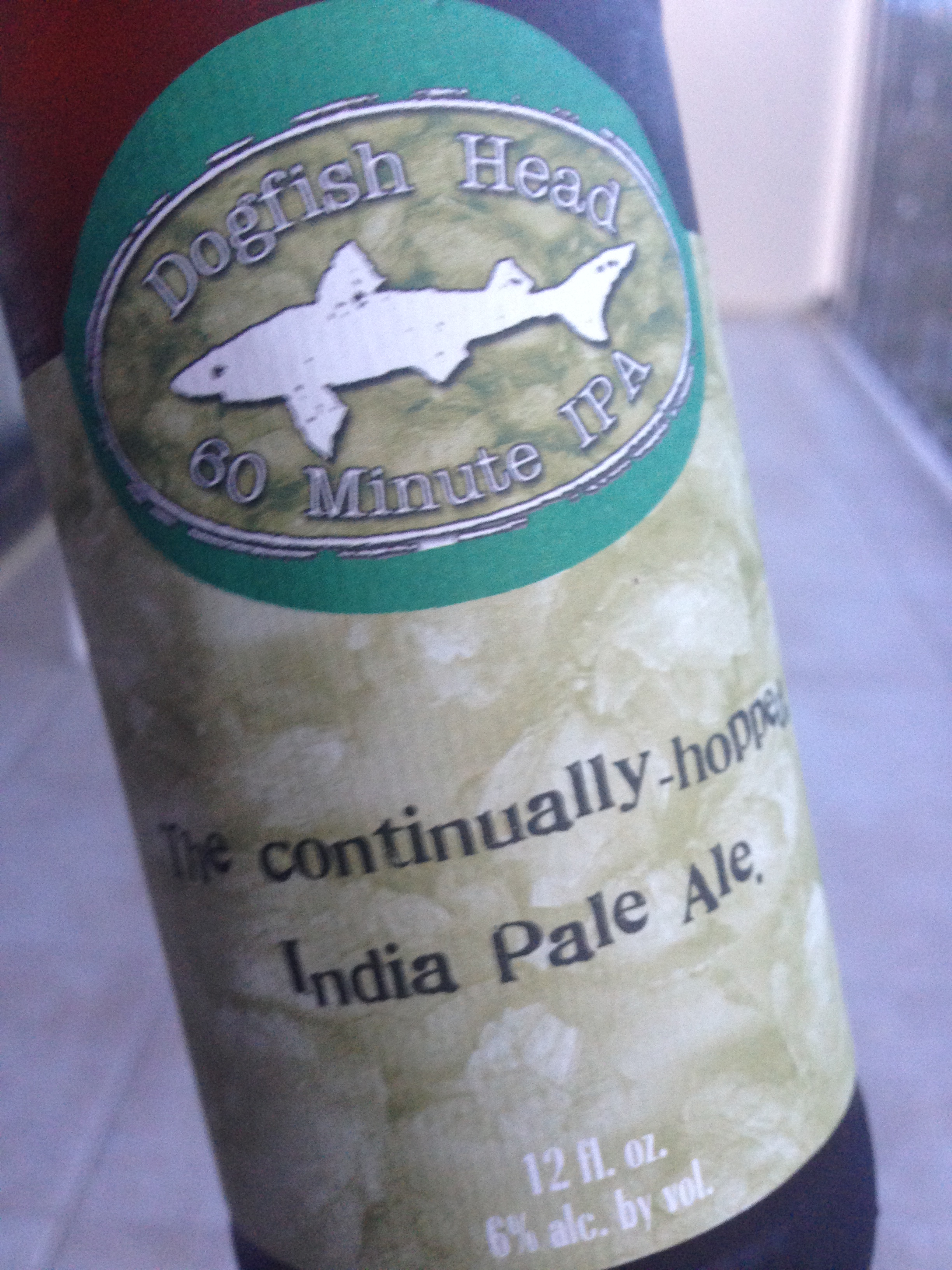
IMG_3553A few days went by and I drank down the stocks of my other beers: some damn fine ones as it turned out. The issue had to be confronted: I thought slow and took out the Dogfish Head bottles. I polished a particularly bulbous ‘70s wine glass, not ideal, but it would have to do. I prepared the seat and low table on the balcony overlooking the sea. I got my book. And I cracked open the crown. The 60 minuter first. As you’d expect from a beer so doped on humolone, the head was effusive, abundant. It was tight too and Honiton lace, you know, the sort that old doilies were made from, was left down the inside of the glass as I drank. The colour was mid gold; but how to describe the aroma? Volatile, fresh, profuse, intense: it raced out of the bottle-neck even before pouring. It was spicy and resinous and quite three dimensional – the dimensions of taste that is. The first taste was zippy and fresh; here now a grassy hoppiness. Across the mid palate was the spiciness and the lingering finish was bitter, quenching, not astringent but actually smooth and rounded. Maybe this is my palate, but I’ve found the same phenomena with other highly hopped beers (Stone Ruination for one): an expectation of being undrinkable (unfinishable is more accurate perhaps) but the opposite is true – providing there is a strong malt backbone, the beers are highly drinkable and surprisingly balanced. Yet for all that, at 60 IBU and 6%, it’s still a half brick in a hop pillow.

IMG_3580The 90 Minute IPA has a pleasing mathematical symmetry too: a 90 Minute hop addition, 9% ABV, 90 IBU. The longer boil also brings deeper colour: here a deep copper brown (quite Best Bitter to be honest), with a just off-white head that again was full and billowing. To drink, the carbonation was surprisingly gentle, natural and sustained. A superbly balanced strong beer that belies its strength, or perhaps, re-writes our perception of what strong beer should be. Whilst 9% Carlsberg Special Brew is cloying and shakes you aggressively by the throat, here there is a profound maltiness, and a pine resin follow through. My note at the time read: “Dangerously drinkable. I understand it’s reputation. Boof!” Clearly, the 9% was already kicking in.

Yet there was a slightly bitter edge as a Brit. Reflecting, I found myself thinking: where are our pale ales of this inventiveness, this majesty? Why isn’t a beer like this being pioneered in Burton, or London. Oh sure, there are some great beers coming through. But a hero? A beer that makes you go, ‘Boof!’? Not just yet. Not just yet.

© David Preston, http://www.beertintedspectacles.com, June 2015

La San Fran Diego

In 1999, the now long-suffering Mrs Tinted was only the short suffering Mrs Tinted. We decided to fly to California for our first wedding anniversary in fact: into San Francisco; a brief excursion north into Marin County (mountain biking pilgrimage), then Napa (wine pilgrimage) then down the fault line – the Big Sur coast (“Warning, bends in road for next 99 miles”) via Carmel (Clint Eastwood), Monterrey (Jack?), then Saint Luis Obispo to Santa Barbara (Santa Barbara Brewing Company, good hefeweizen and chicken burger), avoiding LA (saving the smog for another time) before R&R in San Diego.

I had few expectations of San Diego: it was designed to be a restful full stop at the end of our holiday before the flight home. It turned out to be yet another highlight.

From a beer point of view, to say California is a delight seems trite and unsurprising nowadays. Back then however, the beer scene was still emerging, albeit at pace, but remained centred on San Francisco. We drank Anchor of course, which was all that it promised and more: malty and dry, yet smooth too. We found great bars in the city (Jack’s Cannery) and in the country – a small brewpub in Napa City served a rip-roaring IPA that we wolfed down with wood fired pizzas before it became standard. But San Diego? Well, suffice it to say, we weren’t expecting any such surprises: we were going for the weather, nice beaches, no doubt, a day trip to Tihuana and probably a few bottles of Tecate.

Gloriously off script, the perceptions were all wrong. The Zoo: incredible (the incredible masticating Panda); Upstart Crow, a little bookshop… no, actually my favourite bookshop in the whole world (for a time at least) down on the quay. Adobe settlements; The Padres baseball team, with excitement building as they strove to win the World Series (they didn’t in the end), and our hotel, a sort of half America’s Cup cum half bric-a-brac temple cum half archaeological salvage thrown together in an arresting way. A hotel considerably better than my fractions.   And it turned out, the nascent brewing scene was the cherry on the vacational cake.

Oh, I know that beer geeks will likely sniff: but we both really enjoyed Karl Strauss Brewpub (and I’m happy to admit that I Iike ‘Rock Bottom’ too – better that than a Hungry Horse any day). Most of downtown San Diego is so unprepossessing, and it fitted right in, with a concrete camouflaged frontage. Not the beers though: there was Red Trolley Ale, immeasurably better than the average for that oddly faux – and typically unrewarding – beer style of ‘Irish Red’. It foamed and fizzed and had a lovely malt character. Tower 10 IPA, now a range mainstay, was what you’d expect: a blast of grapefruity C hops and a solid malt backbone. And located dangerously close to Hotel Bric-a-Brac and opposite the airport runway (here I go, ‘sell, sell, sell’) was Oggi’s Pizza & Brewing Co. We ordered take out from it one night and only called in right at the end of the holiday:  cue general werreting and gnashing of teeth. The beer was nothing memorable (for craft) other than it kept great company: the view across the beach, the bay, the gentle sizzle from what most Americans consider the best climate in the country. Oh, and pizza. Don’t forget the pizza.

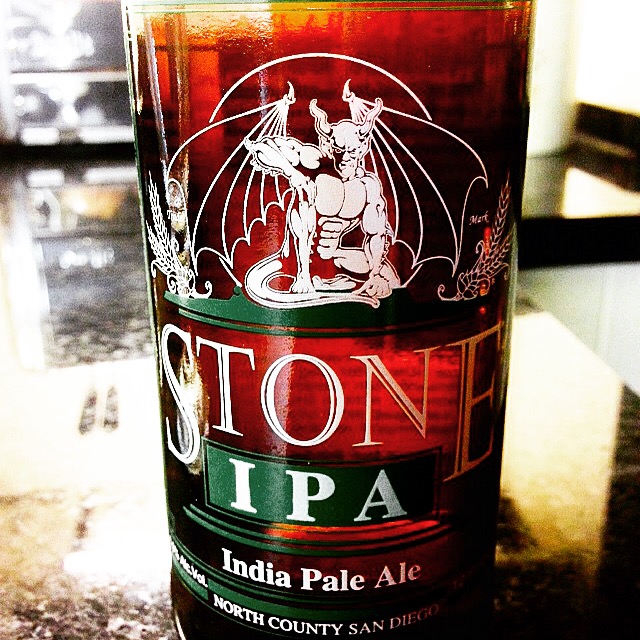
"My precious Stones"Today I suppose much of the talk of San Diego is about Stone Brewing. In ‘99, it was a shadow of its future self and I didn’t, as I undoubtedly would now, make a diversion out to Escondido to visit the bar and shop. But I was still excited to get hold of a couple of Stone beers just after Christmas through Beer Hawk: not being that close to a regular supply here in Burton on Trent (I mean, why would Burton on Trent have a decent beer shop FHS?). In fact, drinking these beers fired up for me a mélange of California, not just San Diego. A sort of ‘La San Fran Diego’.

From San Diego there’s the understated bullishness, the challenger mentality that comes from being the US’s eighth biggest city, yet squeezed right up against its second biggest. Take the IPA: this is not a beer by halves (or thirds). There’s a spicy, hop leaf aroma that’s full on yet appealingly dry and dusty. The alcoholic warmth is marked but not over-powering, and a mouthfeel that’s chewy, with round caramel and a pearl barley breadiness.

From LA? Well, there’s brashness and confidence; perhaps some artificial inflation too: I mean, the IPA is an umphhhing 6.9% and the Ruination IPA is a wheezing 8.2%. These beers do not whisper into the room. They drop in, in a mechanically powered suit and then blow the head off the guests sitting round the table, pronouncing “I AM Runination Man”. These are after all, the beers that started an arms race.

IMG_2936But there’s some San Francisco too, some old school California. A bit more culture, sophistication; keeping something back – the fingerprints of Anchor and Sierra Nevada linger here still. The Ruination for example, makes a strong pronouncement, but it’s actually remarkably restrained. The aroma is earthy and spicy – not fresh spices but roasty and dungy (this, as I have said before, is ‘a good thing’). The alcohol may put hair on your chest, but it’s combined with fruitiness too. Ruination is 100+ IBUs. That’s a lot. Yet it doesn’t drink that way; it has a strong malty sweetness, which acts as a foil, a counterpoise. It’s a ruinously good drop.

© Beer Tinted Spectacles, 2015

Punchy

Last night I went for a run, and, as a beer zealot who recognises the isotonic refuelling benefits and mysto-alchemic properties of beer, decided to have an IPA as my recovery – bottle conditioned, so feisty and full of the effervescent pep that I so badly needed.

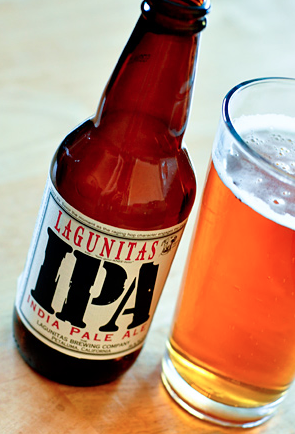
Screen Shot 2014-11-26 at 14.26.21I reached for a Lagunitas IPA, 6.2%, which had been subconsciously put there earlier. A beer that in their words is, “homicidally hopped”. And boy, did I want to murder it. Levering off the crown – Boof! Hop aroma, oily, resinous, wafting out before I even got close, before I even touched the bottle. I poured and sipped in small measures, teasing out a fulsome head (really, it needed no encouragement), sipping and replenishing, sipping and savouring. Beer enthusiasts will know this beer, so let me be brief: it dates back to 1995 when it was launched as a seasonal (I first drank it in the Napa valley in fact), and comes from the fifth biggest US craft brewer: it is spicy, with a bold citrus edge in the aroma and a well balanced sweetness all the way through; for a beer of such beefy strength, there is little evidence of that unbalancing, almost winey, ethanol. In short, here is a top class American IPA, very much of the style, very much of the quality you’d hope for. And good old Adnams bring it to these shores; doubly whammy.

What struck me as I polished the Lagunitas off was how few UK ‘new wave’ craft brewers deliver pale or India Pale beers with such uumph, such attack, such boldness. Oh sure, we treasure balanced drinkability over here, and of course, we serve in larger quantities, but I didn’t struggle to drink this beer. I wasn’t left with that cloying feeling of ‘Woah, boy! Better go easy’. On the contrary, here was an eminently quaffable beer, high on taste, higher on ‘goes down easy’. And ok, I don’t live in a part of the country that is spilling over with top class craft breweries or more to the point, top class independents retailers – it’s down to the supermarket with a bag full of pennies and a bucket load of hope for me – but even so, the brutal truth is, I haven’t yet had a British pale beer brewed with Lagunitas’ level of chutzpah – full stop. They’re either too tame, too listless – or, at the other end – attempting to be so extreme that they lose their point as a beer – overly hopped, overly malted, forgetting that refreshment, drinkability and intrigue are needed too.

Perhaps where we need to focus is back onto the pale ale & IPA styles that we can do brilliantly, with our ingredients – that feels like an opportunity.

© Beer Tinted Spectacles, 2014

Fursty Ferret-legging

In my drinking youth, I spent a few years living in the south west.  We’re talking Devon not New Mexico here, as such it was a landscape of verdant rolling hills, cream teas, bleak windswept moors and tors with outstanding free houses, often looked away in a leafy hamlet. The Drewe Arms. The Well House. The Bridge and Lighter at Topsham, the Warren House Inn, The Turf Locks – a tiny but representative sample.  Back home in the North West, the pubs had been industrialised in comparison – owned by the big (or big regional) brewing groups, and for the most part lacking the individual quirks of the pubs down on the peninsular.  It’s the same today, (relatively) economically backward, but much further ahead in terms of freehouses and regional ale choices on offer. Cornwall, in fact, has leapt forward, with more cask and craft breweries than it’s ever had, and Devon is moving that way too.

In the ’90s, the pubs were often better than the beer.  As students, we raved about the Beer Engine at Newton St Cyres but it was a fair old drag to get there and the rewards were often ropey.  Truth was, the big brewers had the most interesting cask choices:  Bass was widespread and consistent, damn fine in Ye Olde Shippe off Exeter’s Cathedral Close and The Bridge; Director’s back then was strong and winey, with a really pronounced floral hop character: the drink of choice in The Jolly Porter (at least if you weren’t on Snakebites) and the Turf, and Flowers Original was good – hoppily so at The Drewe Arms (a Whitbread pub at the time).  Occasionally 6X would crop up, or perhaps Adnams Broadside. The Double Locks, as popular with the horsey set back then as it is today, could still be relied for some interesting local choices, including Otter which had just started up, or Butcombe from over the county line.

Yet ironically, the beers from the local regionals were woeful.  St Austell had a great pub estate but the beers… whsssh. They were all three letter acronyms like ‘PMT’ and ‘WTF’.  These were the days when filling the brewery was more important that what came out.  I seem to recall that brands like ‘Tinner’s Ale’ and ‘Dartmoor Best’ (read: ‘Worst’) were the fruit of their loins at the time and to be avoided.  Nearby Usher’s brewery was uncreatively known as ‘Gushers’, putting the Burton ‘Snatch’ to shame with it’s sulphurous egginess, only that, unlike the Burton beers, it shouldn’t have been there.  And there was Hall & Woodhouse, less common in those parts and awfully tangled up over Tanglefoot, which was pleasant enough when kept well, but otherwise (and generally) a fine gut turner.

IMG_2588Not so today.  These boys have pulled their socks right up.  You’re as likely in Staffordshire today to find St Austell ‘Tribute’ as you are Pedigree (I’m sure the stats won’t bear me out on this, but you get the point).   It’s a fine pale ale, with a hop forward sweetness that is rewarding and potently drinkable.  I seem to recall reading that it was first brewed in celebration of the Solar Eclipse (the one the clouds spoilt) but elsewhere I’d heard that it was actually one of the old three letter acronym (‘TLA’?) beers modified, given a spine, beef upped and generally brewed consistently.  As for Hall & Woodhouse, what a transformation. I briefly worked with their brewer Toby Heasman when he was at Bass and whatever training he got there he’s put to good use.  Of all the beer joints in all the world, a Travelodge would not rate as one you would want to walk into. But there, in Blackpool, did I enjoy a minor revelation.  Faced with a draught beer selection of Stella Fatois, Budwiener and Drossingtons, eyes turned to the fridge.  Perhaps a sneaky Budvar?  Maybe a Leffe wouldn’t be too much to ask?  But lo! Two bottles of Fuller’s London Pride and some Badger ‘Fursty Ferret’ wiped the worried brow.  And, my, it was grand.  Beautifully balanced – albeit on the malty side, with a pronounced citrus aroma and bite; even my granddad would have enjoyed it, proud northerner though he was: ‘It were a graidely pint and you conner say diff’rent’. Ironic that in Lancashire, fabled land of flat caps, whippets and ferret-legging, I should find a ferret of a different kind and a southern beer should have infiltrated these stoically northern climes.


© Beer Tinted Spectacles, 2014