A Belgian Tart

The question I pondered on while walking between the vast, oak maturation vats of Rodenbach was, ‘why here?’. The sour beers of west Flanders are another of the golden strands of uniqueness in the richly weft tapestry of Belgian brewing. But how? How did these insanely complex beers to brew, confrontationally surprising beers to drink, develop and thrive in this rather forlorn, horizonless town in the western reaches of Belgium?

This particular journey was something of an odyssey. In two days I had experienced breweries and brewers of Belgian special ale, lambic, white beers and now the sour beers. The connection was Palm, who had purchased the shares from the remaining members of the Rodenbach family in 1998 and were giving their time in order to strike a potential distribution deal. Rodenbach wasn’t on that agenda, but you could tell they were itching to show me the brewery when they learnt that beyond commercial considerations, I was also interested in their brewing heritage. We galloped across Flanders from north of Brussels to the east, past Oudenaarde, Bruges to Roselaere. I hadn’t quite appreciated what I was about to see.

Roselaere itself is industrial, located on a major canal that opened up the industry in the area, and played its part in later years in cementing Flemish identity. The landscape was lumpily flat; an occasional berg standing out afar; raised pavements curving sinuously over canal bridges, small copses of trees, the lower branches removed to give them an almost abstract, perfectly round-back Mister Men form. The buildings typically sported Dutch gables and the characteristic thumb high brown bricks that add extra emphasis to their mortar and horizontal plane. The influences on the beers of Roselaere were from all sides; from Flanders to the east, from the Netherlands to the north, France to the south and from England a short paddle over the water westwards, where at the time ageing beers in wood was most advanced and widely practised.

Portugal and others 2006 031_fotorIn comparison to the earthy plainness of the town and surrounding countryside, the brewery is arresting. I have visited brewing sites in the Czech Republic and Bavaria and stood in awe at cathedrals to brewing. The lager tanks below the Smíchov brewery in Prague; the billowing beer tents of Munich’s Oktoberfest or the Cannstatter Volksfest in Stuttgart; the medieval fairytale dreamland of Bamberg’s breweries; or the intimacy of drinking fresh Kölsch next to their maturation tanks in a bar in Cologne. This was something else though; a brewery of complexity and astounding, industrial design it left me dumbstruck.  I padded round, head straining back and forth, I struggling to compute the intricate details of ingredients, fermentation regimes and processes, the effects of aging, the alchemies of blending. Yet the impact of the brewery hit home immediately; the idiosyncratically beautiful malt drying house and in particular, the halls of foeders, their huge oak maturation barrels. Thick vertical staves reach 15 feet up, more for some; with a burnished nutty complexion and stand-out grain more like chestnut or pitch pine and a sheen as if massaged with the natural oil from workers’ hands over countless years. Multiple bands of iron hold the pressured tanks together, picked out in letter-box red, whilst resting on small stone feet, picked out in whitewash, which allow air to circulate and tapping or moving the beer. Each was numbered with a wrought iron plaque like those on the side of a steam engine.

Portugal and others 2006 032_fotorLater I attempted to decipher my mental notes: it is a mixed fermentation; the young beer is first fermented in stainless steel tanks with a mixed culture: a magical soupy catalyst developed from when Rodenbach cooled their beers in the large, shallow, open top coolships once used widely in Belgian breweries, less so today. The mix is a typically hungry strain of saccharomyces cerevisiae and bacteria which produce lactic acid. They ferment in that order too, the first producing the fruitiness, the second the more complex tangy, tart characters. But as if this wasn’t enough, most of the beer is then transferred to the foeders, where it matures for a further three years picking up the oaky tannins and retro confectionery tastes (Pear drops, Sherbet Lemons, and I even got a whiff of ‘Toxic Waste’ in there too (that’s sourness… if not that retro)).

The heart of the poet in me celebrated this wonderful beer shrine with its wonderful, distinctive beers; the hard commercial head fretted over how long it would last in the cut throat world of globalising brewing, where enzymes and ‘essences’ are used to mimic the complex flavours of genuine craft.

IMG_2028_fotorPerhaps though, the trenches of defence lie in the beers themselves. These are not easily attainable beers, not instant crowd pleasers. They all need a rite of passage; multiple attempts; repeated sipping through quizzical looks, gurning faces and sharp intakes of breath on encountering the sourness. They display layers of complexity which anyone with a normal food vocabulary would be unable to compute – ‘what was that?’. Biscuity malty notes; fruity spiciness; oaky tannins; cidery appley bite; the sour aromas of wine vinegars with the sharp tanginess of wild bacteria. Rodenbach is a reasonably sizeable brewery but their products are niche. Many brewers, trained in industrial scale lager and ale brewing dismiss them as undrinkable (undrinkable classics, perhaps). The beer writer Michael Jackson felt somewhat exploited when he was quoted ad nauseum by the brewery after describing Rodenbach’s beer (the Grand Cru) as ‘the most refreshing beer in the world’. Yet you can see where he was coming from; the complex fruitiness on first sip gives a layers of flavour reward whilst the tartness gives a pleasing sour pinch in the aftertaste. A virtuous circle of quenching drinkability and savouring reflection? In recent times, I read that the blend of Rodenbach original had been amended to make it slightly sweeter, less sour – a larger proportion of young to old beer and on drinking a bottle recently I would concur. The lines of defensibility though lie in remaining highly different, a difference which Rodenbach should both emphasise and treasure.

© Beer Tinted Spectacles, 2014

Where the wild things are

The first time I went to New York everything was so familiar I managed to convince myself that I must have been here before. I hadn’t. Years of episodes of Taxi, Friends, big budget movies, low rent movies and the persistent ability to be at the centre of global news makes it so familiar. From the ridiculous to the sublime perhaps, but I feel the same way about Brussels and the Payottenland, the low, hedge lined, deep ditched farmlands out to the west of the Belgian capital. I’ve been only twice, both fleetingly.  The first time was a road trip, passing through whilst heading elsewhere and pausing only on the outskirts of the capital. The second was a business trip, where any memory was wiped clean by one too many devilish beers in La Mort Subite.  

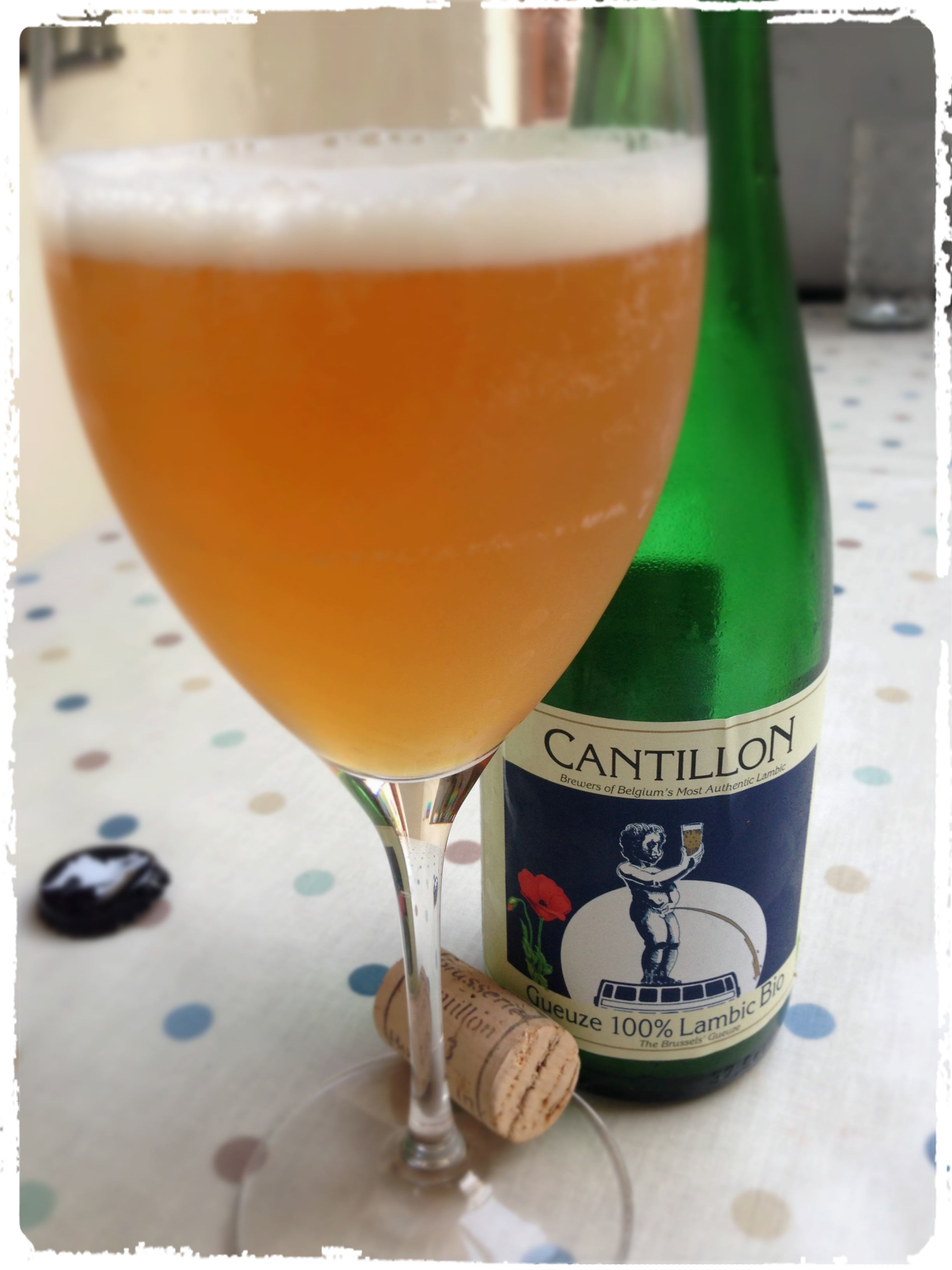
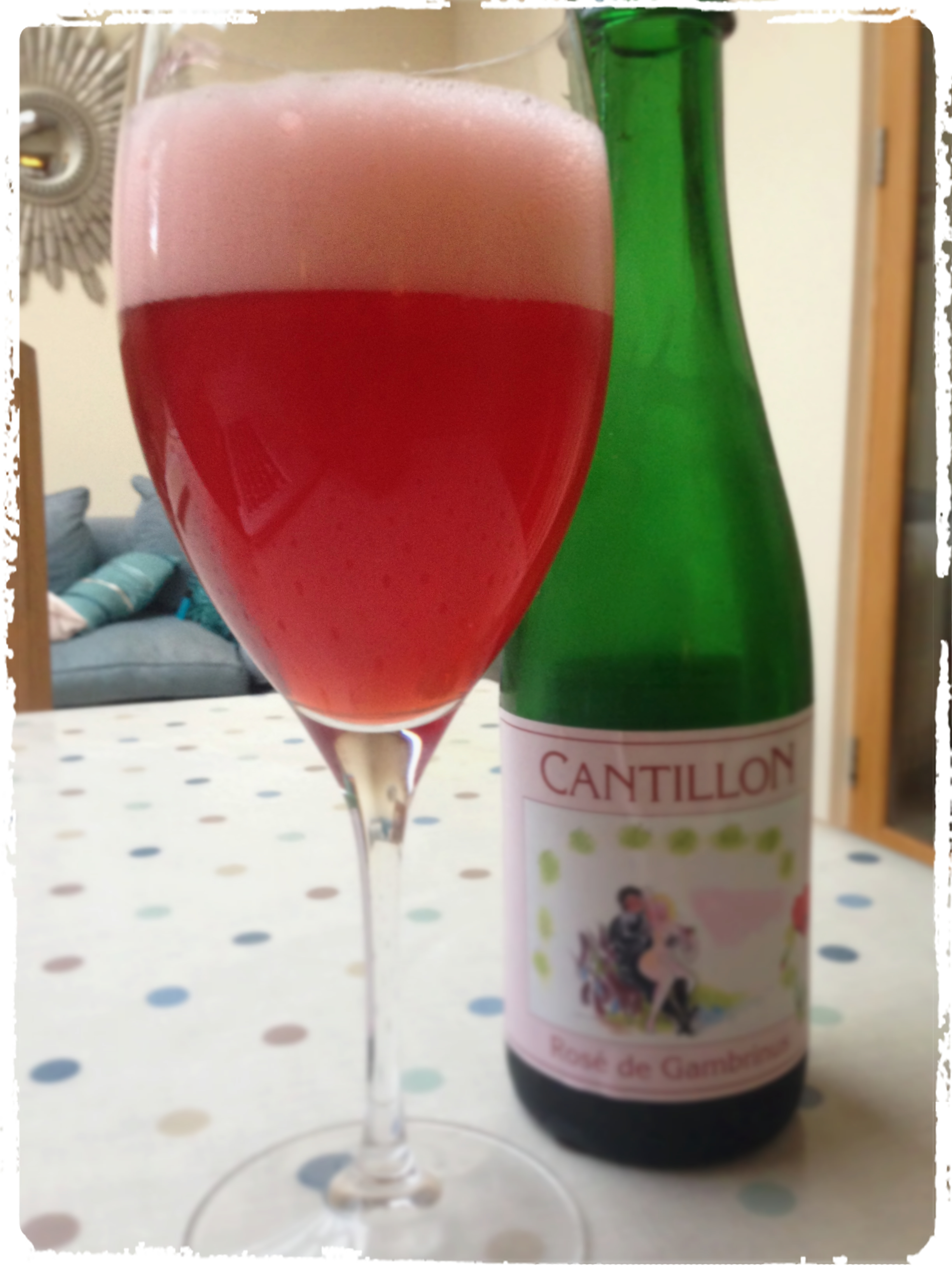
Yet it all seemed so familiar. And again, this was the case when I received some Cantillon lambic beers from Beer Hawk last week: the Gueuze, the Kriek and the Rosé de Gambrinus framboise. I’ve not been to Cantillon yet, but ex-colleague, friend and Edinburgh brewer Bob Knops has – some of his photos appear below. The product shots are mine: strange how even the packaging can link you to a place. These are the bottles of gourmands. Of people who care for tradition and taste above function and form. Thick, heavy weight bottles, fortified bases to withstand the pressure of refermentation in the bottle; wide brimmed crowns, levered off to reveal a cork seal below. Unnecessary? Antiquated? Yes to both if you wanted to argue it that way, which underlines how important these beers are.

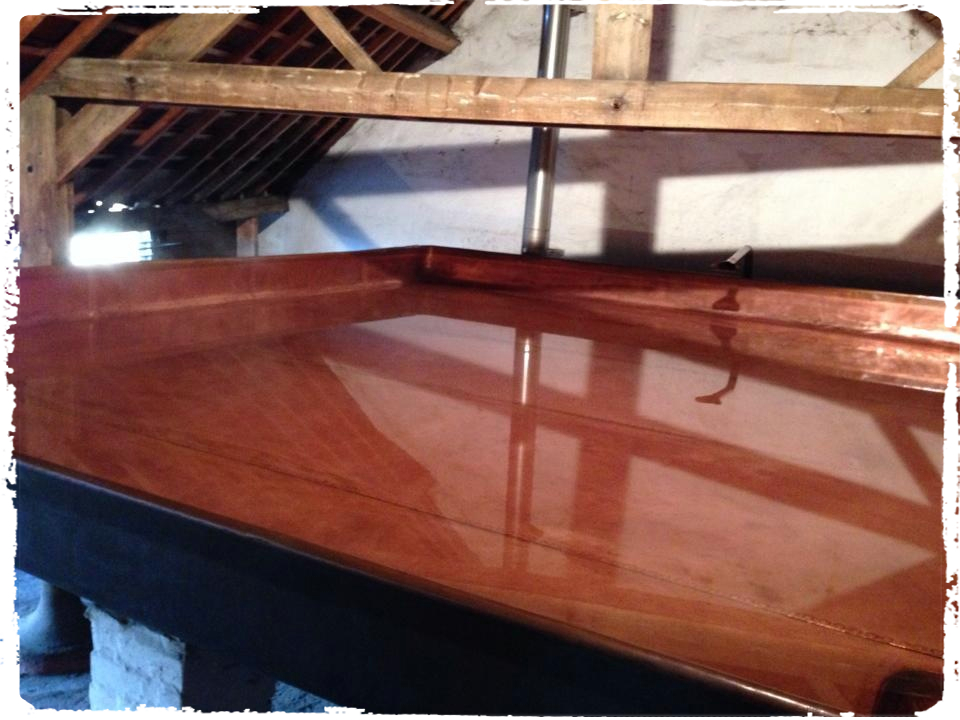
Cantillon brews in a very traditional way, even for lambic beers; making a gloopy, turbid mash of malted barley and unmalted wheat; a prolonged and vigourous boil with the addition of aged, cheesy hops, required not for their aroma but their antiseptic band-aid protection. And then inoculation of the wild yeasts begins, as the wort is put in a broad and shallow coolship, under the roof beams of the brewery, to let nature’s playthings have their saucy way with the wort’s sugars.  For the base lambic, the beer is moved into oak barrels, where it goes through a journey of staged fermentations, not just with brewing yeasts, but wild yeasts and bacterias that produce a wild array of different flavours & aromas. These fermentations are only complete two years later (and potentially longer).

The Gueuze is a blend of young (roughly two year old lambic) and older, 3+ years,  lambic. The older lambic is reinvigorated by the sugars remaining in its younger sibling and refermentation begins anew. The result is a sparkling beer (unlike lambic, which like traditional cider is all bit still).  Immediately on prising out the cork the wild aromas fly out: winey, ascetic, and vaguely pooey, a mucky straw smell like a remember from the floor around Reynolds farm when I was younger. Unattractive? The description sounds it I’m sure, but the words do not do justice to the aroma which is endearingly attractive – surprising, and complex.  To the eye, it was a hazy yet vivid gold, with a profuse head that quickly dissipated to a thin velvety sheet atop the beer.  Carbonation was visible and audible, and felt too, with a tingly sizzle in the mouth. The taste is led by a coating dryness, quite sour but appetising and finished with a surprising touch of lemon peel.

The Kriek lambic was a delight too: building on the flavours and aromas of the Gueuze but overlain of course with the marzipan nuttiness of cherry stones and the plump berry fruitiness of the cherry flesh. The beer was burgundy red in colour, with a pink, sustained, head that formed energetically. This was a refined beer: which in a ironic twist tasted fresh and young despite its ageing. The playfully named Rosé de Gambrinus is the real jewel.  Whole raspberries are steeped in two year old lambic only. Compared with the other two, at first I thought this beer was thinner, less complex – but on continued drink, so I realised what an elegant, refined beer it is – more a champagne than a Rosé. To smell, there’s plenty of delicate berry fruit, yet it’s not over sweet and has a clear, corky sourness too. The beer had taken the ruddy hue of the raspberries with a lighter, pink head than the Kriek and a strong, excitable, effervescent carbonation. To taste, the beer was neither as dry nor as punchily sour as the other two, but it was sour all the same – drinkably so. The raspberry sweetness – the little there is surprisingly – is superbly balanced, just sweet enough to pull you back for the next sip yet with a complementing, ascetic bite to complete the circle and quench. It’s nothing like sweetened beers that are increasingly popular where the sugar has been used in the fermentation. In fact it’s nothing other than an excellent framboise; an excellent beer.

I must go there, to this rural brewery in the the city. But when I do, it’ll feel like an old friend I’m sure.

IMG_0958_fotor

IMG_0961_fotorIMG_0960_fotor

IMG_1935_fotor

IMG_1941_fotor

IMG_1946_fotor

© Beer Tinted Spectacles, 2014
First three photos,Bob Knops. http://www.knopsbeer.co.uk

Tinted Shorts: Mort Subite, original Gueuze, 4.5%

"there’s none of the agricultural astringency of some lambics, but enough of the farmhouse aroma to know that wild yeasts are present."
“there’s none of the agricultural astringency of some lambics, but enough of the farmhouse aroma to know that wild yeasts are present.”

Lowlander Grande Café, London, June 2014

I’m fascinated by spontaneous fermentation. Can there be a stronger link in any food or drink we consume today with the beginnings of civilization; the beginnings of domestication and agriculture? I also find it fascinating that as a brewing method it has only survived in Payottenland in Belgium (at least until recently). Is it because allowing the wort to cool in the attic space, open to the elements is a mucky and time consuming way of doing things? Is it the simple hit-and-miss nature of it all?   Is it the end result – uncarbonated lambics – that are too limited in appeal and there variants, Gueuze, Kriek, Frambozen, Faro too time consuming, too tricky to master?

I thought about these questions as I sipped my Mort Subite Original Gueuze in Lowlander this week. It came in a natty little 25cl bottle which, at 4.5% ABV, was just right for the time. On pouring it was a burnished Chesterfield brown with visible strings of carbonation firing up form around the base of the glass. The head was open and fine, leaving lacing diaphanous and sheer, not the clumpy lines of mixed gas draught beer. There’s a marked (appley?) fruitiness in this gueuze and to sip, a gentle sweet wineyness too (hints of orange muscat dessert wine?); there’s none of the agricultural astringency of some lambics – perhaps not enough in fact – but sufficient farmhouse aroma to know that wild yeasts have been working their magic. It’s not a classic Gueuze by any means; but for the time and place it was smooth, approachable and sufficiently interesting.

© Beer Tinted Spectacles, 2014

Lager, Part 8: Frankenbier

In Western Europe and North America breweries are opening again at a tremendous rate.  There are more breweries now in the U.S. than there were before Prohibition in 1919; there are more breweries in the U.K now since about the same.  Countries traditionally more focused on the vine than the bine are now tooling up and building breweries, with craft beer in healthy growth in countries such as France, Spain and Italy.

Yet until recently, over half of the World’s breweries – the World’s breweries – were in one country. You don’t need me to tell you which, I’m sure.  Not only was Germany easily the most breweried nation, over 50% of those breweries were in just one State, Bavaria.  And whilst we tend to associate Bavaria with Munich, the most heavily breweried part is further north, a band of rolling, rich agricultural land called Franconia. Indeed, it is said (although not officially measure or recorded) that it isn’t the Czechs who drink the most beer per head, but the Franks. It’s probably true. The region is peppered with breweries, from Nurenburg in the east to the traditional wine lands of Wurzburg in the west. From large, industrial breweries now part of national or multinational chains, to farmhouse breweries operated as co-operatives by village residents.  It is a beer dreamland; the royal palace of beer. And the crown jewel is Bamberg.

I have written of Bamberg before. Go there. Even long suffering partners will not complain when they see this medieval peach of a town. If needs must, passing off visiting the numerous beer halls as essential cultural, tourist-trail immersions should be a relatively straightforward strategy.  But for wine lovers, one brewery in particular may be a step too far. For Bamberg is known in particular for brewing one speciality, one style of beer utterly uncompromising in flavour. Like Lambics in Belgium, it is a style of beer that will transport you back to a distant past; of primitive brewing technologies, an age of agriculture and beer as subsistence not savouring.

The beer is rauchbier. Smoke beer. Open a bottle of rauchbier and you don’t get the aromas of malt or hops – well, not initially at least. Rather, these are the aromas of smoked meat or smoked salmon. A campfire, with damp kindling is brought to mind, woodsmoke drifting lazily through the sluggish early Autumn air.  The aromas come from smoked malt, kilned most typically over beechwood, the benefit, it is generally believed, was to enhance the keeping qualities of the beer but more likely, it was a taste acquired when many foods were preserved with smoke. A natural partner: spicy, smoked German sausage, or deliciously oily smoked eel perhaps, washed down with a rauchbier.

These are not beers for the faint-hearted. Once, in a bar in Leith – the Pond – I spotted a bottle of Bamberg’s most famous rauchbier from the Heller brewery in the fridge. I ordered a bottle and let an inquisitive colleague stick his nose in. He recoiled, aghast: “Peperami!” he spat. “You can’t drink that!”.

IMG_1316IMG_1317That was the beer I first encountered in Bamberg many years ago. It wasn’t a chance encounter – we, my brother and I, went in search of it. The Heller Brewery is tiny in global terms, but big in the town. It’s the bar against which other rauchbiers are measured and their bar serves rauchbier in large measures.  The brewery itself has a wonderful tap & restaurant, with dishes paired to go with their beer. And that beer is Aecht Schlenkerla Rauchbier. Genuine Schlenkerla smoke beer. It is baroque. No, medieval is better – even the bottle label seems smoked stained. The typography is illegibly Germanic. The bottle shape, chunky, straightforward, utilitarian.  Everything about it says ‘what is inside is important’. Yet there are surprises. For such a full-on flavour fest, this is a lagered beer. Not, obviously in the Bavarian helles style, this is a dunkel lager – a stronger Märzen in fact. And as it proclaims on the label: “Dem Bayerische Reinheitsgebot entsprechend gebrautes” This is a beer authentically brewed according to the Bavarian Purity Law – no funny business to deliver that smoky flavour; just malt, hops and water.  And all this makes sense. Because Schlenkerla drinks counter-intuitively. Everything about the bottle says heavy, intense, challenging. The aroma on opening the bottle and pouring the beer strengthens this views; the first sip taking it further.

Yet wait. Go beyond what your mind is telling you and drink. Breathe. For a powerful beer, this isn’t overpowering. The smoke is mainly in the head, captured in the cells between the bubbles. The liquid is softer; a digestive-like maltiness is there, some gentle warming alcohol esters and most surprisingly, little bitterness. The flavour in fact fades quite quickly. It is a remarkably drinkable beer.  More than that, it is an evocative beer. A beer that takes you back to a place. Even if you haven’t been to Bamberg, Schlenkerla takes you back in time. To steep gabled, half timbered, medieval streets maybe. And certainly, to a taste of how beer once was that we have now almost forgotten.

© Beer Tinted Spectacles, 2014


65° 41’ North

It was Slati Bartfast, the planetary designer in The Hitchhiker’s Guide To The Galaxy who was particularly proud of his handiwork in penning Norway’s fjord coastline (“the fiddly bits”). Rightly so, he did a cracking job, what with their soaring cliffs, spouting waterfalls and magnificent base jumps, if that’s your thing.  In fact, I find the map of the whole North Atlantic fascinating, from the mouth shaped bite of Scapa Flow on Orkney, to the fine filigree fingers of the blustery Shetlands and the Faeroes with their whale-backed mountain ridges, arching as if ready to dive. Then beyond, to Svalbard and across, to the land of ice and fire itself: Iceland, precariously perched just below the Arctic Circle on one of the world’s most active volcanic boundaries.

Iceland has always fascinated me: when I was younger, it was the Norse mythology, the Cod War and the Sagas, many of which are set on the island and spelt out the lives of the brave wanderers who had upped sticks and island hopped until they settled on what we now know as Iceland.  It shows how tough these characters were when you consider that they thought the island verdant and warm compared with where they had left. In fact, it’s said that those original Norse settlers called it ‘Iceland’, despite its greenness to discourage further immigration and leave more of the land and resources to them. In an ironic twist, Erik the Red, later banished from Iceland for sundry pillage, brawling and fornication related misdemeanours, settled on the icy landmass he found further west and called it ‘Greenland’ to attract more settlers (before buggering off yet again and investigating the coast of today’s Labrador and Newfoundland).

I went to Iceland in 1991 after leaving University, to dig pits, study soil and ice sediments, measure glacier melt and do various climate-change related activities in the days before anyone seemed to be bothered about that sort of thing.  What I did not do was drink beer: firstly due to a lack of geographical proximity to any licensed premises and secondly, because I was poor and beer was – is – tear-inducingly expensive.   For the first four weeks, I stayed on a farm in the far north, Dalvík.  Our party, split into two: one half, my research tutor, his wife and young child stayed with a farmer who they had known for many years.  The other half, me and a small party of German researchers, stayed on a deserted farm a few miles further on.  Beer was so prized that it was the way we paid for our hospitality, along with a case of good single malt. The reason was Prohibition – at the time, Iceland had only legalised beer two years prior; its strength was strictly controlled, as was who could sell it. Like many Scandinavian markets you could only buy alcohol from a Government licensed shop.  And because the ban on beer had only just been lifted there were no Icelandic brewers and so everything was imported, everything expensive.

22 years on and the situation has changed.  I can’t tell you this from primary research (I plan to go back soon but haven’t made it yet) but through other means, chief of which is the small but growing number of Icelandic breweries I’ve been keeping an eye on.  Back in 1991, when I met my brother in the final week in Reykjavik, we pushed the boat out one night, wandering down to the sea front area and treated ourselves to a pizza and a Pripps Blå: a nondescript margherita and a nondescript Swedish euro beer but *ouch*, it dented my wallet when I could least afford it.

IMG_0652IMG_0658Today though I am drinking a beer from one of the nascent craft breweries. This one in fact is close to my affections as it’s from Akureyri, Iceland’s second largest settlement and situated just below the Arctic Circle. It was the place I flew into all those years ago before heading even further round the northern coast to the farm. It was here we did our shopping; buying delicacies such as caviar in metal tubes or vac-packed puffins. It was here too that our Jeep broke down and we ended up making an impromptu meal on a camping stove from air-dried cod, turnips and a can of tomatoes, just off the forecourt of the most incongruously placed Esso filling station imaginable, before eventually fixing the engine problem with a pair of old tights.  There was no brewery back then. Today there are a few, including Iceland’s largest, Villifel (Viking) and a smaller, craft ale brewer, Einstök Ölgerđ. It was beers from the latter that I found in the Harvey Nics pop up shop in The Trafford Centre of all places.

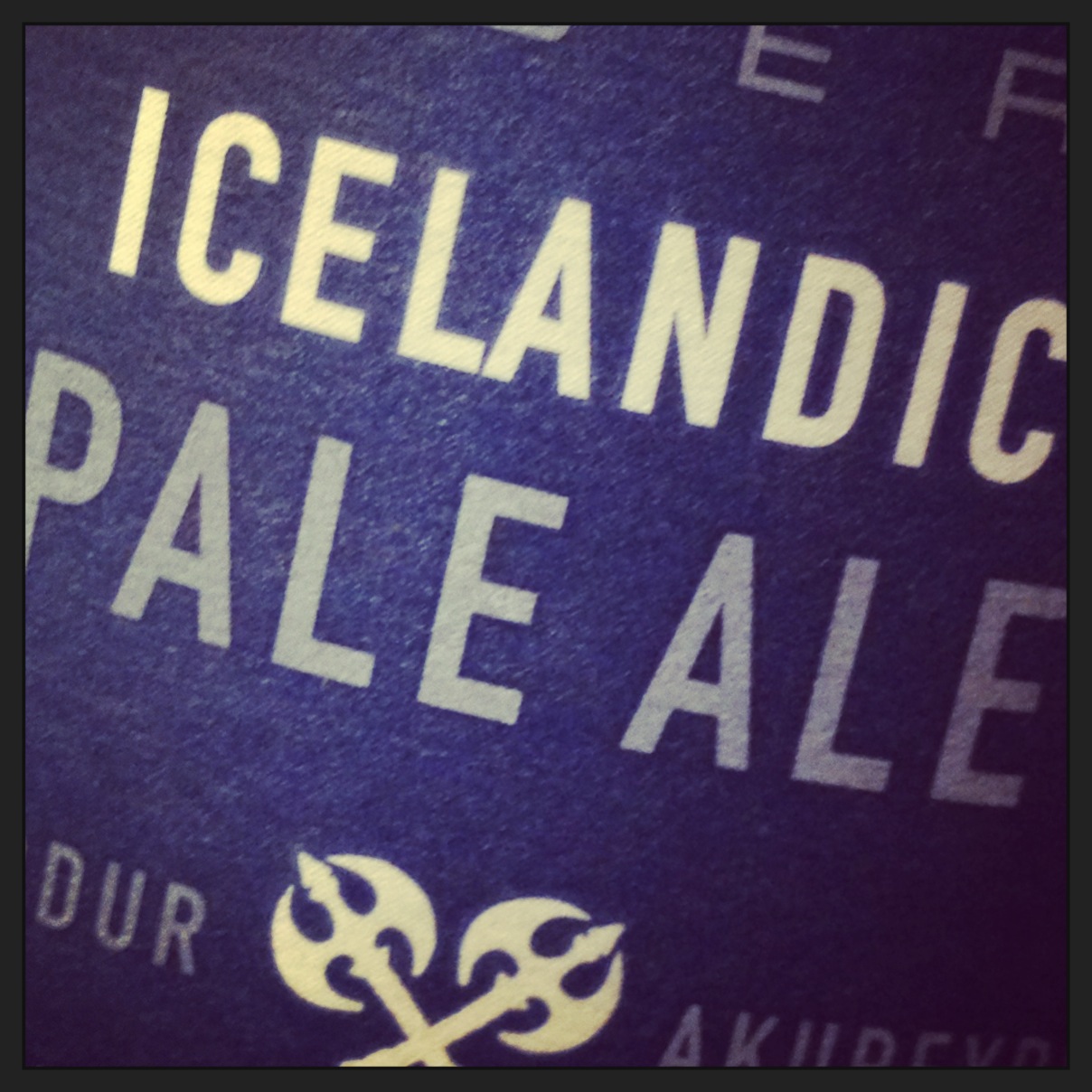
I bought a couple of bottles of the Pale Ale, a 5.6% affair, presented in a dark blue Scandinavian minimalist label-set, featuring some bearded bloke with a horned helmet and crossed axe detailing. All very dark ages chic.  It’s a good beer: very much in the style of an American pale ale, with a melted caramel colour and a grassy, lemony, wheaty aroma and a soft, gently carbonated body with a sharp hop tang. It’s a beer perfect for these high latitude dark nights and short days, when the sun hardly seems to rise above the horizon.

© Beer Tinted Spectacles, 2013