Lost Blogs #4: A Vote for Debeerlution

Beer Tinted Spectacles was originally posted to Posterous, which closed suddenly and made life irritating for a while. Some of the blogs were lost, recently found and are republished here.

For fear of painting the world with broad Impressionist brush strokes, my regard for Scottish beer a few years back wasn’t high. It all started with my first business trip north of the border, working for the then leading brewer in Scotland and the heady excitement of sampling some of the country’s leading beers. A pint of Tennent’s is what you would expect of a 4% session pale beer to be, only with better than average marketing and an inharmonic aroma somewhere between corn on the cob and a malodorous whiff of Marigold gloves. A pint of Tennent’s Special (a 70/- ale) was an unpleasant, soapy experience, which I pledged never to repeat. There was a more malty but equally bland 80/- too, and then there were the competitor beers, like McEwan’s Export which, let’s just say, won’t be featuring in any good beer guide. Hence my first evening saw me swing from naïve excitement to disillusionment, a mood not enhanced by lodgings in a rather ‘tired’ Toby Inn on Corstorphine Road. Not that much different from England and Wales at the time then, except for the blocking tactics of a powerful duopoly stymieing choice to a greater degree than down south.

In future months and years it was interesting to learn more about the Scottish market and despite that first experience, good times were had, including being part of launching beers like Tennent’s Gold Bier – in fact, generally there was a more pro-lager, pro-American leaning (brands like Bud, Miller had higher shares north of the border and North American brewers saw Scotland as prime real estate for their brands – Coors Extra Gold, Molson Dry and even Schlitz all had a crack). There was also virtually no infrastructure for cask beer.

Hop, skip and jump twenty years on and look at the transformation. What started as a trickle of dissatisfaction with the restrictive duopoly led to interesting start ups – Traquair House, Caledonian and William Bros (with their excellent Heather Ale, Fraoch) exemplified the emergent undercurrent. Brew Dog or Innes & Gunn followed as brands not just cutting through in the Scottish brewing scene but across the UK and beyond….and there are many, many others besides (see http://thebeercast.com – for a good round up of Scottish brewing with an Edinburgh orientation).

Which leads to the Archerfield estate, just outside Edinburgh, on the beautiful southern Firth of Forth shore – the ‘Golf Coast’ as it’s colloquially known for the number of international links courses with pot bunkers that swallow small children whole. It is also the home of Knops’ Beer Company. Bob Knops was, not so long ago, an operations manager for a big brewer north of the border. Always professional, reliable, committed… but his heart was never in it. He was a trained brewer, and he wasn’t brewing. Now he is and after initially contract brewing, he now is running a gleaming new-build brewery in the Walled Garden at the Archerfield estate. Like the Lost Gardens of Heligan but with more spas and fewer ‘losts.’   There’s a broad spectrum amongst craft brewers – at one end, those inspired by past styles, or past companies – bringing them up to date, or just plain bringing them back. At the other, there are those actively shaking off the legacies of the past and trying something new.   Knops’ beers lean towards the former but with a generous smack of contemporary rule-breaking. The beers themselves have a story at their heart; in some, the plot is Scottish – like ‘Musselburgh Broke’, ‘Black Cork’ or the IPA with its roots firmly in the Edinburgh tradition of IPA. Others feature international characters like ‘Californian Common’ – a Knops’ take on west coast U.S. steam beer. The twist is the presentation – LNER or GWR railway posters from the 1920s and 1930s spring out, with bright, striking labels and engaging pack copy.

And picking up on a recent Tinted theme, Knops’ beer show the diversity that exists within ale. Of course there is an IPA – and this one is well structured with a punchy, cleansing bitterness and an appealing brightness & presentation. But the California Common is less common on these shores. Even in San Francisco, they’re not sure how the name arose, but it seems to be to do with the ‘steam’ that arose off the shallow fermentation vessels as they cooled the beer in the colder air blowing in from the Pacific. I’m not sure Bob has mounted fermenters on the greenhouse roof, but the beer has that Anchor Steam quality – something that you can’t quite put your finger on. A bitterness, yes, but also a Czech lager-like cleanness on the palate and then back to a pale ale maltiness. Black Cork is even less clear – a beer whose origins and taste are now shrouded by time. Using as much historical information as they can, Bob and his team have recreated a 6.5% ABV whopper – you sense ingredients measured in ‘good handfuls’ feature on the recipe, with a full malt backbone, but an intriguing cut of citrus that must come from generous hopping. And then finally, Musselburgh Broke, which reminds me of classic Scottish 80/- beers, executed well. There’s lots of malt in here and it shines through: it’s full and coating as you roll it around your mouth but the brewing is adept enough to ensure the hopping regime encourages drinkability.

The disillusionment from that dreek October evening in Edinburgh is finally beginning to lift.

For further info and stockists on Bob’s brews, check out the website: www.knopsbeer.co.uk

©Beer Tinted Spectacles, 2013
Small beers

There’s a ‘born again’ zeal of enthusiasm about cans amongst the craft beer fraternity; it’s intriguing and amusing. For years, brands of beer that put their product in cans were deemed in some way cheap or sold out. There was a lingering perception of ‘tinniness’ but also associations of ‘13½ Free!’ or ‘500ml extra value’ or even the faintly ridiculous pint cans that you still see in the UK, which seem to be tottering along on super high heels, just waiting to ‘do a Naomi Campbell’.   It’s been a source of frustration for can makers for years and their industry body, which is imaginatively titled the ‘Can Makers’. Because, cutting through any of their potential bias, cans really have been a brilliant beer package for donkey’s years. They are incredibly light to transport (filled and unfilled); rugged, despite the incredible thinness of the can walls; efficient conductors of heat so they chill down quickly. And they are also flavour fast: the cans are lined with a food grade film which prevents any contact with the steel or aluminium walls and of course, no light is going to sneak through, eliminating the threat of light strike.

So it must be down to the craft brewers. They have stepped in and reversed the decline in cans’  perception, because otherwise, nothing is different.

Except, no. There are a few differences this time round. And it’s the craft brewers who have seized them.

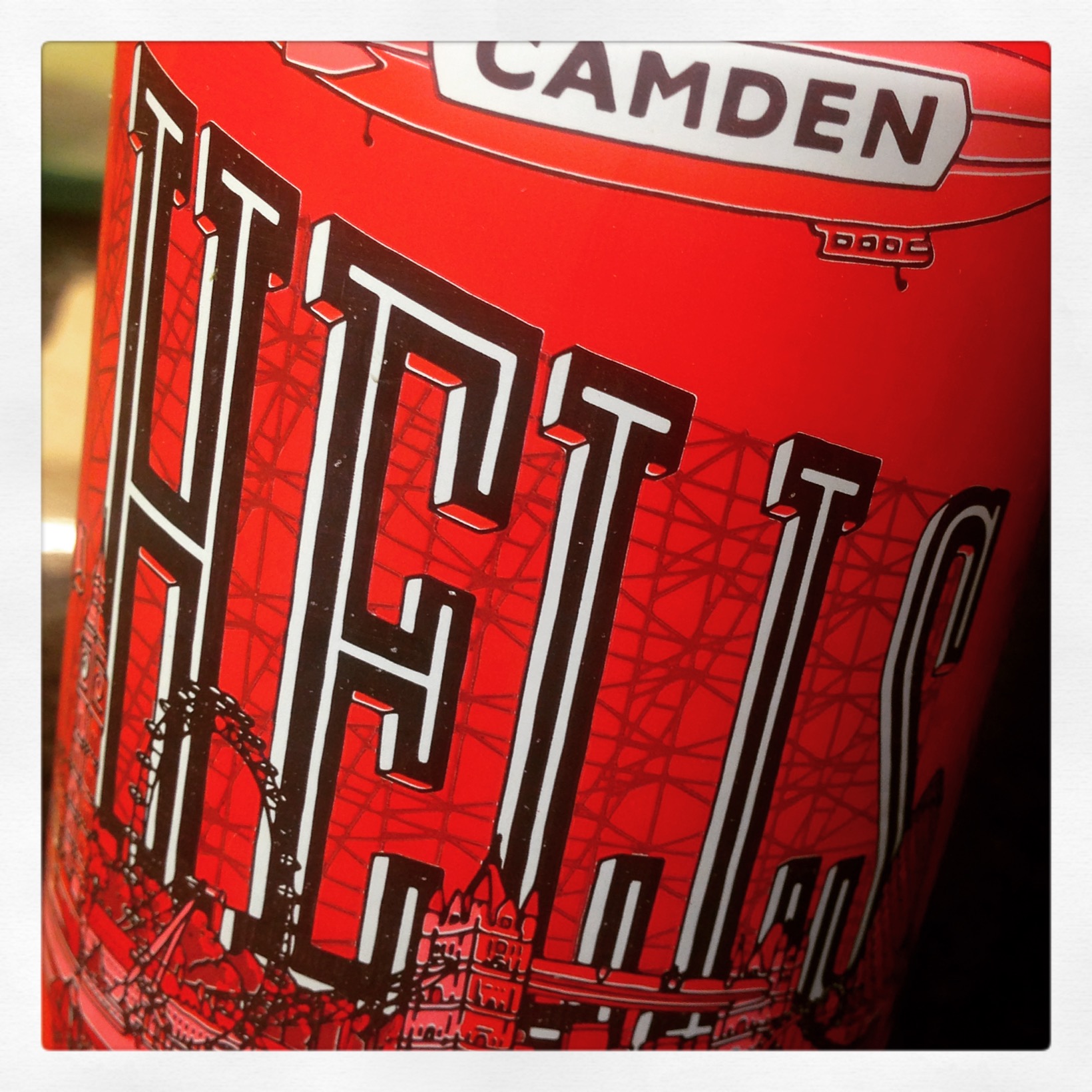
Camden Hells: great design, right size. It all feels, well, right.
Camden Hells: great design, right size. It all feels, well…. just right.

The first is size. The craft brewers have embraced small cans – better, for the often more challenging styles of beer they’re brewing, but also, just a more enjoyable portion. 330mls are hand sized and the volume fits in a wider range of glassware; they’re less likely to warm up as you drink too (it’s gone). Truly, it’s always baffled me why UK beer consumers simply wouldn’t accept a can size in beer that is totally acceptable to them in soft drinks and totally accepted when they travel abroad. Different beer in a different pack – that seems to have done it.

The second is finish. The craft brewers are embracing the material and its potential in a way that few of the more established players have done or are attempting now. More often than not, a brand’s design is simply ‘applied’ to the can and disharmony is the result (I know, been responsible for a couple myself). Where the design joins – tricky; the way the logo works with the curved face – a challenge. Brand owners and design agencies have broadly given up, resulting in something…  just not right. But some of the craft brewers have said: how can we use the shape of the can to enhance our brand? To take it on and improve it? Beavertown is the notable example here: their cans are art, quite literally. There are no issues with worrying about facing them forward, as they can be faced anyhow and make a panoramic comic book shot working along the shelf. Magic.

And there’s feel too: varnishes and textured finished have been around for a few years, but it’s taken the craft brewers to use them to their potential. Why? Because they’re not scrimping for savings, worried about the added ‘on cost’. The value built into their inherent proposition allows them to buy slightly more expensive cans and reap the reward. Look out for stippled matt finishes and spot varnish. Little touches yes, but in the hand, they transform how the can feels and even – gasp – make you think about drinking from it.

IMG_2959
Can design mastery from Beavertown. Wonderful stuff.

But one issue is overlooked. Unlike bottling, canning your beer is a more serious financial proposition. Can lines aren’t cheap – and they’re certainly more expensive than bottling lines. They’re also a bugger to run – the tolerances compared with bottling are much tighter – think Formula 1 car vs rally car. Both high performance, but one takes it to another level.

And then there’s the cans. This isn’t like buying a run of labels for bottles: there’s no writing them off by popping the old labels down to the local recycling tip. Buying a run of cans is a major undertaking and if you buy them, by god, you use them.   And finally, there’s a structural question. Whilst bottling lines are – broadly speaking – ten a penny, canning lines are something else. There are fewer of them; they’re largely fully employed and also, and this is a big issue if you brew 10 barrels a week, massive. There are whole canning lines dedicated to Coke. Not Coca-Cola’s range of products, just Coke. 24 hours a day. All year. Picture it: “’Scuse me mate, can we fit in a run of 8 Ball Rye next Tuesday?” “Er…. no”. So what’s happened? Well, the incredible thing is that some of the brewers have taken on the challenge and have bought canning lines. That takes big balls. Big balls of lead. But there’s beautiful commercial creativity too: there are operators now running mobile canning lines. They come to you. Fill. Clean down. Offski. That is brilliant.

And the even better news is that it’s just begun. Tinted was responsible for bringing thermochromic – temperature sensitive – ink onto cans 10 or so years ago. But 5 years from now, that is going to look – aptly you may feel – like very small beer.

© Beer Tinted Spectacles, 2015

Prizes Schmizes

It seems a rare thing nowadays for a beer not to have won a significant award and be shouting it loud and proud. ‘Winner! Taste of Eastmorland 2001’; ‘Winner! Borchestershire County Show, 1998’ or, actually, much more likely to be global in nature. The clues will be there: little golden gongs on the label, with indecipherable text and maybe a touch of spot varnish or embossing as a token of our pride. ‘Winner of the World Beer Cup, 2007’, or some such ceremony in Chicago dating back to, what, 1899? Forgive me if I come over as a touch cynical but these awards have always seemed like a Crufts ‘Best in Show’ award. Oh, I know they take a lot of effort to achieve, much pulling of hair and many a sleepless night; the equivalent of beery detangling and grooming no doubt, but, at the end of the day, they only really matter to other dog breeders. I own a Bitza* and she’s best in show for me, no matter what the bigwigs at The Kennel Club may say.

The truth is, the sparks that trigger a particular brand of beer to success and acclaim are more than the product alone. Not that having a distinctive product doesn’t help. Far from it in fact: many a GBBF winner has encountered production capacity challenges immediately as a result of winning an CAMRA award. But the slew of beer awards to date have only celebrated the beers – the liquids – not the significant other factors in the weave and weft in any brand’s DNA. Until now.

Screen Shot 2015-01-23 at 16.22.05The Beer Marketing Awards, announced at the end of last year, will celebrate the marketing activity that has changed behaviour and attitudes of drinkers. Because even if you have a jaw-droppingly good beer, without others hearing about it, you might as well whistle in the wind. I remember Michael Jackson, dropping his head slightly and peering at me professorially over his glasses, and telling me (as a marketeer myself – and therefore a sub-species) that he didn’t like the idea of ‘brands’. For him, even using the term ceded too much influence to the marketeer over the brewer. Yet, ironically, what was Michael Jackson himself if not a great brand in the beer world: ‘The Beer Hunter’ tells you everything. Brands are critical, vital. In fact, brands are business. And marketing is their voice.

The Beer Marketing Awards are a step to rebalance the world of beer recognition and to celebrate more than the brewer alone in creating success. Have a look at the website of the competition to see the categories (www.beermarketingawards.co.uk): but be assured of this: this is not just a competition for big companies with big budgets. ‘Big budgets do not great marketing make’ as a former boss of mine used to say (a salesman in fact). Yes, the awards will celebrate traditional advertising, but the truth is in a tightening legislative world, it’s getting harder to make an impactful advert nowadays, and expensive too. So the awards also recognise social media, design, public relations, competitions, sponsorship…even a brewery’s merchandise. Every commercial brewer in other words does marketing; and every commercial brewery is eligible for the competition.

So take a look at the website and post your entry (deadline looming so don’t delay). Who knows, you may be able to feature it on your packaging in what…a hundred years from now?

* You know, ‘bitza’ this and ‘bitza’ that.

Disclaimer: David Preston, a.k.a. Beer Tinted Spectacles, is a judge of the 2014 UK Beer Marketing Awards, and this blog does represent his heartfelt views.

© Beer Tinted Spectacles, 2015

Spirited

With craft brewers driving the beer agenda, it’s taken the big boys some time to get off the cost cutting and efficiency path and start to really innovate again. It’s interesting to watch: whilst craft beers generally focus on taste, flavour, quality, savouring; the big brewers target what they perceive as products that are more sessionable – and therefore for them, more scalable.  Fruit is one focus; lower alcohol level another (making use in the UK at least, of that 2.8% duty break) and the third is spirits.

CubanistoThere’s quite a range of beer / spirit fusions now: bourbon flavoured beers (Buddy’s, Dead Crow); rum flavoured beer (Cuvano and Cubanisto, the latter recently launched by ABInbev) and of course, Desperado’s, a tequila flavoured beer.  Let me be frank. The majority of these products do nothing for enhancing the reputation of beer, an ancient, agrarian and natural product that is respectful of the grower, the brewer, history and the drinker. These are factory mixed concoctions thrown together in a back street industrial unit, made from any old beer the owner can fix up; not actually containing the spirit in question (Why? duty dear boy, duty), then weasel-worded to sound authentic and enticing to a half cut Friday night drinker who can no longer take pint volume. These are products about profit not responsibility, and with that in mind let me also be clear: many of them will be runaway commercial successes.  Mankind likes to be have an easy drinking skinful on the cheap, ‘twas ever thus and it will continue to be. Take Desperados: a sickeningly sweet and cloying Tequila parody that is nonetheless a rip-roaring seller. That’s business, I suppose.

Naming the spirit on the label is an eye-trick. Perfectly legal (when accompanied by the word ‘flavoured’) it is a shortcut; a shortcut to creating a quick mental impression of the flavour expectation and oh! yes; tricking the drinker into thinking it contains the spirit in question.  The strange thing in all of this is that it seems perfectly legitimate and possible to investigate using the flavours of spirits to inspire great beers. But why not go at the opportunity with some integrity?  Bourbon after all does have rounded honeyish flavours and rich, steeped red fruit notes: barrel aging can give you all of these. Heck, adding some honey or some red fruits could give you that.

IMG_1232And a few brands are now proving this: Innes & Gunn have been barrel aging successfully for a number of years to get these new spirit inspired flavours. More recently I had a bottle of Head In A Hat ‘Gin’ – a 4.1% golden ale which uses gin botanicals from a small South London brewery called Florence (friend of Dillon and Zebedee?).  According to the brewery, the botanicals come directly from the still of the City of London Distillery – and certainly those gin botanicals come through. The beer has a subtle flavour, with a clear edge of juniper and definite warmth, with a coating, peppery mouthfeel and aftertaste.  And this is most definitely a beer, not a pastiche, with a large, loose head and a hazy butterscotch colour; drinking in fact bigger than its alcoholic strength.

In truth, it was a relief to find it.  I remain unconvinced – and a bit troubled to be honest – about these beer / spirit hybrids yet Head In A Hat shows that there is another dimension of subtle flavours from an adjacent world that beer can wrap its arms around.  Saying that, there’s also a whole world of hop, malt and yeast flavours to be discovered too – and frankly, I’ll go there first.

© Beer Tinted Spectacles, 2014

The Session #83: Against The Grain

The Session, a.k.a. Beer Blogging Friday, is an opportunity once a month for beer bloggers from around the world to get together and write from their own unique perspective on a single topic. Each month, a different beer blogger hosts The Session, chooses a topic and creates a round-up listing of all the participants, along with a short pithy critique of each entry (see link, posted to comments in due course). This month’s Session is by Rebecca Patrick at The Bake and Brew (http://thebakeandbrew.com) on the topic of how much our taste or opinion of a craft beer is affected by what friends and the craft beer community at large thinks.  Do we (a) go with the flow or (b) go against the grain?

The Session ImageThose familiar with Sir Terry Pratchett’s ‘Discworld’ books, will no doubt be aware of Ankh-Morpork, the twin city sitting either site of the gently bubbling, foaming and glooping River Ankh which is centre of the Turtle-shouldered universe he has created.  Ankh-Morpork is the city where it’s at:  multi-cultural, industrious, artistic, political, inventive, hosts of the greatest seats of learning and commerce – a melting pot of global influence.  The parallels with a city like London are deliberate.    Both cities are a good place to start in thinking about the trickle-down effect – one theory for how influence is created and spread.

The basic premise of trickle-down is either economic – a wealthy or ‘elite’ group in society adopt a product, service or behaviour which they abandon as ‘the masses’ adopt it – or social – for example the way cycling behaviour is spreading in London, and accelerated by the policies of Boris Johnson which initially at least, flew in the face of the supporting evidence.   But if you build it they will come, and what with Boris Bikes, cycling superhighways, Cycle To Work schemes and inventive manufacturers like Brompton, ultimately cycling triumphs.  And there can be reverse trickle down (trickle up, I suppose) too – in Ankh-Morpork, the adoption by the leisured classes of the sport of Foot-The-Ball is a case in point.

There are many ways we can influence and be influenced, some of which we may even admit to, but it seems that with craft beer, and with beer blogging, understanding trickle down is key because there are so many potential influencers – new start up brewers; official beer writers; unofficial beer bloggers; trade publications; CAMRA, the list goes on. That’s not to say it’s a theory that necessarily holds water – I once ran a project for a brewery investigating how influence spreads out from London into the provinces only to find out that there were as many examples of new trends springing up in smaller urban centres – the difference being that they didn’t tend to gain the same level of scale, and certainly not as rapidly.   But surely amongst beer writers we must be influenced by one another, by the different perspectives we bring – and surely over time this must impact drinkers?

Well, there’s certainly been a decade long creeping barrage of influence now: and in the UK cask beer remains the only segment of beer not experiencing scary decline – a trend repeated in its own way in many other countries.  Here, no self respecting pub fails to offer a decent range of regular and guest cask ales – indeed, in my local there’s even a small selection of U.S. bottled craft beers – and most critically, in some respects the most important influencers in this – the trade buyers are getting the message.  Sure, the likes of the big supermarkets have been stocking a decent range of interesting beers for a few years now, but B&M Bargains, really?  Oh yes.  And when we see the circle coming round again and more and more specialist beer and cider retailers opening and being successful, then we know the worm is truly turning.

Personally though, I like to think I have my own agenda, viz:  One: for every one craft beer I drink which is stunning there are 2 or 3 which don’t pass muster – this can’t be ignored.  Two: proper lagered beer will soon have its day again, rightly so.  Three: yes, the big brewers can brew decent tasting (craft) beers, but enjoy them quickly before the accountants insist on replacing the malt with liquefied pulped insect adjunct. Four: I absolutely believe that you have to (re) acclimatise yourself to hoppy bitterness after years of seeing brands being turned into blands.    Where did my agenda start?  Honestly, I’m not 100% sure.  Some from experience.  Some from emerging beliefs, anger or enjoyable experiences.  And yes, no doubt some from the opinions or recommendations from beer writers and experts.  At the end of the day though, the only thing that really counts for me is the overall experience of the beer itself:  is it beautiful? Does it pour delightfully with a head you want to drink in and drink through? Does the taste make you pine for more?  No, the real influencer for me is not trickle down, trickle up or hit-me-square-between-the-eyes-with-a-brick. It’s the vision, and the ability to execute the vision, of the brewers themselves in the finished beer.   And the true reality is that most beer drunk today – here or in other markets – remains characterless, passionless, cheap-brewed, artificially carbonated factory beer.  Whatever the influences on us, however much influence we think we have had as a community, the hard truth is, we are still at the beginning.  It’s a brutal fact to help keep us focused.

© Beer Tinted Spectacles, 2014