
For every trend, there’s a counter trend. For every artisan baker firing the ovens at 3am to conjure up beautiful rough cobbles of sourdough, there’s a new ‘Chorleywood’ enzyme innovation; textureless white sponge with seeds, or bits of fibre you can’t see, or just a new whiter-than white White. For every back street coffee bean roaster, filling the air with their smokey perfume, there’s a new micro-grind instant from some multinational hiding their true colours.
And so it is in beer. At one end, the focus is on old styles dusted down, or new styles drawing inspirations from as far back as Mesopotamia; from fermentation with wild yeast, or bacteria grown on mouldy fruit, or kettle souring or barrel-ageing. Of Quintuple IPAs or session beers hopped to the Copper top to make up for lack of alcoholic body: and this is good; no, this is awesome – it’s the producer-powered, purpose-fuelled revolution against the brewing as Economics not as Art. It’s the rivulet of reactionaries that’s become a flood – a flood that even the Big Brewers can’t resist; entering through mimicry, partnering or acquisition. Yet, oddly, perhaps they’re looking in the wrong place. Perhaps, in the quest for solving the problem of the decline in mainstream, mass-produced lager they’re looking to craft, and artisan, and hand-produced and small-scale and then looking to scale these up. And undoubtedly, much of this will be successful, despite the claims that a backlash will defeat it.
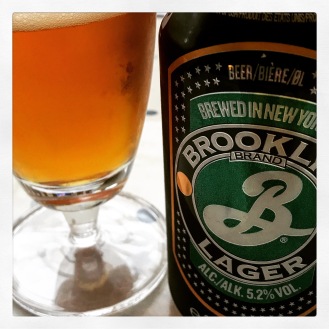 But there’s something going on in their core. Drinkers are turning back to lagered beer. And yes, they’re undoubtedly turning to the real deals: like Budvar, brewed with Moravian Malt and Saaz hops and matured for 102 days; or like Brooklyn Lager, brewed to a recipe from before Prohibition, with it’s deep conker-red colour, and off-white head and thick, coating body or they’re discovering little gems like Windsor & Eton’s Republika, which may not be true to a particular style, but is as damn fine a lager beer as you’ll find.
It’s more though. It’s drinkers not rejecting the likes of Camden Hells or Meantime’s London Lager, just because they’ve been acquired by someone bigger – but continuing to be pulled towards them. And it’s also the rise of a new wave of Big Beer brands: Nastro Azzurro, Estrella Damm, Amstel. Sniff all you like, but these brands are growing – maybe not drunk by you, or me, but growing… because people want to drink them.
We’ve got to look beyond the sensibilities of ownership, the emotions of scale, to see what’s going on. There’s a return to lager amongst drinkers, and it’s accelerating. It’s a return that will soon spur the current losers in this battle – the likes of Carling, Carlsberg and Foster’s to react in the only way they can, by properly listening to what drinkers want and innovating. This is a good thing too. It’s signalling a return to a beer style that stands the test of time. The span of flavour profiles within lager may not be as broad as top-fermenting or wild-fermented beers (well, certainly if you exclude smoked lagers anyway), but it’s robust. There’s something for everyone: tastier beers like Pilsner Urquell at one end, to simply sessional everyday quaffers at the other. There are lagered specialities like dunkel beers in the mix, as well as *faints* light beers. This is a beer style that didn’t conquer the world through force of arms, but through drinker preference. In the UK it may have started as a beer for women but it didn’t take longer to become the beer for louts. That’s some shift. And it’s a shift that’s behind us now: lager is legitimised; lager’s time is coming again.
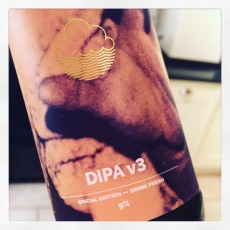 It’s this ‘when it’s gone it’s gone’ word of mouth that seems to be fuelling Cloudwater’s burgeoning reputation. Their Double IPA v3 (DIPA v3) has a menacing, grasping hand jumping out as a greeting: it sports bittering hop in abundance and then four aroma hops Citra, Chinook, Comet and Mosaic, a blend of east coast, west coast and the Pacific all raining down in Manchester. With the addition of brewing sugar, this beer is a whopper and it seems to cover every dimension of IPAdom: piney and tangy, like you’re shoes scuffing up pine needles in a forest; grassy and dry, with the aromas of newly mown lawns in Spring and that spiciness, both I think, from the prodigious hopping and the yeast strain. I drank it whilst reading the paper (at 9% ABV, I should say whilst I could read the paper – it got a little blurry after a while, but that could be age) and the ever-so off white head lasted and lasted as only the real cream of Manchester could.
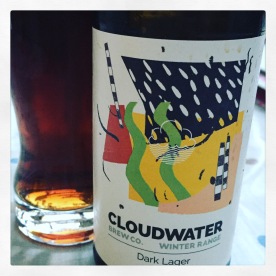 I was actually more impressed though with their Dark Lager from their winter range. A more modest 5.5% ABV, but actually a ‘dark’ ‘lager’, i.e. it was dark from the more roasted proportion of the malt, but it’s many stratifications of flavours, its layers attested to good lagering. This wasn’t a mild ale that’s been laid-low for a week more and masquerades as ‘lager’. This had that rounded smoothness, that matured and assured depth of character where no single element overwhelms – and – and this is important, it is drinkable, sessionable, call it what you will. A lager in name, with the character of a refined ale. And there is something of the Lowry about these beers; seemingly simple – from the labels, to the styles – but underneath it is beguilingly complex and fulfilling. A fitting revitalisation to a part of Manchester that has been under a raincloud for many years.
 Beer Tinted Spectacles