Lost Blogs #1: Under Brownwood

Beer Tinted Spectacles was originally posted to Posterous, which closed suddenly and made life irritating for a while. Some of the blogs were lost, recently found and are republished here.

For whatever reason, I’ve never really got on with Newcastle Brown Ale but I wanted to. There was a bit of a boom for the brand again in the mid ‘90s, fuelled by a failed attempt by an Australian brewer to buy the brand. For a while front labels were inverted (I hadn’t noticed until someone pointed it out) and there was a general fuss made across the north east. So I gave it a crack again back then, but no, it just didn’t flick any switches for me… at least not on taste anyway. I’ve always liked the bottle; I’ve always liked the schooner glass and I’ve always bought into those hard working Geordie values. Taste though – didn’t get it and still don’t.

Yet, like with mild, there’s a bit of a general brown resurgence going on. This was triggered this last weekend gone by a pint of ‘Milkwood’ in a local Vintage Inn. Brewed by Brain’s in commemoration of Dylan Thomas, it’s a 4.3% brown ale. And it is brown, which is a start. Don’t mock – one of my issues with Newkie Brown is that’s it’s not – it’s more of a deep, chestnut red. No it is –buy one and have a look. It’s not unattractive, just not that brown. So anyway, Milkwood – a brown ale. And putting to one side the less than scrupulously clean glassware, it was a decent enough pint. A tightly loose head with a thick creaminess that somehow managed to support some big bubbles, mid brown colour and a clean, malty taste with just a touch of granary crust nuttiness. Nice lacing too which I like to see.  And selling well up against Pedigree and Everard’s Tiger.

The interest in the style is good to see, for it could have gone the way of the Dodo. Original styles, dating back 300 years or so were likely brewed with brown malt that a higher level of roast from direct fired malting. Pale malt revolutionised beer both in the UK and on the continent – but with every revolution there is a loser, and brown ale was one. Whilst brewers continued to be brewed, now they were sourced from pale malt, or crystals malts that add a more coating sweetness or brewing sugars were added. Strengths fell over time too, a trend exacerbated by two wars, until eventually only really Mann’s Brown Ale existed a connection with the original brews from the past (Newcastle Brown Ale was a twentieth century invention, ironically by a brewer from Burton).

I wonder though how much of the recent resurgence in the style comes down to what’s going on across the pond. Newcastle Brown itself has become the 15 year overnight success story – selling about 450,000 barrels of beer to the USA each year. It’s now the number one British brand. The once positively ubiquitous Bass has been soundly mismanaged by Anheuser and Newkie Brown has doffed its grateful hat and Dyson’ed up their business. The American craft brewers too have copied and reinvented the style. As you would imagine, many US versions have a more distinct hop character, but are none the worse for it. Sierra Nevada do a very drinkable Autumn Brown Ale, and the wonderfully named Dogfish Head also do an ‘Indian Brown Ale’ which I snuck into my repertoire whilst out in Denver on beer business one night. Something similar happened in Hawaii* too – where I had a brown ale from the Kona Brewing Company (which I only bought at the time because I was thinking of buying a Kona Mountain Bike and wondered if the two were linked. They weren’t – and remember folks, don’t drink and ride.) This one in particular was a smoothly drinkable version, reasonably hopped. It reminded me of the Geordie nick name for Newcastle Brown, ‘Dog’ so called because it bites your legs apparently. Well the Kona Indian Brown Ale certainly did, as it was secretly hiding it’s mid 5s alcohol.

I’m pleased the style is doing the revival, particular in the UK. Whilst I like the hoppier versions from the US, I find that there are enough IPAs and double IPAs doing the hop full frontal. A beer style that swings the other way, with a lingering sweet character is needed in the lexicon of beers.

© David Preston, Beer Tinted Spectacles 2012
The Beer Guy

Within beer circles there are now public personalities in ways unimaginable a generation ago. Many brewers are celebrities, some like Sam Calagione become media figures. There are revered saviours, like Fritz Maytag or Michael Jackson. Sages too, like Ken Grossman. Or outspoken campaigners, like Roger Protz. Yet, my friend Dan Rosenbluth, who died recently after a short illness, was largely unknown in the broader beer world, despite being universally popular and loved amongst his considerable circle of peers and friends. Dan had an impact as significant as that of these names and many more – but, typical of him, it was perfectly understated. He was, to use his phrase (although he never applied it to himself), a beer guy through and through. More than this, he remained a beer guy in the increasingly un-beery world of multinational, corporate brewers. Some feat.

Dan was born in California, although he was raised in Florida and that’s where his heart was; a man of the South yet, set against the ill-informed stereotype of the ‘Confederate Redneck’, Dan was broad-minded, liberal and outward looking. These values, underpinned by his unblinking fairness and generosity made him a mentor to many and a role model to more.

In the world of multi-national brewers, the competitive focus isn’t just on their peers. It’s on consumer goods businesses: marketing-led companies, FMCG companies. Companies where the consumers is King and bottom line profit is the whispering Councillor behind the throne. The product happens to beer, but the focus, the driver, the end game is money. Just money. Oh, they’ll deny it. But it’s the truth: because the behaviour of these businesses reveals it. The brewer is no longer the hero. The accountant rules the roost. The beer itself may be carefully brewed, but uniform consistency is the only mantra; the reverence has gone. The rules of accounting say high gravity brewing; two day lagering (if any); ‘precision’ brewing, adjunct mashes, pasteurisation. Such tools are the name of the Accountant-brewer’s game, because without them, in such a cut-throat environment they believe, you won’t survive. And the Queen of these companies is the marketeer. I was a Marketing Queen and I’m proud of it. But I’m proud of it because I loved beer and for me, the science of marketing was there to support the art, the passion, the reverence of and for brewing.

Dan was the same, yet more so. He worked at Coors in Golden, Colorado, at a time when Anheuser Busch, still independent, were dictating the agenda of the market. If your beer wasn’t light, it wasn’t right. If your beer didn’t have IBUs below 10, you were doomed. Coors, particularly before the days of the joint venture with SAB (Miller Coors), did have a brewing heart. Pete Coors was a brewing meddler (in a good way) and even had – has still, in fact – a small-scale brewery where he would ‘try things’ (Barman Pilsner probably being the most successful). And much against modern multinational practise, he would also support initiatives from people like Keith Villa to try experiments, to have a go. One such experiment was a beer that ultimately became called Blue Moon.

Dan came into the marketing team at a time when craft was growing but not ripping up trees. Blue Moon had tickled along for a decade, largely going nowhere. He was asked to review its performance with a view to ‘rationalising’ it. The pressure on him was severe because, when he looked at the numbers, he could clearly see why he was being asked. The volumes were small. The beer was complex to brew. The profit delivery was modest. In Coors terms, it got lost in the rounding.

Yet Dan was a beer guy. He could feel the opportunity. He could see it was ahead of its time. He implicitly understood who might drink Blue Moon, why and when. The way he told the story involved some benevolent fudging of numbers and some heartfelt groveling. But he won the day. They tightened what the beer was about (‘artfully crafted’) and stuck with the programme (such as existed): the right serve; the right glass. Simple stuff, executed well. Today, Blue Moon Belgian White is the single largest craft brand in the U.S.

And there’s the rub isn’t it? How can a ‘craft’ brand be from a multinational giant like Molson Coors / Miller Coors? Without getting in to the argument which is a well-trod and frankly rather dull tale now, the point is, Blue Moon is a watershed brand in U.S. brewing. It is the brand that changed the paradigm both of the big brewers – they quickly came to see that flavourful beers could be business drivers for them – and smaller brewers too – because they got the benefit of a major player opening up ‘craft’ with retailers in a way that alone, would be more difficult to do.

The argument around brands like Blue Moon being / not being craft is perfectly legitimate. In due course, when the pain of Dan’s passing has subsided somewhat, I may even join in. But more than anything else, every time I see that distinctive blue label, that luminescent, cream coloured moon, I shall think of my good friend and the role he played in helping to change the attitudes of the big US brewers towards craft beer and ultimately, the benefits that had for all.

In Memoriam. William Daniel Rosenbluth. August 1969 – July 2015. A Beer Guy.

© David Preston, Beer Tinted Spectacles, 2015

The Fifth Element

It is best described as a dream? Perhaps it is, perhaps it’s just an idyll. But anyway, in this dream, I am the owner of a small, rural brewery. If it helps to picture it, it’s down a long country lane, one of those beautiful shire lanes in England with grass growing down the spine and the tarmac flaking and giving way at the sides. The vistas are long, across the water meadow (yes, they do still exist) and towards distant dark hills. There are some passing places on the road, but they’re informal: one in a field entrance where the gate hangs off its hinges; another where the gravel path to the ford scrunches down to the river, lazily. The building housing the brewery is round a sharp left hand bend. They’re farm outhouses, with ruddy-cheeked bricks, sharply mortared, with blue brick edges, smoothly curved. Roofs are clad in steep pitched Staffordshire grey tiles, bedecked in moss and chipped like a boxer’s teeth. The water for the beer bubbles up from a spring just where the hill line breaks and a copse of old mixed trees starts, some beech, some oak, hedge elm and the stickleback flashes of silver birches too.

Why a farmhouse brewery? Why artisan? I have no particular farming connection and I live in the country so there’s no pent up rural frustration, no unmet need to be ‘closer to nature’. But there is the connection of beer to its origins: being closer to the earth, the water, the fields where the crops are grown. Somehow, when the brewery is under a railway arch, or a steel clad industrial unit the connection is weakened, or worse, when it’s some industrial edifice on the outskirts of say, Manchester, that connection is lost. Here, it’s industry. Here, it’s 7 day a week brewing. Here, it’s ‘sales and operational planning’. Even the ingredients are tamed; modified malt; hops pounded and pelleted so there’s no goodness left; adjuncts for consistency and efficiency.

But the idyll is not some fantasy, not, well… idyllistic. It’s happening. As my writings have taken me further afield so my desire to reopen old, closed doors has intensified; and my willingness to experiment with wildness; with inconsistency; with tastes that make you squint has strengthened in turn.

A few years ago, I travelled through Payottenland, visited Boon, on my way in fact to Rodenbach. That was the extent of my primary research into spontaneously fermented, or oak-aged beers. I am the beginning of my new journey, of personal pioneering. Early discoveries this time round have startled me. That of Elgood’s of Wisbech, as old fashioned as they come, who have re-commissioned an old coolship so they can spontaneously ferment, installing wooden beams above it to capture microbes and build a circle of wild fermentation. This is surprising. That beers with a sour, wild, uncontained character are becoming the ‘in thing’ with urbanites is startling. And the closest thing I have found so far to my idyll, are the beers from Wild Beer Co in Somerset. They are on a farm, down a country lane. It may not be the centre of human population, but it’s Wild Yeast Central. Ironically though, I found their beers in Sourced Market at St Pancras, on a railway concourse at the heart of our most congested metropolis. Wild Beer Co talk about adding an extra element: the first water; the second, hops, the third, grains, the fourth, yeast. The fifth is wildness.

IMG_3936By this point, I was already lumping around a full satchel, so only bought a couple of their brews, but what brews they turned out to be. The first was a one of their everyday drinkers, their ‘everyday sours’, to use their language. Wild Goose Chase is a ‘farmhouse pale’, brewed with their wild yeast culture and gooseberries. Gooseberries: an utterly underrated fruit anyway and yet perfect for beer; the tartness complementing the malty sweetness, the aroma incisive, cutting. It promised much and delivered – a gently ‘sour acid’ aroma (if you can have such a thing… prickly somehow); to look at, a milky gold, lively with a gentle, natural carbonation. I expected no head and it poured with none, but was not the worse for it: it was delicious, fruit, tartly quenching beer. The other was a Saison – the boldly entitled Epic Saison. Unusual for a beer that is fermented partly with bacteria, this was generously hopped (the traditional role of hops was to impede bacteria – more a problem when you are designing the bacteria in) with a dry slice of melony, passionfruity U.S. grown Sorachi Ace hops but still with that loamy European earthiness more associated with a tart beer. It would be tempting and stereotypical to describe such a beer as a ‘fusion’ – in fact, it seems quite naturally ‘of here’, like a fruit pie baked on a tin plate, plump, sharp and sweet but with that doughy, buttery taste of the fields, of dairy, of the land. My note taken at the time simply said, “Well brewed, drinkable and edgy. An irresistible combination.”

These beers fuelled my desire to learn more, to taste more. To find the beers of New Belgium, Allagash or the Jolly Pumpkin; to try a ‘kettle soured’ beer, like those from The Commons. This sounds like a journey down a long, interesting country path, one with some grass growing down the middle, a farmhouse outbuilding holding a rustic brewery and wild yeasts floating through the breeze.

© David Preston, Beer Tinted Spectacles, 2015

Cigars, Keys and Panhandles

If I had to draw a brewery hot spot map of the U.S., it would glow red around Chicago; it would burn with fiery hues in a stretch from San Diego up through California, and the top left, Portland, up into Washington State would light up the rainy night sky with its incandescence. And of course, for fear of upsetting anyone Stateside, it would be peppered with spots of orange and red just like the holes surrounding my dartboard; peppered from Alaska, Hawaii and right across to the Atlantic seaboard. Except for Florida.

What Florida is known for is a state that grows citrus fruit (somewhat erroneously, it’s predominantly a cattle grazing State nowadays), welcomes Canadians for their Winter hibernation, has a world class theme park in a swamp, a rocket base and has an incredible coastline with an enceinte of beautiful Keys, home to Manatee, ‘gaters, everglades and the Lesser Spotted Key Lime Pie. But beer? No, non, ni.

Why? Why did I believe this? And why have I changed my view? Well, just a few short years ago, I combined a business trip with a holiday to the state. The craft beer range in the supermarkets were slight; internet search engines for ‘Craft beer Florida’ or ‘Florida microbrewers’ broadly drew a blank. It seemed that The Sunshine State was still in love with sunshine lagers designed for hydration and slaking thirsts, not offering character or uniqueness. On my particular travels, I found one brewpub, located in a characterful building, but on checking it a few years later, found it was closed.

Hit the fast forward button and zip through the last five years. Select Genesis’ ‘Supper’s Ready’ from Spotify* and scroll through to 12’ 27”, blow your whistle and shout, “All change!”

The first difference: the snack and drinks trucks around the Disney Parks. Yes, they’re still selling plastic beakers of Bud Light. But they’re also selling Sam Adams Summer Ale. Think what you like about Jim Koch, but that feels like a mighty beachhead to me. And then there’s the selection of craft beers in C stores and supermarkets, which I wrote about in a recent post – you can’t miss it. Craft beer is reaching maturity too – or at least it’s now a dominant trend you can’t ignore rather than something that’s emerging. People are getting excited and on board. And more particularly, Floridians are getting excited and on board.

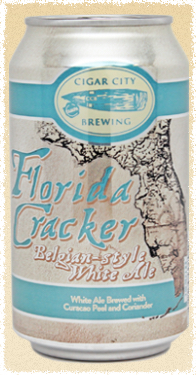
florida cracker_FotorAnd so it came to pass then that we ended up in a friend’s swimming pool, cooling down after a day kayaking drinking cans of Cigar City Brewing’s Florida Cracker. I liked this beer very much: it was a Belgian style ale, brewed in the American way; some unmalted wheat, curacao orange peel, coriander and according to their web page, a Saison yeast. It was a blissful combination after a hot day; characterful yet refreshing; reasonable pokey in alcohol (5.5%ABV) yet hopelessly drinkable. The brewery was in nearby Tampa and from the range that I saw, and the fact that the locals I spoke to knew of it, bodes well.

Just to the south of Tampa is circus country; Sarasota is where The Ringling Brothers circus had their base, provenance which lends its inspiration to Big Top Brewing Company and many of their brands. I got some Circus City IPA – a feisty, hop-forward beer. And again, in cans – this time packaged on a mobile canning line; the can being stickered (nicely done) rather than printed – an additional help to the would-be brewer. There are more: I liked the look of Fat Point in Fort Myers too but couldn’t make it down there; further south there’s a brewery on the beach in Naples. In fact, poking the wasps’ nest found me stumbling upon the site of the Florida Brewer’s Guild. Take a look. Little breweries popping up everywhere. Soon the map of Florida will be painted red.

*Other music providers are available. Oh, and it’s from ‘Foxtrot’, 1973.

© David Preston, http://www.beertintedspectacles.com, June 2015

Never meet your hero

There’s all sorts of cod advice on the internet about why you shouldn’t meet your heroes. A motif of this revolves around the fact that your hero isn’t in fact some 2 x 6-packed Hercules-cum-Adonis with the intellect of Stephen Hawking and simply oozing pheromone-rich, indescribably alluring charisma out of every unblemished pore. In fact, they are likely to be quite human. One eye slightly higher than the other, one ear slightly lower than the other, a troublesome, unspoken wart, hairy nostrils and perhaps a small holiday tattoo to unrequited love on the nape of the neck, just behind their ear.

Generally, I attempt to avoid hero-worship if I can help it and possessed of sufficient rationality, this doesn’t tend to be a problem. Where I do have some hero-magnetism is with underdogs: Damon Hill was one, but he also had a very stylish racing helmet, which counted double. Irreverence and authenticity helps too: my daughters and I met Bradley Wiggins in a queue at Manchester Airport once; he was perfectly down to earth and back then, not as famous as he is now (this being a few months before winning the Tour de France and Olympic Gold); but, although we have an ‘in’ joke when we see him on TV, we also recognise he’s just a family guy who is particularly good at his job and also particularly apt at speaking his mind. But heroes? Real heroes – I could count them on the fingers of one hand with a digit to spare.

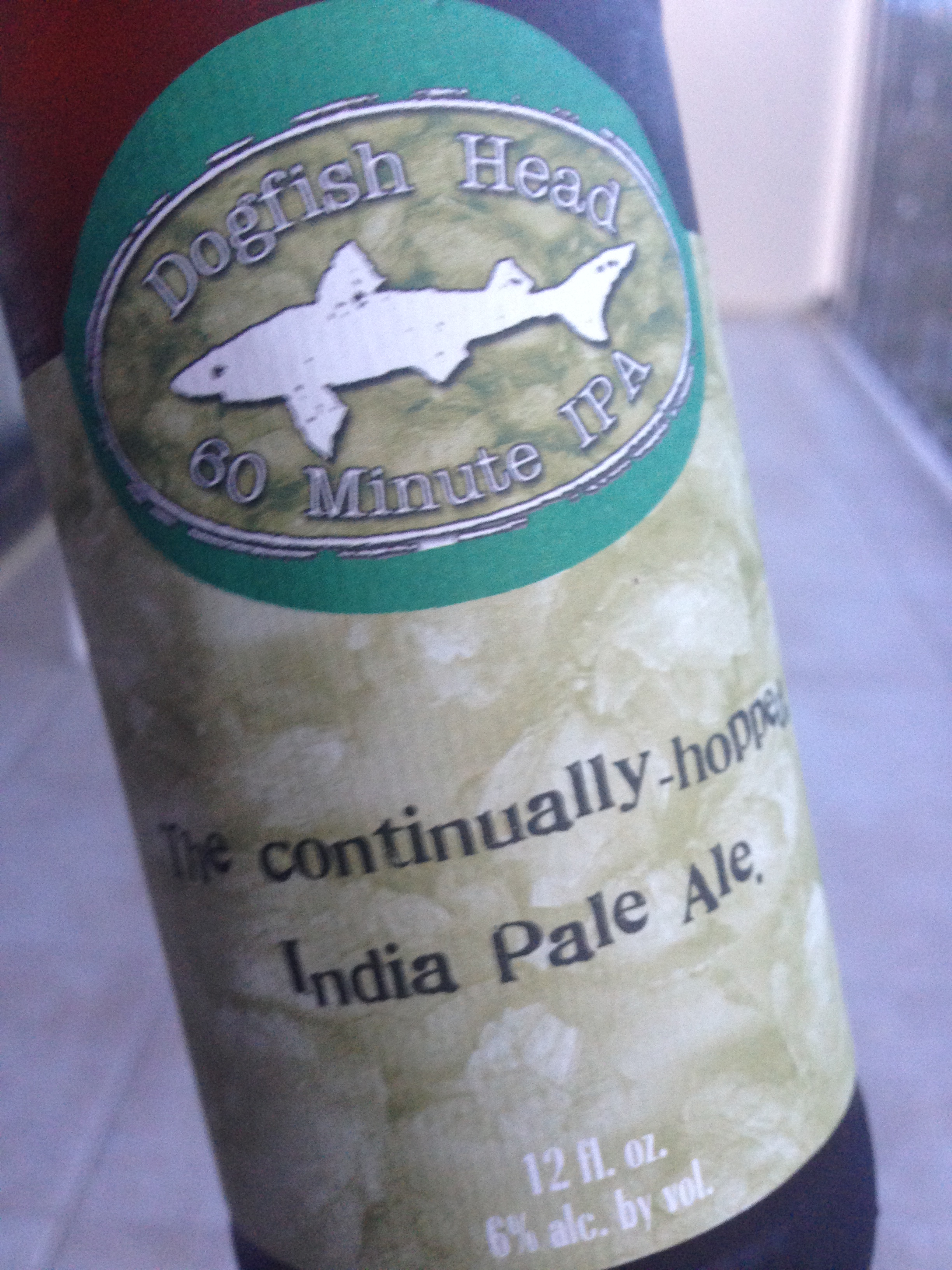
Plucky underdogs, irreverent and authentic. Well, there’s a better definition of craft beer than I’ve seen hithero. And musing on this, I realised that I do have more heroes than I admit to myself. They’re just not human; they’re of the malty and hoppy variety. Ultimately, there is a whole generation of brewers who, in my lifetime, have saved beer from a uniformly bland future. Many of them are U.S. stories, and as such, brands that are hard to find on our shores. I found two on my recent trip Stateside: beers which, to a craft beer enthusiast, and possibly those living near a good retailer (probably in London) will be familiar: Dogfish Head 60 Minute and 90 Minute IPA.

The story of the company’s genesis is written up in a part-autobiographical / part-business text by its founder, Sam Calgione, an affable and slightly languid New Englander. He’s also familiar to many more (albeit also on the subject of beer) through the company being featured on Brew Masters on Discovery Channel (2010). Sam, like many of company founders like to tell the tale of his distinctive ales as widely as he can and it’s worth tuning into some of his TEDx lectures, particularly on those that tell of the story of some of his beers and how they came about.  At the core of Dogfish Head beers is a central thought: ‘off-centric ales for off-centric people’.   There, in the credo of the brewery, is a manifesto that says: ‘we will play round the edges’. It says, ‘You don’t consider yourself mainstream; you’re an individual. So are we’. And that becomes the product brief: Dogfish Head beers must be different – different, not just from Big Beer, but different too from many other craft brewers. Hence: Midas Touch Golden Elixir, based on a recipe dating back before, well, before Last of The Summer Wine for sure (actually it purports to be inspired from a recipe from the 8th century BC and contains Yellow Muscat Grapes – Compo would be proud). Or Pangaea, which is brewed with an ingredient from each continent, including some Antarctic water. Or Noble Rot, a Saison, brewed with malt and grapes, the grapes being infected with botrytis for that Chateau d’Yquiem touch.

Now, if you’re a Big Beer player, you must compete in pale lager: Carling; Carlsberg, Heineken, Moretti, Jupiler, Asahi, Tsingtao, Bintang, Castlemaine, Molson, Corona, Quilmes. Similar build, similar personality, different clothes. If you’re a craft brewer, then you need to compete in IPA – well, pale and India Pale certainly. This was the challenge faced by Sam Calagione and the Dogfish Head team in the early 2000s. They’d crunched the numbers. They were pondering how to ensure the brewery remained full, and full with beers true to them. They needed an IPA. But how to do IPA the Dogfish way, the off-centred way?

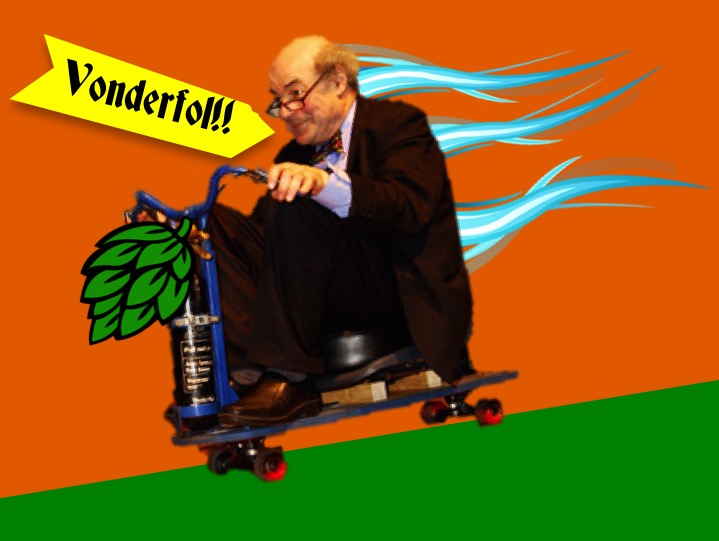
Heinz WolffThe answer ultimately, was to deploy an elaborate, Great Egg Race contraption to make small additions of hops every minute for the length of the boil: for 60 minutes, 90 minutes, 120 minutes; in my head I have my old chemistry classes in mind; vertical pipettes mounted above a steaming copper; Professor Heinz Wolff gently adding ze hops all ze time. Vonderfol! Don’t spoil it for me.

But anyway, there they were, two of them at least, on the shelf in Publix in uptown Sarasota. Six packs and singles of 60 and 90 Minute IPA. I’ll be honest, time actually did slow; I handled them cautiously, reverently, gently. I think I might have stroked one, and purred, ever so quietly. And then this strange thing happened: I got them back to the condo, chilled them down, but I couldn’t open them. I mean, what if, just supposing, it turns out to be, well, just a quite ordinary, no doubt tasty, but still, quite ordinary IPA. What if, all the hyperbole was just that? Mere hot air, evaporating away like the steam from a copper boil?

IMG_3553A few days went by and I drank down the stocks of my other beers: some damn fine ones as it turned out. The issue had to be confronted: I thought slow and took out the Dogfish Head bottles. I polished a particularly bulbous ‘70s wine glass, not ideal, but it would have to do. I prepared the seat and low table on the balcony overlooking the sea. I got my book. And I cracked open the crown. The 60 minuter first. As you’d expect from a beer so doped on humolone, the head was effusive, abundant. It was tight too and Honiton lace, you know, the sort that old doilies were made from, was left down the inside of the glass as I drank. The colour was mid gold; but how to describe the aroma? Volatile, fresh, profuse, intense: it raced out of the bottle-neck even before pouring. It was spicy and resinous and quite three dimensional – the dimensions of taste that is. The first taste was zippy and fresh; here now a grassy hoppiness. Across the mid palate was the spiciness and the lingering finish was bitter, quenching, not astringent but actually smooth and rounded. Maybe this is my palate, but I’ve found the same phenomena with other highly hopped beers (Stone Ruination for one): an expectation of being undrinkable (unfinishable is more accurate perhaps) but the opposite is true – providing there is a strong malt backbone, the beers are highly drinkable and surprisingly balanced. Yet for all that, at 60 IBU and 6%, it’s still a half brick in a hop pillow.

IMG_3580The 90 Minute IPA has a pleasing mathematical symmetry too: a 90 Minute hop addition, 9% ABV, 90 IBU. The longer boil also brings deeper colour: here a deep copper brown (quite Best Bitter to be honest), with a just off-white head that again was full and billowing. To drink, the carbonation was surprisingly gentle, natural and sustained. A superbly balanced strong beer that belies its strength, or perhaps, re-writes our perception of what strong beer should be. Whilst 9% Carlsberg Special Brew is cloying and shakes you aggressively by the throat, here there is a profound maltiness, and a pine resin follow through. My note at the time read: “Dangerously drinkable. I understand it’s reputation. Boof!” Clearly, the 9% was already kicking in.

Yet there was a slightly bitter edge as a Brit. Reflecting, I found myself thinking: where are our pale ales of this inventiveness, this majesty? Why isn’t a beer like this being pioneered in Burton, or London. Oh sure, there are some great beers coming through. But a hero? A beer that makes you go, ‘Boof!’? Not just yet. Not just yet.

© David Preston, http://www.beertintedspectacles.com, June 2015