
Brass balls and bar humbuggishness

What is it that makes up the right ambience, feel, vibe, in a bar or pub?  It’s one of those things I imagine to be quite intangible, but I wonder whether that’s really true…  I write this waiting for a meeting in Farringdon, so rather than buy an expensive and disappointing coffee in a chain, I’m sitting in the diner-cum-style bar*, ‘Smiths’ of Smithfield.

This bar is at least 10 years old, and it hasn’t changed substantially in that time.  I know this because a Dutch man with a deeply glottal, spittle-projecting name told me about it. Phonetically, Herrrrrt ten Karrrrrrte was aghast that I wasn’t aware of this bar, and that it was a stockist of the beer that we shared a mutual commercial interest in.  It turns out that Herrrrrrrt had discovered it on a long weekend break from his home in Holland; what had started with the intention of a romantic break of discovery, museums, long walks in royal parks with his partner, hadn’t got much past an alcoholic breakfast at Smiths, which turned into a lunch and eventually into high tea, all fuelled by the rich and distinctive taste of Grolsch.

It’s a formula that has been much aped now, but this bar is still a bit of a ‘Daddy’. Industrial chic is probably the term – the old metal pillars treated with Hammerite, holding up huge spans of pitch pine; metal ventilation ducts all New York loft style; exposed concrete, roughly set, and railway station touches like a rotary display board that in any other place would announce arrivals or departures…here it announces house blend breakfast smoothies. The ‘innards’ are ‘out’ards’ so to speak, like those de-skinned anatomy models doctors use. It’s not, in short, the place where a couple of decades ago you would have dreamed of serving food and beer from, and for that very reason, it was, and is, a triumph.

IMG_1898
‘Smiths’ of Smithfield. Raffishly Post modern neo-iconclastic industrial chicishness. A bit.

‘Triumph’ – yes, I admit it’s a subjective statement; but sitting in a full bar at 9am on a Thursday seems like a good barometer to me. People working in the leisure trade tend to bang on about two things (a) ‘woe are us’ our pubs are closing, and (b) the saviour is serving food.  Both fill me with ire. Mitchells & Butler’s do a total disservice to their (acquired) pub legacy by declaring themselves ‘agnostic’ about beer and now planting their flag very pointedly in ‘restaurant group’ terra firma.  This is missing the point, pretty widely.  Because what makes these places successful is the guest being able to decode what the bar is about.  Perversely enough, M&B do this pretty well with their ‘unbranded’ brand, Castle – essentially a series of draught focused bars, that stock a combination of more unusual and eclectic draught beers, ciders and spirits. They serve food but the orientation is drinking.  Likewise, a Toby Carvey serves beer, but you know that really it’s a mid price restaurant, or a Vintage Inn, whether we may decry it or not, does feel like a pub (the focus is on the bar as you enter).  It’s just that their focus will be on food in the future.  In an different orbit, a chap I know has a ‘formula’ for his drinking pubs: they are oak-led (floorboards, bar, chairs, tables); the cask pumps are the entire focus of the bar; it’s smart old brewery memorabilia and a lit fire. ‘Smiths’ is successful because its food and drinking is so seamlessly integrated in the way that some of the great North American ‘casual dining’ bars are. I remember going to ‘The Keg’ in suburban Toronto once, where there was a guest list of beers, local beers on draft (sic), beer and food pairings, and a ‘special’, cooked with beer.  A great beer bar in any other name, but the food was totally integrated and, I’m led to believe, that ‘The Keg’ is pretty typical.  ‘Smiths’ does this effortlessly too…in the mornings and at lunch, it’s an American diner, London style. But come the evenings, you move upstairs for food and downstairs becomes the hub.

There’s a big part of me that agrees and sympathises with the plight of the British pub, now being sponsored by CAMRA.  For me, it’s a particular concern in smaller communities, and where other facilities have closed or been axed over time. But there’s another voice too – that of inevitability and innovation.  Great, inspiring, successful bars and pubs are floating to the top – those that don’t innovate, don’t inspire drinkers to visit, well, they will fail.  That’s competition folks. The key is to take the time to learn the lessons of success and strap on the big brass balls to do something about it.  Complaining about our fate will not get us anywhere.

*’Style’ bar…sorry about that. It’s like saying ‘Cool’ Bar. The very act of calling it that proclaims as deeply uncool, and hence unstylish.  Although in this case, it is.

© David Preston, Beer Tinted Spectacles 2012
The first Pint

The week was long, they worked me hard,


Outside, sun beating down in relentless shards,


Teasing me, taunting me, calling my name,
‘

Put down your tools, join in my game…

’
No! Continue to toil I must,


To earn my bread, a sorry crust.


But after the train, and my journey home 
I necked that beer….

…ahhh, first pint syndrome.

© David Preston, Beer Tinted Spectacles 2012

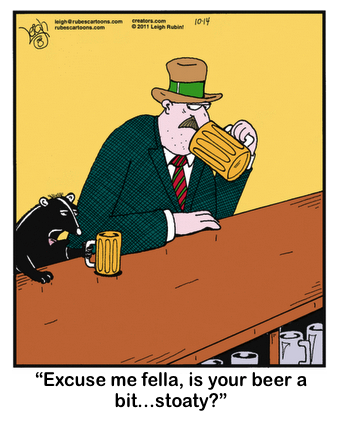
My beer seems to taste of ferret.

It’s difficult to be precise on the facts on this, but according to some research* I read, roughly half of beer drinkers like the taste of sunstrike in beer.  I’m in the other 50%. In fact, famously I was once described by someone as being the most attuned person to the smell of horse blankets, wet dogs, damp cardboard and skunkiness.  I cannot attest to the accuracy of this statement but I chose to take it as a positive affirmation of my razor sharp senses in relation to beer. *cough cough*.

Let’s deal with these two things in order.  First, ‘sunstrike’ or ‘sunstruck’.  It would be easy to get technical, and thereby get it wrong, as I am no expert, but in essence, hops contain compounds, humoloids, humolones….something like that, which react with ultraviolet light.  Beer that is unprotected – which is at least the third of beer in the UK – all that is sold in clear or glass bottles – can succumb to the effect very quickly**.  Put it out on shelf, leave it in the front of a fridge, put it down on the table outside whilst you enjoy your barbecue…. in no time at all, the character of the beer changes. I say the character of the beer – for me, it’s the aroma that hits me between the eyes, but there’s no doubt that it impacts the taste of the beer too***.

So secondly, to those attributes: aroma and taste.  It’s most definitely impacted by UV.  The reason, allegedly, that many drinkers like the taste is because they associate it with beers they have had on holiday…Spanish beer often gets the finger levelled at it here, ‘It’s like that San Miguel we had in Magaluf’. i.e. beer that has been enjoyed in searing temperatures, blinding light in the middle of the day – and probably not out of a can (plus when you are relaxed and on holiday – that’s a totally different subject).  I shot an advert in Barcelona once, and I remember enjoying a beautiful glass of San Miguel in a bar just off La Ramblas…that was fantastic, so personally it doesn’t compute, but I get the logic.  Frankly, as soon as I crank off the crown, if the beer is sunstruck I can tell.

It’s that often quoted aroma – skunk – that is the giveaway.

Yes, skunk.  I recognise it as skunk because we used to keep a domesticated one.  It was ever so handy around the house. With its black and white stripes it was great at bossing the magpies out of the back garden and its hair was so long, fine and luxuriously silky, it made an ideal shoe polishing accessory.  Brought up a lovely sheen it did.  And the kids just adored taking it for long walks across the fields; they were never bothered by dog owners.

Seriously, how can I describe this fetid, accrid pong as ‘skunky’ when it has no meaning for me? It must have for Americans who coined it, but for me, nothing.  I therefore set about the challenge of finding out an equivalent smell; a description that has validity to us, here, in these sceptred Skunkless Isles.

To our friend, the skunk, or polecat then.  I never realised that his spray is released from two glands either side of his anus. Nice.  Or that he is unnervingly accurate at ranges of up to 5 metres. Move over, Phil ‘The Power’, you may hit the double tops, but skunky here has a double bottom. And that they only spray when they feel threatened. No way.  Yet everyone struggles, including Americans it seems, with describing what ‘skunky’ actually is.  Burnt rubber? In small quantities apparently.  Roast garlic?  That sounds ok.  Ammonia like? Suitably nasty, but if that was it, surely you’d describe the smell as ‘ammonia’.  Rotten eggs?  Somehow it doesn’t capture how awful the smell is. By all accounts, skunks are close relations to weasels and ferrets, so perhaps I need to tap up some of my Lancastrian mates to see if they can help. Seek in the trousers of wisdom my friend, and you shalt find.

I have not yet conducted primary research.  The next time I go to Chester Zoo, if you see someone poking around the back end of the animals in the ‘Mephitids’ section, ‘tis I.  If you see someone being carted off to Chester Magistrates Court, ‘t’will be me.  Or scrubbing themselves down with Carbolic Soap for a week. Yup, me too.

Ultimately I suppose, who cares?  Apart from lexicological colonialism by the Americans (get there first and you get to keep the descriptions), it doesn’t really matter.  Except, when I try and tell my wife that her beer is off, and have to use the word ‘skunky’.  She just shoots me that, “Don’t patronise me, you tosser” look and stalks off. No, we need language that we all understand to describe great flavours and off flavours.

“Wet stoat” it is then.

Now, I’m just off to speak to The Beer Academy. They need to reprint their flavour wheels…

Stoaty *Bass Brewers, Project Ra, 2001. I don’t just make this stuff up you know. Well, mainly not.

**As part of the above project, freshly packaged beer in green bottles was left on a window sill for 30 minutes. When it was opened, it was already ‘off’.

***Brewers can do a few things to prevent sunstrike. The most common thing is only sell your beer on draught or cans, or not package beer in anything but dark brown bottles. But you know, this is not that practical and research tells us that consumers prefer green or clear glass.  The other thing you can do is brew with isohumolone free hops – chemically altered hops that have the specific compounds removed – Miller Genuine Draft is a good example, so too Sol.  Clever science, but to my taste, the beers take on a soapy mouthfeel and begin to taste very similar.. I’d rather run the gauntlet myself.

© David Preston, Beer Tinted Spectacles 2012

Sign Language

Last night was another Peroni experience.  My girls both came home from school with lovely school reports and as I have been working away a lot we decided to hold Friday Night Pizza Night out of home rather than in. So we tootled off to Ask and placed our order.

I haven’t actually checked, but I think there’s an Austin Powers Conspiracy going on in the sphere of Italian restaurants.  We use  vouchers to save a bit of money, and they all come out with minutes of one another – this is either incredibly effective competitive monitoring, or more likely, they are actually all one commercial concern.  This theory is supported in my eyes because the three protagonists are getting more distinct from one another: Pizza Express the mainstream offer, with wide appeal, upmarket enough for a treat but not so pricey you can’t dine there often; Strada, playing on the authenticity card and hence pricier, and then below them Ask, which is outwardly less authentically Italian and more ‘inspired by Italy’.   But they’re not different in beer:  Nastro Azzuro 330ml, Nastro Azzuro 660ml (for that sneaky upsell) and Peroni Gran Reserva for when you’re feeling flush, or more likely, not driving.

The point of this is not to complain… although I would like to see a wider selection – Menabrea perhaps – or one of the great beers from Le Baladin? No, the point was that sad though I may be, the experience made me reflect on semiotics.

Semiotics is quite a specialist psychological field and is now employed by all sorts of companies, as it can have a real impact on how a brand or an experience is understood by its end user.  Essentially semiotics is all about the meaning that derives from non verbal cues and signals.  It’s about how a beer presents itself (how it ‘codes’ to use the lingo)  and the real experience, not what it says about itself.

Take Ask for example: the experience of ordering, receiving and drinking my bottle of Nastro Azzuro is a good cross section in Semiotics.  One of the benefits for stocking such a small range of beers is that you see what’s there as you walk in.  A lady opposite me had an ice cold bottle and branded glass sitting in front of her on the table: refreshment is cued up. I order one:  the glass has been frosted, and the beer is clearly deeply cold; the condensation sitting on the label.

Ah…the label. Peroni really is a masterpiece in how it presents itself.  It adheres to some premium lager expectations and betters others.  The design of the label uses many classic references in beer design: hops and barley; bottle embossing; international awards (generally won at the turn of the 20th century for some reason); oval shape and riband devices – all say ‘a well constructed beer’. But Nastro challenges too: it’s predominantly a white design, and white cues ‘value’ or ‘cheap’. But they balance it with a non beer colour (a rich blue) and little touches that are psychologically big touches: just the right amount of gold edging or lettering; mock hand-written script; delicate background detailing.  You may think this is accidental – but trust me, it isn’t. Everything on this label, everything, is there for a reason and has been well thought through.  It is the consistency with which SAB have executed these little touches, and how carefully they have built the distribution over time that has transformed it into a hot brand.

I’m not in SAB’s pocket so I shall blow no further air up their trumpet, but it is worth reflecting on the power of semiotics.  Nastro Azzurro is a perfectly alright, perfectly average beer, but the bigger experience it delivers is a multipier effect (Stella Artois is an even more stark example).  No, a basic understanding of semiotics is particularly important in the burgeoning world of craft beer. Start-ups don’t have big (read: any) money for marketing.  The assets that they do have that the drinker touches: the bottle, the beer mats, the glass, the font or badge, the website – these take on a disproportionate importance. Making them consistent, not chopping and changing becomes critically important not just because it’s a better use of money but because it makes sense given that a drinker may not experience your product that frequently.

The question is which codes to keep and which to break – and that’s something to think about as you work your way through the many great beers emerging today.

Cumberland

Brew Dog
Stretching codes: a shield, but little else


© David Preston, Beer TintedSpectacles 2012

Blonde Ambition

At the Oktoberfest one year, a whiskery old Bavarian chap leaned over to me, winked and said conspiratorially, “You would make a fine member of the Hitler Youth”. I reckon he’ll be there this year too, intimidating the foreigners.  The point is that until my early 20’s I was blond. My wife is blond. My daughters are blond. And let’s be honest, blond is where it’s at. At least, it is in food and drink.

I was mulling on this as I drank a pint of Hawkhead’s Windermere Pale, described on its label as a ‘blonde beer’.  And it is; it’s a moreishly moreish 3.6% ABV pale ale, as bright and glowing as a sherbet lemon with a beautiful hop note on the nose, which reminds me of Amarillo but I’m sure can’t be. It’s not alone.    Most major ale brewers have a blonde in their range now, be it Wychwood or Fullers … and the smaller players are in on the act too – Slater’s of Stafford with their Top Totty Blonde (the one that caused a Parliamentary kerfuffle recently – but not as seismic as Jimmy Carr fortunately) and then of course, is Castle Rock, which with Harvest Pale, ‘The Finest Blonde Beer’, won Champion Beer of Britain in 2010.

Far from being the realm of the Ginge, Scotland seems a hot bed for blondes, so to speak. Innes & Gunn, Oban & Aran all contributing fine examples, spurred on I’m sure by the great success of Deuchars north & south of the border. So many blondes in fact that it’s almost become a beer style in its own right.  Given that there don’t seem to be any rules about what makes a beer ‘blonde’, this alone is interesting.

And if that’s happening here, you can imagine what’s going on over the water: a blonde bombshell (*groan*).  There are genuine ‘blonde’ beers – blonde wheats, Belgian-style blonde ales, double hopped blonde IPAs, American Blonde Ales; and then of course there are just the gratuitously named blonde beers, like ‘Pure Naked blonde’ or ‘Big Ass Blond’. Right on.

cornish-blonde
I chose this image after Googling ‘Big Ass Blonde’ took me to pages the kids shouldn’t see.

It’s not just beer though. Wherever brand owners are looking for a short cut to a ‘lighter’ product, the word ‘blonde’ is cropping up. Take Starbuck’s, they have just launched a ‘Blonde’ roast in their stores – in fact it’s a range, including ‘Veranda’, ‘Willow’ and ‘Decaf Willow’. Mind you, given that many people call it Charbucks, they probably needed to. Apparently they are ‘subtle’ ‘refreshing’ ‘lighter bodied’ yet ‘full of flavour’. Sound familiar?

And it makes the job of innovating a lot easier.  When I’m developing my next new beer, I shall be raiding the shelves of the hair colourant market.  My ‘Plum Power’ Pale Ale and ‘Cayenne Red Mahogany Brown’ Ale are just bound to be winners.

© David Preston, Beer Tinted Spectacles 2012