Staffordshire Mountain Time

Jens and I had just arrived in from a long haul schlep from Heathrow to Denver – seven hours time difference between Greenwich and my favourite time zone of all – ‘Mountain Time’.  Wouldn’t that be great? If all mountains shared the same time zone? From the Himalaya to the Andes, from the Urals to the Lakeland Fells, whenever you climb above 1500m you equalise with Denver, Colorado.  That way, we could drive up to the Lakes or the Highlands and drink beer simultaneously with the Great American Beer Festival, although perhaps in the dark…  On this occasion, sticking with current conventions, we had flown a quarter of the way around the world for this particular bout of jet lag, and we weren’t going to waste it on sleep.  The tactic of course: immediately assimilate yourself by going to a bar.

We headed for Blake Street. Just one block from Coors Field (with the most excellent, but sadly closed, Sandlot Bar / Brewery) we knew there were a couple of excellent bars.  Falling Rock Tap House earned the honours of slaking mutual first pint syndrome – I had a Fat Tire from New Belgium – an oldie but goodie which I perversely enjoy for its barnyard (read: cow muck) aroma, Jens something much darker (What? Than cow muck?) and inevitably featuring ancient grains or triple truck loads of hops, or something. I think Nelson Sauvin featured but my beer notebook wasn’t working at the time.   More beers and a light pre-order of kickers featuring, from memory, a magical set of buffalo wings and enough ‘nar-chos’ to fatten up this week’s Christmas Turkey (Note: not ‘Natch-os’ as I requested, creating much confusion.  Fortunately I didn’t request the ‘Toe-mar-to Solsa’ so we managed to navigate that tricky spot.  And heaven forbid if they are ever served with ‘Tune-a’ in the footure).  Anyhoo, the conversation became more animated and a heated debate opened up regarding the Cascade hop and its train – the other ‘C’ hops).  In the Blue Corner – the hop heads, who appreciated when the hops were treated delicately but generally, were seeking vast quantity. In the Biney Green corner, were the Purists, appreciative of the energy and momentum created by U.S. craft brewers but a little scathing of the indelicacy of hop quantity that many craft beers boasted. ’They all taste the same – it’s just too much hop, hop, hop’ was the refrain.  I was a broadly neutral voice in the debate between brewers, but at the time holding a candle to the Purists’ view.  Too many glasses of beer had been unfinishable; too many face-puckeringly astringent as opposed to lime-suckingly sharp and refreshing.

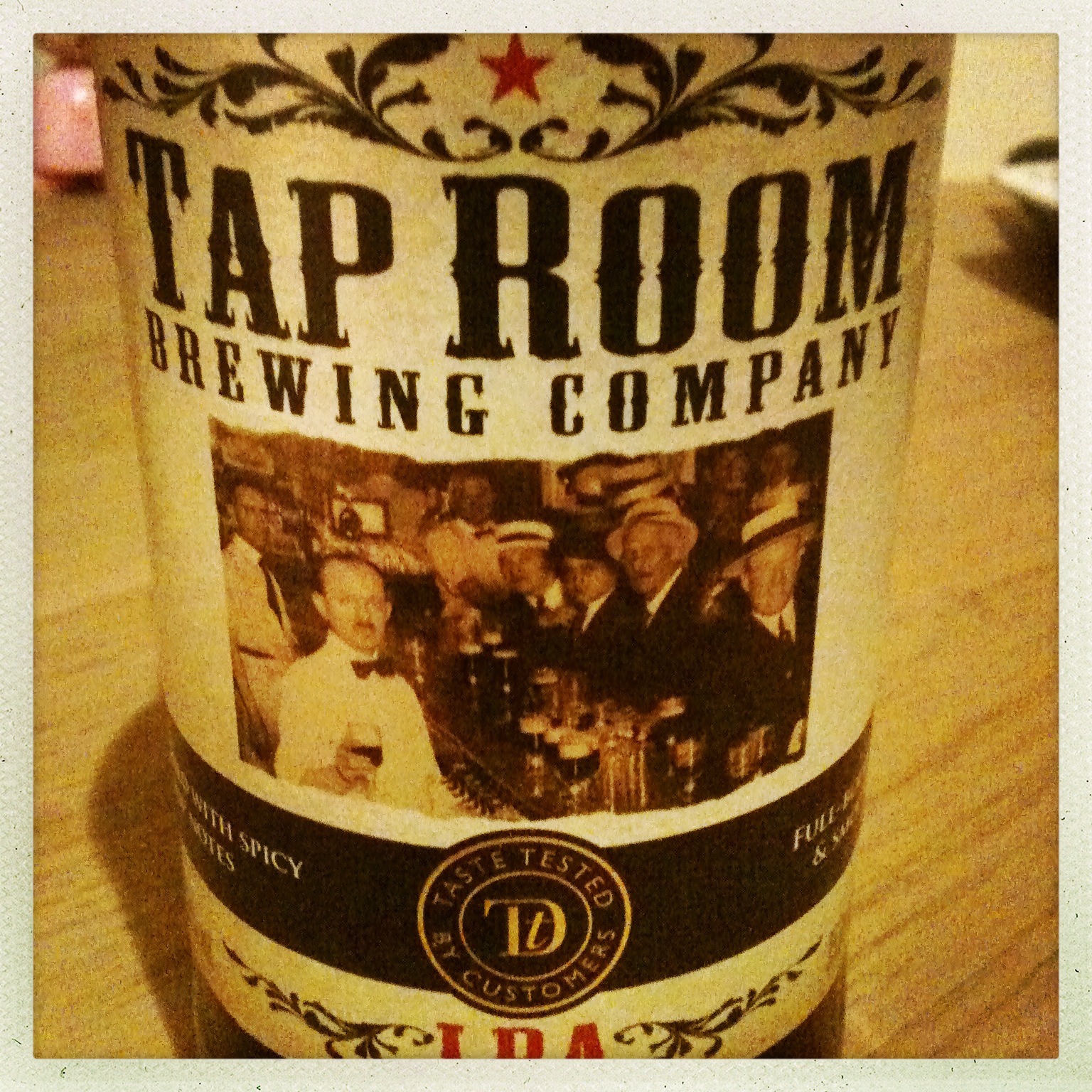
Yet those who have visited these pages before will know that I appreciate American inventiveness, particularly in the sphere of Pale Ales and IPAs fed to me on the lean diet that we enjoy on these shores. Of Goose Island and Sierra Nevada Pale Ale, enough has been said (quite justifiably) so I shall say no more today. But what a find the other day – one of those pleasant, out-of-the-blue surprises, that lifts your heart. And with it a touch of annoyance too – in the form of more beers in Sainsbury’s ‘Taste the Difference’ range. A Pale Ale (imaginatively entitled ‘American Pale Ale’) and also ‘Tap Room Brewing Company IPA’.    It seems from the blogosphere that I was not alone in being surprised by these beers’ appearance and it was only serendipity that allowed me to spot them in store. In the midst of the big Christmas shop, with the trolley losing its agility under the weight of festive groceries, I had carefully slotted some Goose Island and Brooklyn Lager into crafty niches between the bottles of Belvoir Presses (get me!) and the once-a-year parsnips when I decided to pause awhile over the UK range (actually to see if a friend’s beer had been listed yet). My eye was drawn to two slim 330ml bottles amongst the sea of 500ml pseudo-pints.  Naturally, despite the mechanically challenged trolley, I managed to engineer space for two bottles of each – the Pale Ale described as having ‘citrus aromas and malty flavours’ (no shit!) and an ABV of 5.3%; the IPA a more bullish yet still drinkable 6.3% and billed as ‘bold with spicy hop notes’.  Come on down!

IMG_2454 IMG_2455Well, my! What a find.  The Pale Ale in particular is a little haughty starlet.  Enticing you from the moment you lever (TWIST!!) off the crown.  Citrus notes – sure, but also a spiciness, which I assume comes from the hops, and a body, befitting a mid 5s beer that is both delectably drinkable yet supported with chiselled broad-shoulders. The mash contains wheat as well as barley and the roundedness comes through in the mouthfeel.  And my sort of beer – a come-hither-young-man aroma, multi-dimensionsal on the first sip and a lingering after taste that rolls around the taste buds gently tinkling a fading percussive melody on your tonsils with its Xylophone beaters, until the next sip is called for and your hand unfailingly answers.  The IPA in comparison was a bit of a let down – a good beer, but not a great one.  For a bold strength it flattered to deceive a little, drinking under its weight and creating a stewards’ enquiry from Barry McGuigan’s corner.  But not a bad beer, with a bright orange colour and a dense, compact head that laced beautifully. Alas, no timpani on the tonsils this time round.

And it revived memories of the old debate in that Denver bar.  U.S. craft beers – all the same? All hops and no knickers?  Well not on the evidence here – the tantalising tastes enjoyed in Staffordshire of all places have me pining to go back Stateside to update the argument.

© David Preston, Beer Tinted Spectacles, December 2012

The Session #70: Sausages

the session beer blogging fridayThis month’s communal beer blog is about ‘Hype’ in beer. Well it got me thinking about one of my favourite texts on branding – a little, easy to read book by David Taylor entitled, ‘Where’s the Sausage?’ With a name like that, it would be easy to classify it along with classics like ‘Who Stole My Cheese?’, ‘Kiss That Frog’ and other such daftly named tomes with zero afterlife, but no. ‘Where’s the Sausage?’ has a serious, memorable and most of all common sense message:  in all your marketing efforts, if you build your brand on dodgy claims and weasel words, if you believe the hype so to speak, then you are building your house on sand and at some point it will all come crashing down.  Or, as a wise old sage of a boss once put it to me, ‘If you put red diesel in the tank son, don’t suck on the exhaust’.  In the case of ‘Where’s the Sausage?’ the exhaust sucking is committed by a Marketing Director (ex advertising agency, as they always seem to be), who forgets the proud porky legacy of this particular butchery concern, and ambitiously moves them into sausage (read: “Meat Feast!”) pizzas.  And Italian sausage at that. In so doing, the distinctiveness, the quality and most importantly, the truth is lost. Without spoiling this future Hollywood hit for you, the day is saved by a couple of old boys who snuffle in the truffles to find out what the company did best, and make it appropriate for the market today.

SausagesAnd sausage is an appropriate metaphor for beer on two counts. Firstly, some beers actually taste of sausage. No, really.  Empirical evidence, of one, has demonstrated that Aecht Schlenkerla Rauchbier (a Bavarian smoked beer) does taste of spicy salami amongst other things (car tyres?)

Secondly, there’s the act of slicing the sausage. Classic brand building thinking has you hunting for unique selling propositions for your brand. For finding a new slice on the category.  To demonstrate this, and in deference to my friend and ex colleague Chris, let us at this point refer to the case of the humble tomato.  It was not that long back that you went to the supermarket and you bought a bag of tomatoes.  Snooker ball size. Round. A shade of red, generally. Typically loose, but sometimes pre packed in 6’s in to a tray with plastic wrap round it.  Then the hype begins: ‘Tomatoes sales are growing, how do we increase them further?’   A creative session is organised. Suppliers are invited in. Growers get together.  Bigger multipacks. Smaller mulitpacks. Smaller tomatoes. Bigger tomatoes.

‘We need to make them more glamourous, give them more appeal!’ ‘Beef tomatoes’ ‘Cherry tomatoes’, ‘Plum Tomatoes’ (fresh not tinned), ‘Mini Plum Tomatoes’.

‘Sales are slowing, we have to make the tomato sexy.’   ‘Santos Plum Tomatoes’, ‘Sicilian Mini Plum Tomatoes’, ‘Vine ripened tomatoes’ ‘Green tomatoes’

And on, and on.

For a while sales increase. And like blood around a floating corpse, sharks begin to circle. More supermarkets get involved.  Growers swap from unfashionable crops (like hops, or apple trees) and build greenhouses for their tomatoes. Yet at the same time, imports increase as the Dutch and the Spanish eye our supermarket aisles longingly. Then the Americans pitch in the off season, and before too long the Chinese too.

And the result?

Sales begin to flatten. Shoppers don’t know where the hell to find tomatoes. You know, the ones that are snooker ball size, round and red… lost in a sea of senseless packaging and niche offers that you only buy at Christmas. So competition increases, prices come down (‘Great news for the consumer’ chime in the Government, productively), growers lose their margin and ultimately sales drop away as interest in tomatoes falls away.

So be careful what you wish for beer world.  Look at lager brands in the UK:

Sausage: you start with Skol and Long Life. 
Slice 1: sales begin to grow, incomes Carling Black Label , Carlsberg and Heineken. 
Slice 2: we need to add more appeal: Fosters, Holsten Pils, Becks. 
Slice 3: we need to sex it up: Grolsch swingtops, Stella Artois, Carlsberg Export.Slice 4: we need to get adults drinking on more occasions: stubbies, embossed long neck bottles, 
Slice 5: we need bigger packs for Christmas: 8s, 12s, 24s, 18s, 16s, 
Slice 6: what if people could give our brand as a present? glass packs, collector schemes. 
Slice 7: I don’t want sex, I want lust! Peroni, Peruvian beers, Thai beers.  
And the result?  Death by 1000 cuts, or at best, one of those part segmented saveloys you buy at the chippy… a supermarket range you don’t know where to start with and boxes of beer priced cheaper than bottled water.

My advice: heed the warning of history. Cask, craft and bottled ale may be a reactionary response to the slicing of the sausage. We can enjoy it now, bathe in the revolution. But at what point does the magnetism of the knife begin to take hold? More slices? More claims? More weasel words? Less truth?

Triple Black Pacific IPA anyone?*

*Served in ‘une chalice’, of course

© David Preston, Beer Tinted Spectacles, December 2012

At Lowlander

London’s Drury Lane is famous for its theatres of course.  The Theatre Royal, The New London, all in their time have witnessed the great and good of thespianism grace their boards.  Up at the top end, towards High Holborn, are the interesting sights though.  Narrow buildings made from small blackened-buff handmade bricks, with that vertiginous sense of perspective as your eye tracks them upwards.  Here, strangely enough, was the original Sainsbury’s store, and here too, inspired perhaps by the visual echoes of Amsterdam, is Lowlander.

It’s a favourite bar of mine. Inspired by a Brussels Grande Café, every attempt has been made to authentically reproduce and convey that feel. From the long bar with the wide aperture beer taps with glass washers below; to the enamel wall plaques advertising and celebrating some of the glotally tongue-twisting brands like Delirium Tremens, Echt Kriekenbier and Trippel Karmeliet; to the reverential alter of glassware behind the bar, celestially lit and tempting you to order one of the bottles to fill them: Westmalle, Trappiste Rochefort, Rodenbach Grande Cru.  And the tables: I’m just a sucker for these long tables, forcing you to sit next to a stranger; inviting you – threatening you perhaps – to strike up a new dialogue or forcing a little smile as you observe groups play out the unspoken dance of rule-finding around who can invade personal space and to what level.

logolowlander

Perhaps Drury Lane is the right location: because ultimately it’s all a faҫade – authentically fake if you will.  But as I refamiliarised myself with a smooth De Koninck last night, I was transported, albeit momentarily, to a real homeland of beer, and was all the happier for it.

© David Preston, Beer Tinted Spectacles, November 2012

50 Shades of Dray

It had clearly become too much for my long-suffering wife. In a delicate eruption of frustration one evening last week she pointedly accused me of watching only food programmes on TV. I can accept that some, small minded individuals cannot appreciate nor accept ‘Pointless’ as the true visual art form that it is.   Yet as always I had to reluctantly admit that there was more than a grain of truth in her accusation. In fact of late, the truth was not a grain but a large soon-to-be-double-decocted mash full, triggered in this case by a monster session of ‘Great British Food Revival’ which I had put on the Sky+ and inevitably, therefore, was watching en masse, putting enormous pressure on her weekly Soap schedule as I fought to catch up in any 5 minute gap that presented itself.

The basic premise of the programme is this; like our canal network in the ‘70s, some ‘great’ ‘British’ foods, are endangered, not through over hunting but through lack of use.  From brown shrimps to asparagus, cured ham to Cheddar (of the proper, West Country variety, natch), from Aylesbury Duck to real ale, unless we change our eating and shopping ways then these fine fares, which we all ‘enjoyed round the table of childhood’ apparently, will be gone forever.

Alas, some of the motifs of the series are weakened by stereotype and bombastic language: “Go on!”, you are urged in each programme, “Just think about the crap you are putting in your basket (Idiot! Charlatan!) and buy the proper stuff”.   It’s well meant; undoubtedly true to a large degree; and I have no qualms at all about raising the profile of some of these high quality products and the producers who fight to save them and make a living.  And yes, you did read that right, real ale was on the list.

Which was funny.  Because if there’s one Great British food (and I think on both measures this counts) that is saving itself then cask ale would be there.  Credit to CAMRA 40 years ago, and credit to the countless numbers of entrepreneurs, home brewers, retired professional brewers, and beer lovers from all walks of life who have had the balls to start a brewery.  But there’s the (*cough!* *cough!*) …rub.   The premise of the episode on real ale was mostly about the balls and not the beer.  That somehow, it was the industrialisation of beer production, and the replacement of the brewing art by employed men, not home-making ale wives or brewsters, that accounted for real ale’s decline. Not shit quality in pubs, total lack of focus by brewers big and small and the global change in tastes towards pale beers then?

hartnett
Angela Hartnett. On the left. Obviously.

And It wasn’t helped by Angela Hartnett.  Clearly, she’s well rated as a chef – whilst I have not dined at one her establishments myself, all this celebrity froth must be for something. But unfortunately she came across as just a touch patronising, actually looking down her nose at people, an apparent haughtiness aimed even at those that she was endeavouring to champion. Annoying really, as it was clear that she has a fair bit of beery knowledge and can use her platform to champion the case for beer.  And. She didn’t venture out of the south east; but that’s just the regional chip butty on my shoulder, so let’s say no more about it. But it’s chips ‘n’ gravy every time, if you’re asking, and  feel free to pop a bit of stout in the gravy for that whole ‘beer and food’ extravaganza if it makes you feel better.

Yet scratch all the criticism. At the end of the day, the angle she was driving down was interesting, borne out of yet more grains of truth; and unlike the previously impoverished attempts at beer programming on the BBC, was relatively balanced¹. Specifically, the role of women in relation to ale has weakened, and extending the ‘cult of the brewer’ to include female brewers is a must if we want ladies to sit up and take notice, not just men.  Getting women to suspend disbelief and try great beers, not just cask beers, is an industry wide action.  Getting the BBPA or other august bodies to promote the fact that ‘beer = lager, ale, lambic’ and not just ‘beer = bitter’ is a pretty basic cornerstone of knowledge that we haven’t yet established. Getting over irrational connections to the pint, and stretching out our arms to welcome in other measures is a must too, heretical though it may be to say it.  But most importantly, getting over the fact that beers ‘for women’ don’t have to be flavoured light beer (or worse) will be the first major victory.  At the end of the day, beer has always been more of a blokes’ drink.  And you know what, that’s OK.  Us men should stop wearing hair shirts of guilty penitence and flagellating ourselves outside the Rose & Crown.  Change nothing about beer today and there are still huge numbers of occasions when women would happily pick up a beer when they’re not now. There are plenty of beers today that hold appeal to both genders – from fresh, cask draught beer at the one end, to Mexican beers and Tequila beers at the other; from sweeter, mild beers to deep brown and alcoholic Italian ones – it’s the context around it; the machismo; the ‘half’ culture we need to break down.  And at the end of the day, I may drink a glass of rosé wine from time to time too without needing a ‘rosé for men’ initiative from the wine producers.

Yet scratch all the criticism. At the end of the day, the angle she was driving down was interesting, borne out of yet more grains of truth; and unlike the previously impoverished attempts at beer programming on the BBC, was relatively balanced¹. Specifically, the role of women in relation to ale has weakened, and extending the ‘cult of the brewer’ to include female brewers is a must if we want ladies to sit up and take notice, not just men.  Getting women to suspend disbelief and try great beers, not just cask beers, is an industry wide action.  Getting the BBPA or other august bodies to promote the fact that ‘beer = lager, ale, lambic’ and not just ‘beer = bitter’ is a pretty basic cornerstone of knowledge that we haven’t yet established. Getting over irrational connections to the pint, and stretching out our arms to welcome in other measures is a must too, heretical though it may be to say it.  But most importantly, getting over the fact that beers ‘for women’ don’t have to be flavoured light beer (or worse) will be the first major victory.  At the end of the day, beer has always been more of a blokes’ drink.  And you know what, that’s OK.  Us men should stop wearing hair shirts of guilty penitence and flagellating ourselves outside the Rose & Crown.  Change nothing about beer today and there are still huge numbers of occasions when women would happily pick up a beer when they’re not now. There are plenty of beers today that hold appeal to both genders – from fresh, cask draught beer at the one end, to Mexican beers and Tequila beers at the other; from sweeter, mild beers to deep brown and alcoholic Italian ones – it’s the context around it; the machismo; the ‘half’ culture we need to break down.  And at the end of the day, I may drink a glass of rosé wine from time to time too without needing a ‘rosé for men’ initiative from the wine producers.

None of that’s the point though.  The real point is this:  if we really want to ‘revive’ real ale, we can’t just focus on women.  The male ‘lager generation’, growing up with exciting lager as a reaction to the drink of their forebears, are now in their 30’s and 40’s and need to be enticed back to drink cask more regularly.  Young adults prioritise their mobile subscription above food and rent, but we need to bring them on side too – men and women.  Our ever-ageing population need to be encouraged to try too, especially if the memories of the ropey stuff from a generation ago hold any truth. If real ale is going to really revive, then it needs broad appeal, women and men, young and old, big brewers and small brewers, national retailers and independents getting behind it.  The Great British Food Revival might help, but it’ll need to broaden its focus to do so.

¹ Oz Clarke and James May anybody? They should sack the Director General for that.

© David Preston, Beer Tinted Spectacles, November 2012

“I’m dreaming, on a jet plane…”

In the spirit of Radio 5 Live presenters who like to make awkward and apparently unlinked segues between pieces, here’s mine. Rod Stewart: sensationally weeps after Celtic beat Barcelona in an otherwise dull football match¹, although he has now declared himself “silly” for giving in to such emotional soppiness. Which are the beers you would “Dream about on a jet plane” (or in my particular case, ‘Virgin Train’).  Here are my contenders:

Sierra Nevada Pale Ale, which, after naming as my “One Beer to rule them all” in a recent post, would be rather remiss of me to leave off the list.  It is naturally a beautifully brewed, versatile, flavoursome and aromatic Californian beer.  It is also the one I genuinely think most about on my Friday nights – the most hallowed of all beer occasions.

Windsor & Eton Conqueror:  in my book, not a session beer, yet the whole concept of dark beers that don’t taste roasted or charred is intriguing.  Conqueror manages this – a beguilingly dark beer, with a fromage frais coloured head and only a lightly roasted note which you pick up in the sides of your mouth. So a burly beer but one which still allows the hop leaf character to show through – too much  so in some of their other beers, but judged nicely here.

Menabrea Blonda: someone who I used to work with would choke on her cornflakes knowing I put this beer on my list.  Brewed in picturesque Biella in the Piedmont region in Italy, the beer itself is a fairly ordinary pale lager.  But it’s the associations that swing it for me – a great match for Friday night pizza, a bar in downtown Milan, the brewery nestled up a tight street in the foothills of the Alps.  Shallow I know, but I can live with it.

St Austell Tribute: something has happened down in Cornwall.  I used to live in Devon and my recollection of St Austell (company not place, although it could have described both) was ‘good pubs, dodgy beer’.  And it was all acronyms like ‘St Austell HSB’ or ‘Bodmin PMT’ that sort of thing.  Perhaps it was Sharps.  Doom Bar taking off and being bought for nigh on £20 mill must have woken up the Cornish to their terroir as there are some cracking beers emerging from west of the Tamar now.  Tribute makes the list – I can get it in my neck of the woods, and it’s a drinker, but Betty Stogs would be on it too if it was more available.

Schneider Weisse: this is the daddy of the Bavarian wheat beers for me.  Erdinger is a little too clovey, a little too texturally thin and a touch too ethanolly in taste for me. Schneider though, nails it.  In decent distribution now in the UK too, which is handy.

Jennings Cumberland Ale:  another associative beer for me – this one is the Fox and Hounds in Threlkeld, the slopes of Blencathra looming behind. Or the Old Dungeon Ghyll in Langdale. Supping slow pints after a day getting lost on Crinkle Crags (again).

Goose Island IPA – Chicago, 1999.  I had been in the US studying for my MBA international assignment and stayed over to meet my brother who was living in the US back then.  He flew to meet me in the windy city and we had 48 hours of tourist highlights.  These included a ‘Half Rack of Ribs’ (note: a half rack, between us) taken I think from a white rhino in the Anchor Chop House. And a deep dish pizza in Pizzeria Uno. An 8” being enough stodge for 3.  But hell, the beer was the revelation.  Goose Island beers in what we thought would be our crappy ‘Hospitality Inn’ bar, but turned out to be a drinkers’ honey pot. Glasses of IPA and Honkers: untouchable.

¹Football fans please forgive me. I did not watch this match nor any other.  Ultimately, it’s lots of grown adults getting all het up about kicking a pig’s bladder.

© David Preston, Beer Tinted Spectacles, November 2012