My Kind Of Town

IMG_1074
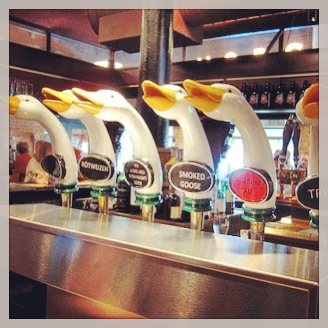
The Goosey Geese Tap Handles of Goose Island.

One city is the United States in microcosm. New York is amazing: soaring, spiky, spectacular. It’s almost a caricature of itself though; too showy; too extreme. San Francisco on the other hand is happening, boho, liberal, supremely geeky – so much so that it could never be described as typical, wonderful though it is.  No, that microcosm is Chicago; a city that for me encapsulates a little of everything you imagine heralds from the States, a little of everything the States is great at. There’s the architecture (Skyscrapers, Frank Lloyd Wright), the music (the blues, the jazz, gospel), the sport (the Cubs, the Giants, the Bears), the weather (+35°C Summer, -27°C Winter anyone?), the industry (head offices of Kraft, McDonald’s, Boeing)… all this and more. Yet there’s something else, something more elusive.  First, there’s the setting.  Most US cities have height in their downtown, but Chicago flies. It’s a city that simply rockets upwards, out of the Plains like the vision of ‘Metropolis’ imagined in early science fiction.  Although not the tallest skyscraper, the Hancock tower provides the best view as undisturbed, you can look out east over Lake Michigan, eyes straining to see the curvature of the Earth, or north as the city drops away, tracing the lake coast as it falls block by block, gradually descending like a city built from Lego, until it is just the shoreline heading into the horizon.  Then, there’s the food and drink culture.  Oh, this may be the Mid West; this may be Six Pack Joe central, but make no mistake, this is a great food city and what’s more, an amazing beer city too.

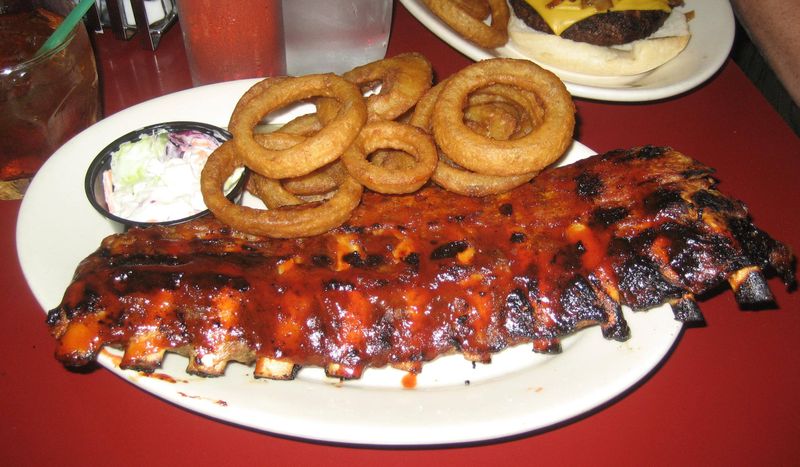
Twin Anchors rack of ribs: “Like an orchestral Xylophone being brought in sidew
IMG_0782

IMG_0784
Take two pizzas. Stack one on top of other. Invert. Add more cheese and tomato. Bake.

I first went to Chicago in the late 1990’s. To be honest, I hadn’t really genned up on the place as the days beforehand had been stupidly hectic, but it didn’t take long to be astounded by the native Chicagoan foods – and the vast quantities served.  It was also the first time I had witnessed Starbuckisation in action.  We stayed in a pretty basic hotel, a Days Inn located perfectly just north of downtown for the bars, business and eateries and bang next door to the Lake Michigan shoreline over Lincoln Park. In no more than 100 yards of us in each direction were 6 coffee shops, 4 of which were Starbucks – easily within sight of one another. Anyway, that first week was business, and as a group we investigated Chicago’s dining and drinking scene. There was deep dish aplenty, a Gino’s East pizza restaurant not far from the Museum of Contemporary Art was my first experience of the famous upside down, inch thick pizza; there were others but Lord knows how we made room for them. Sandwiches too, bagels for breakfast of course, and downtown somewhere just below the Loop tube train, we had a two-inch thick Italian beef sandwiches soaked in gravy and served with whole heads of roasted garlic. Then there were the ribs: the most memorable assaulted us in the Twin Anchors chophouse where I went with my brother the night before Halloween. We were overawed, and not just by the skull decorations – there’s no other word to describe the speechlessness you get when a rack of ribs the size of an orchestral xylophone drenched in pungent BBQ sauce has to be squeezed out sideways through the kitchen door to the diner’s table. We shared a half rack (kids portion?) and were still fit to burst.

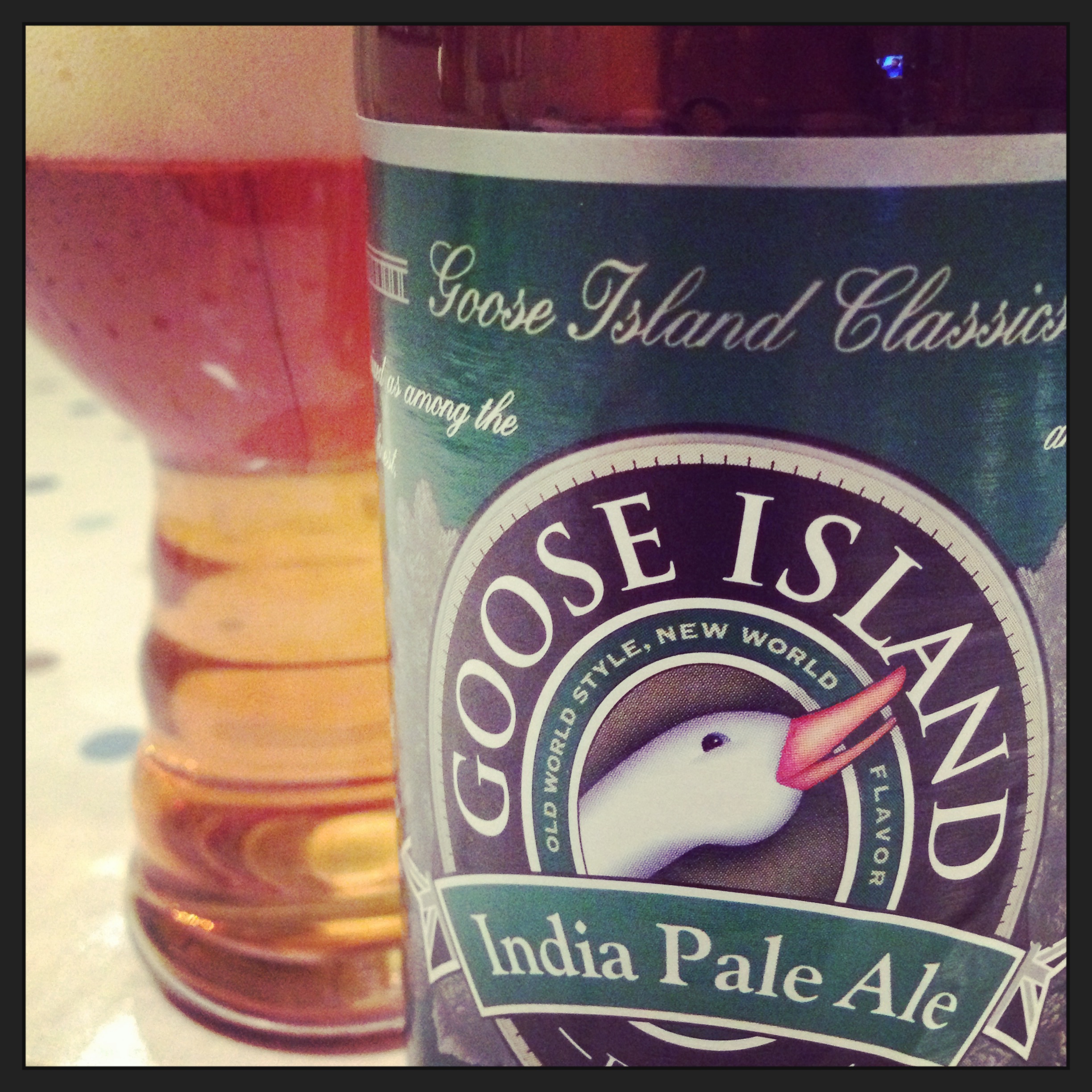
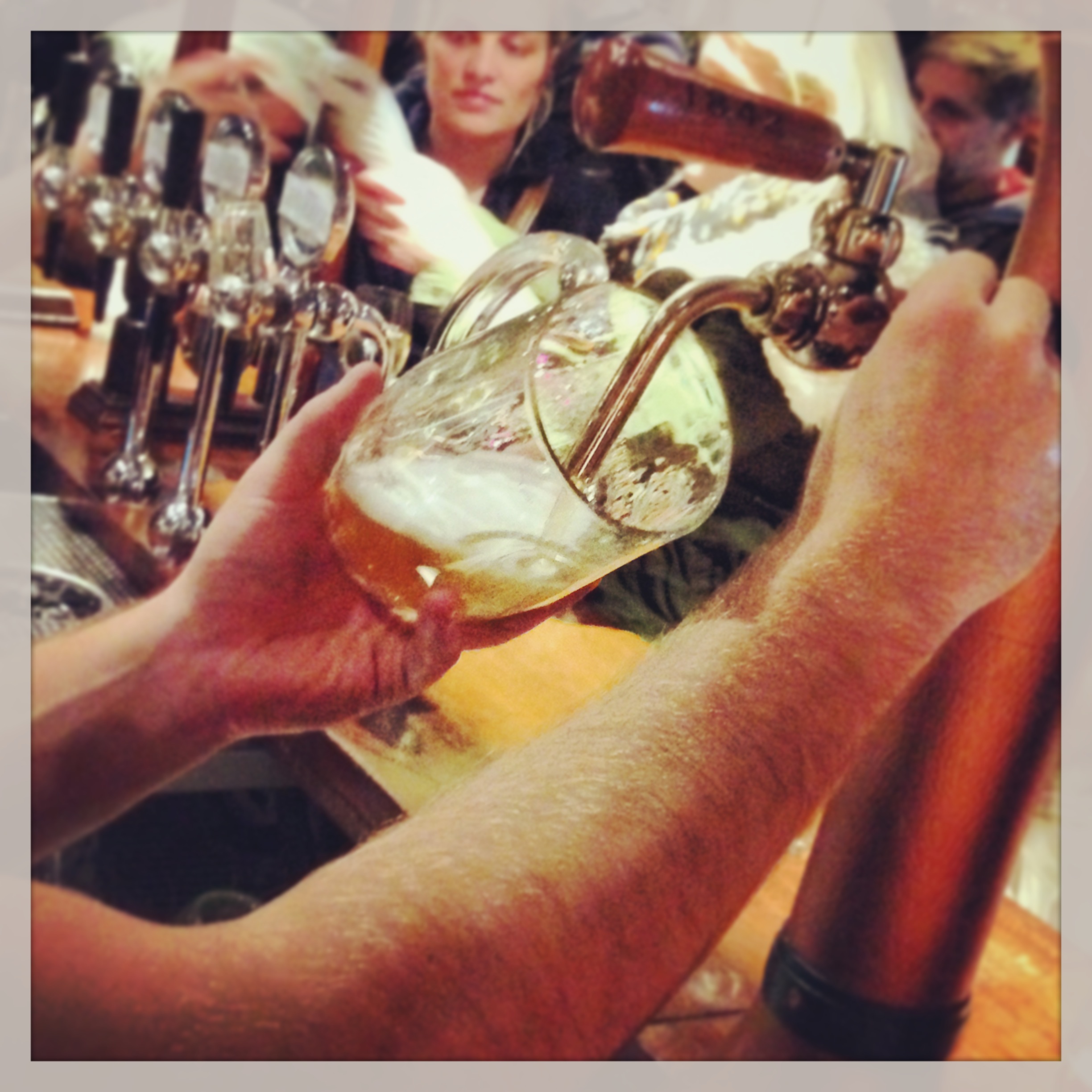
IMG_0766 IMG_0765The leitmotif of the trip though was the beer. The bar in our hotel was a bit like a ground floor ‘Cheers’.  It was not just frequented by guests but locals too, office workers mainly, popping in for a swift beer and bite before they headed off home.  Horseshoe shaped, with the barman seemingly at the centre of every conversation, many sat there at the bar for a few hours, making conversation with anyone who would listen.  As a group of Limeys we were, I’d like to think, entertaining as much as entertainment. Beers? Well, there was the normal selection – Miller, predominant, this being Chicago –  Michelob, Bud and Coors too, even Schlitz which you’ll hardly see now.  But none of these stood out nearly as much as the tap handles of Goose Island – my first encounter with the brewery and its beers. US bars can look like an array of wobbly wickets at the best of times so the Geese of the Goose Island hissed and honked like no others.  And the beers stood out too. At the time I hadn’t realised that we were only two blocks away from the island in the Chicago river that gives the brewery its name. With the passage of time, I can’t remember exactly which beers were on sale apart from two – both still parts of the Goose Island range today. The first, Honkers.  I mean, with the name alone you have to try it. And what a delight – a beautiful lustrous copper colour and fruity aroma with malty bitterness assisting drinkability.  And India Pale Ale, the beer that nowadays you can easily buy over here.  It’s simply an incredible beer: incredible when you consider it’s a fairly basic infusion mash off a single malt base and extensively hopped both with American and English hops. Yet for such a punchy, full on beer it remains well balanced – so its both one to savour and one to drink. My kind of beer; my kind of town.

© Beer Tinted Spectacles, 2013
Porter house Black

The Cathedral Close in Exeter must be one of the finest in the country.  The Cathedral Church of St Peter, an architectural beacon for miles around with it’s twin towers straddling an enormous vaulted nave, look down genteely on a full enceinte of hotch potch buildings constructed in all styles and through all the ages.  Today the shops are mostly cafes and restaurants, a bookshop and some gift shops, yet through all the change one pub still thrives. The Well House must enjoy one of the most spectacular views from its doors of almost any British pub.  And it was an old haunt of mine, taking our pints outside in summer, perching on the low wall in front of the cathedral lawns and wiling away a pleasant hour or three.

I associate The Well House with porter – a beer style that is increasingly in vogue these days but back then was a rarity. It was most definitely unusual to find it on draught in a pub at the time – and in fact still not so common today I suppose.  Alas, the beer was a struggle – I can’t remember the brewery or the brand, but it was an earthy, acrid, scratching beer – it fought you, it bit, it spat – making you work for the rite of passage – one I chose not to take. Almost unbelievably therefore, I have either avoided porter since, or more accurately, allowed myself to be tempted by other types of beer when the choice arose.  Daft really, but it shows the power of a single experience – just one ‘bad’ pint and the whole family of porters is tarnished, wiped off the map for two decades.  Tch.

Porter is one of those fascinating beers that would be of interest for general historians not just beer enthusiasts.  One of the first ‘mass produced’ beer styles, it caught on during the industrial revolution allowing its brewers to scale up as urban population exploded: steam powered breweries; wooden-staved conditioning tanks so large that brewery Directors entertained the great and good within them. All today’s porters guess at what we believe they might have tasted like. It’s believed for example that given that the beer was matured in wood, that the original porters of the 19th century would have undergone some secondary fermentation – from the yeast contained in the casks. It’s believed too that the malt bill would have contained a pretty high proportion of almost burnt grains from the direct firing methods employed at the time. So perhaps my experience in The Well House was accurate. We can only imagine the flavours that would have arisen – winey, vinous, with a cider-like cut of sharpness at their best, vinegary at their worst.

Shepherd Neame brew what for me drinks like a classic porter. They actually brew it for Sainsbury’s ‘Taste the Difference’ range.  It’s ink black – blacker than many stouts (and particularly, much blacker than Draught Guinness which nowadays is almost reddy-brown), definitely as black as squid ink and blacker than the heart, soul and naughty thoughts  of the Lord Of The Underworld. This beer is Seven Hells black and pours with a rocky, caramel toffee head which lingers beautifully and laces frillier than Agent Provocateur frilly knickers.  The smell: it’s Bonfire Night come round again, with cinder toffee and a whiff of Guy-Fawkes-is-Burning pure smoke or perhaps just gently smouldering pallets – all following through into the taste, with an extra sharp edge of charcoal.  Not then a pint-after-pint supping beer; but definitely one for sitting down in the Dickensian bay window seat of a local hostelry on a cold December night, looking out over the Cathedral before crunching home through the winter snow.

© Beer Tinted Spectacles, 2013

Lager, Part VI: Bring In The Tanks

There is no more powerful, evocative and sought after beer idyll as “drinking lager fresh from the lagering tank”.  It is beer perfection exemplified. It is a notion so laden with positive association that it has reached almost mythic proportions. Here we have it: beer as beer should be; beer in the state that the brewer themselves would want you to enjoy it.  Beer that is fresh; is still conditioning; is so lively with natural carbonation; so ever-so-slightly hazy:  is alive. Beer with a gushing, foaming head so unctuously thick, so heavenly white, so unfailingly deep, so velvety creamy that you will think all your Movembers have arrived at once. This is state of grace filled with nostalgia, pining and distant hope, for it is a dying art.

I consider myself lucky enough to have drunk beer from the lagering tank three times: twice in the Czech Republic, once in the U.S. The first time was in the cavernous lagering mines under the streets of Prague, the tanks of Pražské Pivovary, the tanks of Staropramen. It is no overstatement to say that few times in my life have I been speechless with awe, wonder and reverence.  It was truly a near religious experience;  to step down the slippery steps, becoming ever damper, ever cooler, ever gloomier. The Cold War flicker of a lone fluorescent tube our only company. Footsteps bouncing, echoing from the stone floor and low-vaulted ceiling.  And then, turning the corner;  row upon row of enormous white lagering tanks stretching off into successive vaults. Countless tanks, endless caverns, dedicated to beer worship; floating, seemingly like innumerable whales, gently swimming below the surface.  Each tank delicately coated in a thin, glittering layer of condensation. Each tank slashed with the rough chalk marks showing when it was filled, tested, and when it will be ready to broach.

The second time years later was a similar, but further to the north west in the hop growing area of Žatec; again, rank upon rank of lagering tanks, slightly worse for wear, revealing the more straitened financial situation of this brewery compared with those in Prague where the streets are paved with Stag-Do Gold. But it was equally charming, equally moving – knowing that a brewer was dedicated to the considerable investment in time and expense of lagering their beer properly. Knowing that a brewer was still determined to sell proper lagered beer with the roundness and softness of palate that no short cuts can match.

The final time was modestly different, sampling different beers from the Sandlot micro-brewery under the Colorado Rockies baseball stadium at Coors Field. A few were sampled that evening, from a well known wheat ale, to a caramelly amber ale, but the Barman Pilsner was the highlight.  It sprinted through the pig tail into the glass, seething and swirling as it went, displaying that rounded, full character that I had tasted before. From a cellar in Colorado echoes of Bohemia could be heard.

No surprise then that lager brewers are trying to find ways to export – figuratively and literally – this state of lager grace to build their brand and reputation. It’s a drum a few of us have been beating for some time and now the reverberations are being heard.  Perhaps it is a case of necessity being the mother of invention as two very famous lager brewers are at the vanguard: Budweiser Budvar and Pilsner Urquell (PU).  Both have been struggling for traction in the UK in recent years – Budvar to grow their franchise, PU to gain a sustainable market foothold here.

I tracked down PU first, eventually making it to a long overdue visit to the White Horse on Parson’s Green. Unsurprisingly, given the justified reputation of this pub as a leading voice in the beer revolution,  SAB Miller, the owners of PU, have chosen the White Horse to invest in; a tank has been fitted in the pub cellar purely for unfiltered PU.

Beer tanks are old school. When I joined Bass, in my first few weeks I did a trade visit up to a working men’s club in Sheffield. It was a Stones’ club. At the time, Stones was Sheffield. And Sheffield steel meant huge pubs, huge men drinking huge quantities. So out back was a beer tank; the capacity I can’t recall, but it was a big as a farmer’s grain silo, pitched on its side. There was a glass gauge that allowed you to see the beer level: I watched  in naive excitement and not a little terror seeing the level of the beer gauge drop as I stared at it. The beer was the freshest you will taste on these shores: cellar cold, with a crisp, hop bite and thick Yorkshire head sitting on top.  It never hit the sides. Yet, not long after, the tanks were gone; the cost to maintain being the argument, financial as always.

IMG_0627And as so often is the way, the circle comes around.  For now, in an act of post industrial irony, the beer tank has been gentrified – and the Sloany Pony is Exhibit A.  The PU was popular too, served from a Czech twin valve font, where you open the first valve fully first, then adjust the second valve as it flows to perfect the head. The glassware was the Czech equivalent of a dimple: another circle coming back round.  The most notable feature was the aroma. It was grassy and fresh before the head was broken. The pour was a delight and I didn’t complain when it the beer was slightly below the line because the proportions were right. The first sip was another delight, drinking through that head; breathing in the beer before it touched my taste buds. To taste: there was still the assertive hop forward character you expect from PU – if anything more assertively bitter than pasteurised stock. But the aftertaste was markedly more bitter yet, in fact a touch astringent – the opposite of what I had expected.  I struggled through it however…

Budweiser Budvar are taking a different approach. Their ‘Yeast Beer’ heads over in kegs filled from the lagering tanks. It means distribution has to be strictly controlled and the beer IMG_0669needs to be consumed within a week.  I found it in the Draft House on Charlotte Street, London: in fact, I only just found it. There was nothing on the font plaque to indicate it was different from the normal Budvar; no distinct glassware to justify the premium being paid. There was nothing in short, to support the beer idyll of “lager fresh from the lagering tank”.  Shame that.   Unlike the PU, the Budvar Yeast beer was markedly cloudy; as if it had received a little shot of yeast at the pour. And it too, wasn’t hugely different from bottled Budvar, but in this instance was softer, more gentle on the tongue and without the pronounced ethanol note you find in the bottle version.   Other clues were there too: a series of lacey white tide marks left as you drank it; a fuller, yet still delicate aroma.

The experiment for me is achieving mixed results: the reason fresh, lager tank beer is so evocative is because of its rarity.  You’ve got to want to try it; you’ve got to want to make that trip; you’ve got to want to hunt it down. But it’s hard yards – of course it is, otherwise everyone would do it. And the links in the chain are fragile. A fancy pour awry here; an overly foamy pint there; the wrong tap marker here; an unbranded glass there…  and the whole house of cards falls.  The tanks may be back, but the big guns haven’t nailed it just yet.

© Beer Tinted Spectacles, 2013

The Unpronouncables

Many years ago a major British brewer bought a little Czech brewer shortly after the fall of the Iron Curtain. The brewer was the eminently pronounceable ‘Bass’, the acquisition was the eminently unpronounceable ‘Staropramen’.  The plan as I recall it, being on the periphery of events at the time, was to leave the beer well alone but doing something about the name. Something shorter. A trim bar call. Something… well, something pronounceable.   Fortunately, that plan was kyboshed by the Chairman of the company who issued an edict: “And don’t go calling it ‘Star’ or something’.  The rest is history (so far).

From a branding point of view, having a snappy, often short, typically horizontally aligned brand name is the desired state. ‘Avis’ is an often cited example of good practice. Strong colours; able to fit easily within your eye line and most importantly, memorable and pronounceable.  Brewers though like to stick a hop stained finger up at such ‘rules’.  My personal favourite was a German beer that my old company imported from Germany. Its name was ‘Treffliches Altenessen Gold’.  The ad line was a witty, “Treffliches Altenessen Gold. Ask for it by name”.  Alas, the powers that be did shorten that one to ‘T.A.G.’.   Czech beers too, do a good line in naming tongue twisters: to an English speaking tongue, they are difficult to say; to an English seeing eye, they are difficult to read. All of which adds up to their beguiling authenticity.

Less typical is finding a British or American beer that plays by the anti-brand rules. They do exist though; indeed I was lucky enough to drink one of them this week.  The beer in question is an American classic, now imported to the UK by a British classic, Adnams. The brewery in question is Lagunitas Brewing Company; the place of origin Petaluma, California.

Let’s deal with Petaluma first: to get there we need to travel twenty odd years into the past and many miles distant to the wave lapped Lincolnshire coast.   Not that Petaluma is near Grimsby, but it’s through a Grimbarian connection that I first came across it. Petaluma is an area of South Australia known for its fine wines. My brother, being manager of a wine and spirits warehouse in Grimsby, conspired to buy some Petaluma Chardonnay with damaged labels which were declared unfit for sale. From there it found its way to me and my association with Petaluma was made, and the connection was very Antipodean.    So it was ruddy great surprise to pitch up in Petaluma in 1999 on a holiday in California. Quite threw me it did, what with it turning out that there’s a Petaluma in northern California too; and that this same American Petaluma is in the wine producing area, where they too, make fine wine.  All we need now is Grimsby to be twinned with Petaluma and my hippocampus shall explode in shards of shrivelled grey matter.

Lagunitas IPA_fotorBut it’s the beer I’m interested in and that beer is Lagunitas IPA.  Or rather, as it whispers on the label, ‘say….  “lah-goo-KNEE-tuss”’.  Ok, maybe I’ve been pronouncing it wrong, but I know that my taste buds aren’t deceiving me: Lagunitas IPA is an absolutely classic American IPA. I’ll go further, it’s a bell-weather for its style.  Cascade hops feature heavily in the mash but lightly in the  finished beer. The aroma is grapefruit; pure, clear, uplifting. The beer pours with a rolling cloudy density that clears to leave a dense foam; a foam that mollycoddles the aroma, protects it, focuses it.  The tell-tale tree rings of a fine beer are left as you drink it. For a beer of 6.2% alcohol, its punch is delivered through a velvet glove and dances around the ring of your taste buds gently, not feeling too inebriated, leaving you wanting another.

Little wonder that this is one of America’s larger craft brewers.  Little wonder that this is a celebrated beer. Little wonder that only one word can sum it up:    Mag-nif-i-cent.

© Beer Tinted Spectacles, 2013

The Session #81. Women and Beer: Nothing To See Here, Folks.

The Session, a.k.a. ‘Beer Blogging Friday’, is an opportunity once a month for beer bloggers from around the world to get together and write from their own unique perspective on a single topic. Each month, a different beer blogger hosts the Session, chooses a topic and creates a round-up listing all of the participants, along with a short pithy critique of each entry. This month’s topic is from Nitch at Tastingnitch who has chose the topic, ‘Women and Beer: Scary Beer Feminists or a Healthy Growing Demographic?’.  Let the battle of the sexes commence. Or not.  Check out Nitch’s blog at http://tastingnitch.com/

Here we go again. If you have been awake during the last ten years of the craft beer revolution then you can’t possibly have missed the growing narrative around women and beer.  Be it the failed launches of beers aimed at women; be it the Second Coming of the Female Brewer (should I say, ‘Brewster’?); be it the hefty punch carried by many female beer bloggers; be it our first female Beer Sommeliers. The Session Image

In truth, I’m tired of it: not as a bloke, but as a lover of beer. It’s a no news story.

Let’s take the first side of the topic:  ‘Scary Beer Feminists…?’   Well I’ve met some Scary Feminists.  And in the world of work, I’ve met as many nasty, bile-filled and spiteful alpha women as I have nasty, bile-filled and spiteful alpha males. That’s life.  But in the world of beer where beer is celebrated, not just a big bucks business: the craft, cask, micro, flavourful, blogging world, all I’ve met are enthusiasts.  Men and women, ardently pushing their case; why their beer is the best beer ever brewed; why their town or region is the hottest of brewing hot spots.  Sometimes this ardentness pushes into the female:male gender debate – for example, why the growth in brewsters is simply a rebalancing; getting back to a pre-industrial time when women did the brewing, and therefore this is a good thing because women are regaining their rightful place at the ‘brewing table’.  Well, it is a good thing, but a good thing because sufficient numbers of women are now interested enough in good beer without all the stereotypical, schmaltzy, nostalgic arguments that run along with them.

To the second side of the topic: ‘…or a Healthy Growing Demographic’.  Women are just over half of the population worldwide. It tends to be slightly more because women live longer than men, so let’s just park that right there.

The ‘issue’ with beer and women isn’t about demographics.  It isn’t about blokey advertising, although I’m sure that hasn’t helped. It isn’t about the ratios of male to female brewers. It most definitely isn’t about the taste of beer; I dare anyone who encounters the salami and smoked roast meat flavours of Aecht Schlenkerla Rauchbier not to find it extremely challenging when they first try it.  I dare anyone not to find an American double IPA a full-on experience when they first try that.  What I do see is many, many women trying beers like these and more besides, just as they would a new spirit, or a wine, or a coffee. Why the hell not?

No, the issue is culture. Take the UK: whether it was agricultural labourers or factory labourers after the Industrial Revolution, what you were selling was hard, physical, graft. No holidays, long hours, miserable conditions.  Women worked in the fields and they worked in the factories: my gran worked in the Cheshire cotton mills all her life, almost lost her sight through a flying shuttle and her fingers cleaning out the looms which they did without switching them off or slowing them down, weaving the cloth at full pelt. But overall, it bred a working population dominated by men, unburdened by the travails of childbirth (if I think my gran had it tough in the Mills, she was one of 14 siblings – spare a thought for her poor mother, two decades in almost continual child birth). It was a society of exploitation: of long hours and pitiful wages; homes were poor, often cold and dirty. The man would come home; eat; then go to the original ‘Third Place’ – a pub or club, to drink. And drink in quantity.

I don’t believe the change with regards to beer and women has much to do with the craft / cask revolution.  I do believe it has a lot to do with our post industrial society and the behaviour that it breeds: approaching equality in many more aspects of our home and work life.  Is it too big a leap to expect beer to follow?  Is it too big a leap to think how creative people don’t see beer as an opportunity and are getting after it, be it as a brewer, a sommelier, a writer or someone who just wants to try new things.

As far as I see, the healthiest thing for beer would be to make this a non-issue and move on. Celebrate it all. Gender. Creed. Beer Apostle or Beer Atheist. Man, Woman or Vogon. That’s what I intend to do.

© Beer Tinted Spectacles, 2013