
Larndon

Larndon

“It’s truly a 21st Century City now”, John observed. The evening before he’d gone for a walk with his wife down to see the ‘Blood Swept Lands and Seas of Red’ – the display of poppies at the Tower, before they were removed. He and his wife had moved to the city from the west country almost 25 years before – not exactly the streets of gold perhaps, but when you’re from Plymouth you know the buildings must have a little more architectural merit than the post war concrete blocks that make up the port’s current urban skyline. And now we sat in a bar at St Pancras station, discussing business, but also reflecting on how this station, unbelievably threatened with demolition 40 or so years before was now a thrumming hive of connectivity and architectural dreaming writ large. A metaphor for the Capital’s transformation over the same few decades?

This same stretch of the Euston Road was certainly something of a journey from me. When I first worked in London, I was part of an itinerant ‘hit squad’ sales team, selling beer to off licenses throughout London from our base at the Posthouse on Carburton Street (I later learnt that it was ‘the’ prostitutes hotel but never saw any evidence to support this. Today it’s a very respectable Holiday Inn). I drive down, through the warren of streets around Swiss Cottage, along by Regents Park and down Albany Street past barracks and then menacing tenement style blocks and boozers to the top of the Euston Road. Although there were some grand buildings, Euston was squalid, St Pancras run down and Kings Cross best avoided. Today, hipsters are moving out to here and to Somers Town. The off licences we called on were nothing to be proud about: hundreds of Unwins, ‘Super’food and Wine (later, when running the London territory, my first sales call on a Monday was at a Superfoods on Shaftesbury Avenue, where there was already a queue formed before opening for the first chilled can of Tennent’s Super of the day). Pubs were either touristy or showy, or – in another sweep of generalisation – brewery tied, unimaginative and typically, pretty ragged. Grand Met and Whitbread carved up the market, the others fought for scraps. Most bars carried one of a couple of ranges of beer dictated by the national brewers. A foreign, imported lager was met with a surge of excitement. God, we even got excited about alcopops.

It may be stating the obvious to point out how much things have changed. But it’s worth underlining that this change is not simply dramatic, it’s revolutionary. Seeing small brewer IPAs or Porters on draught is nowadays nothing new, rotating casks with dizzying frequency. But for the same now to happen with kegs – and with the lager too – has really changed the rules, particularly if you are Carlsberg, Fosters or Carling.

Today, not seeing a Camden beer on the bar would be unusual down here, and the supporting cast is growing – London Fields, Brew By Numbers, Beavertown, a fridge full of Kernel – gosh, you’ll be as familiar with the beers as I am. And sure, not all are to my taste, but at least now I get the chance to try and swoon or gag from a huge and growing range of interesting beers, an option that wasn’t open to me in my 20s.

As an infrequent traveller to Larndon today, I get to see the city changes in stages not as an evolutionary curve but as the steps of change. And I get to keep my eyes open for the growing number of beer shops that would put Superfood to shame and make my memory of 9am super strength lagers a distant, and best forgotten, memory.

© Beer Tinted Spectacles, 2014

Fursty Ferret-legging

In my drinking youth, I spent a few years living in the south west.  We’re talking Devon not New Mexico here, as such it was a landscape of verdant rolling hills, cream teas, bleak windswept moors and tors with outstanding free houses, often looked away in a leafy hamlet. The Drewe Arms. The Well House. The Bridge and Lighter at Topsham, the Warren House Inn, The Turf Locks – a tiny but representative sample.  Back home in the North West, the pubs had been industrialised in comparison – owned by the big (or big regional) brewing groups, and for the most part lacking the individual quirks of the pubs down on the peninsular.  It’s the same today, (relatively) economically backward, but much further ahead in terms of freehouses and regional ale choices on offer. Cornwall, in fact, has leapt forward, with more cask and craft breweries than it’s ever had, and Devon is moving that way too.

In the ’90s, the pubs were often better than the beer.  As students, we raved about the Beer Engine at Newton St Cyres but it was a fair old drag to get there and the rewards were often ropey.  Truth was, the big brewers had the most interesting cask choices:  Bass was widespread and consistent, damn fine in Ye Olde Shippe off Exeter’s Cathedral Close and The Bridge; Director’s back then was strong and winey, with a really pronounced floral hop character: the drink of choice in The Jolly Porter (at least if you weren’t on Snakebites) and the Turf, and Flowers Original was good – hoppily so at The Drewe Arms (a Whitbread pub at the time).  Occasionally 6X would crop up, or perhaps Adnams Broadside. The Double Locks, as popular with the horsey set back then as it is today, could still be relied for some interesting local choices, including Otter which had just started up, or Butcombe from over the county line.

Yet ironically, the beers from the local regionals were woeful.  St Austell had a great pub estate but the beers… whsssh. They were all three letter acronyms like ‘PMT’ and ‘WTF’.  These were the days when filling the brewery was more important that what came out.  I seem to recall that brands like ‘Tinner’s Ale’ and ‘Dartmoor Best’ (read: ‘Worst’) were the fruit of their loins at the time and to be avoided.  Nearby Usher’s brewery was uncreatively known as ‘Gushers’, putting the Burton ‘Snatch’ to shame with it’s sulphurous egginess, only that, unlike the Burton beers, it shouldn’t have been there.  And there was Hall & Woodhouse, less common in those parts and awfully tangled up over Tanglefoot, which was pleasant enough when kept well, but otherwise (and generally) a fine gut turner.

IMG_2588Not so today.  These boys have pulled their socks right up.  You’re as likely in Staffordshire today to find St Austell ‘Tribute’ as you are Pedigree (I’m sure the stats won’t bear me out on this, but you get the point).   It’s a fine pale ale, with a hop forward sweetness that is rewarding and potently drinkable.  I seem to recall reading that it was first brewed in celebration of the Solar Eclipse (the one the clouds spoilt) but elsewhere I’d heard that it was actually one of the old three letter acronym (‘TLA’?) beers modified, given a spine, beef upped and generally brewed consistently.  As for Hall & Woodhouse, what a transformation. I briefly worked with their brewer Toby Heasman when he was at Bass and whatever training he got there he’s put to good use.  Of all the beer joints in all the world, a Travelodge would not rate as one you would want to walk into. But there, in Blackpool, did I enjoy a minor revelation.  Faced with a draught beer selection of Stella Fatois, Budwiener and Drossingtons, eyes turned to the fridge.  Perhaps a sneaky Budvar?  Maybe a Leffe wouldn’t be too much to ask?  But lo! Two bottles of Fuller’s London Pride and some Badger ‘Fursty Ferret’ wiped the worried brow.  And, my, it was grand.  Beautifully balanced – albeit on the malty side, with a pronounced citrus aroma and bite; even my granddad would have enjoyed it, proud northerner though he was: ‘It were a graidely pint and you conner say diff’rent’. Ironic that in Lancashire, fabled land of flat caps, whippets and ferret-legging, I should find a ferret of a different kind and a southern beer should have infiltrated these stoically northern climes.


© Beer Tinted Spectacles, 2014

“Landlord, Landlord”

Landlord_fotorLast night I had two pints of Landlord and a pint of Bass. Less said about the latter the better: a brand pillaged by its owner, put out to seed and now wholly bereft of its nutty, malt loaf character, it has moved from sublime to ridiculous. This was brought into sharper relief in a week where it was announced that Bass’s former owner, and now in an ironic twist the parent of new cask leader Doom Bar, are preparing to expand capacity for that brand by 40%. The Landlord was something else though. This beer has made its long march from its home in Keighley not just in terms of miles, but in years. It seems a stubborn beer, letting the punches from lesser spotted craft IPAs and ‘blond’ ales roll off it as it sticks to its knitting. The only concession to modernity seems to be the dissonant inclusion of a web address on their pint pots, but other than that it’s wheatsheaves and stout, ruddy Yeomans all the way.   What a fine beer this is: a beer for all occasions yet one with real character too. Deftly handled hopping, a strong malt backbone and a lengthy but not pronounced aftertaste that whistles to your taste buds to come back and finish the job. Shame I spoiled it all by asking for, “a pint of Landlord, Landlord”, inexcusably followed by a slight chortle, then an apology, the latter sparing me from being unceremoniously booted out – and rightly so. Next time I will keep such crassness to myself.

© Beer Tinted Spectacles, 2014

A Belgian Tart

The question I pondered on while walking between the vast, oak maturation vats of Rodenbach was, ‘why here?’. The sour beers of west Flanders are another of the golden strands of uniqueness in the richly weft tapestry of Belgian brewing. But how? How did these insanely complex beers to brew, confrontationally surprising beers to drink, develop and thrive in this rather forlorn, horizonless town in the western reaches of Belgium?

This particular journey was something of an odyssey. In two days I had experienced breweries and brewers of Belgian special ale, lambic, white beers and now the sour beers. The connection was Palm, who had purchased the shares from the remaining members of the Rodenbach family in 1998 and were giving their time in order to strike a potential distribution deal. Rodenbach wasn’t on that agenda, but you could tell they were itching to show me the brewery when they learnt that beyond commercial considerations, I was also interested in their brewing heritage. We galloped across Flanders from north of Brussels to the east, past Oudenaarde, Bruges to Roselaere. I hadn’t quite appreciated what I was about to see.

Roselaere itself is industrial, located on a major canal that opened up the industry in the area, and played its part in later years in cementing Flemish identity. The landscape was lumpily flat; an occasional berg standing out afar; raised pavements curving sinuously over canal bridges, small copses of trees, the lower branches removed to give them an almost abstract, perfectly round-back Mister Men form. The buildings typically sported Dutch gables and the characteristic thumb high brown bricks that add extra emphasis to their mortar and horizontal plane. The influences on the beers of Roselaere were from all sides; from Flanders to the east, from the Netherlands to the north, France to the south and from England a short paddle over the water westwards, where at the time ageing beers in wood was most advanced and widely practised.

Portugal and others 2006 031_fotorIn comparison to the earthy plainness of the town and surrounding countryside, the brewery is arresting. I have visited brewing sites in the Czech Republic and Bavaria and stood in awe at cathedrals to brewing. The lager tanks below the Smíchov brewery in Prague; the billowing beer tents of Munich’s Oktoberfest or the Cannstatter Volksfest in Stuttgart; the medieval fairytale dreamland of Bamberg’s breweries; or the intimacy of drinking fresh Kölsch next to their maturation tanks in a bar in Cologne. This was something else though; a brewery of complexity and astounding, industrial design it left me dumbstruck.  I padded round, head straining back and forth, I struggling to compute the intricate details of ingredients, fermentation regimes and processes, the effects of aging, the alchemies of blending. Yet the impact of the brewery hit home immediately; the idiosyncratically beautiful malt drying house and in particular, the halls of foeders, their huge oak maturation barrels. Thick vertical staves reach 15 feet up, more for some; with a burnished nutty complexion and stand-out grain more like chestnut or pitch pine and a sheen as if massaged with the natural oil from workers’ hands over countless years. Multiple bands of iron hold the pressured tanks together, picked out in letter-box red, whilst resting on small stone feet, picked out in whitewash, which allow air to circulate and tapping or moving the beer. Each was numbered with a wrought iron plaque like those on the side of a steam engine.

Portugal and others 2006 032_fotorLater I attempted to decipher my mental notes: it is a mixed fermentation; the young beer is first fermented in stainless steel tanks with a mixed culture: a magical soupy catalyst developed from when Rodenbach cooled their beers in the large, shallow, open top coolships once used widely in Belgian breweries, less so today. The mix is a typically hungry strain of saccharomyces cerevisiae and bacteria which produce lactic acid. They ferment in that order too, the first producing the fruitiness, the second the more complex tangy, tart characters. But as if this wasn’t enough, most of the beer is then transferred to the foeders, where it matures for a further three years picking up the oaky tannins and retro confectionery tastes (Pear drops, Sherbet Lemons, and I even got a whiff of ‘Toxic Waste’ in there too (that’s sourness… if not that retro)).

The heart of the poet in me celebrated this wonderful beer shrine with its wonderful, distinctive beers; the hard commercial head fretted over how long it would last in the cut throat world of globalising brewing, where enzymes and ‘essences’ are used to mimic the complex flavours of genuine craft.

IMG_2028_fotorPerhaps though, the trenches of defence lie in the beers themselves. These are not easily attainable beers, not instant crowd pleasers. They all need a rite of passage; multiple attempts; repeated sipping through quizzical looks, gurning faces and sharp intakes of breath on encountering the sourness. They display layers of complexity which anyone with a normal food vocabulary would be unable to compute – ‘what was that?’. Biscuity malty notes; fruity spiciness; oaky tannins; cidery appley bite; the sour aromas of wine vinegars with the sharp tanginess of wild bacteria. Rodenbach is a reasonably sizeable brewery but their products are niche. Many brewers, trained in industrial scale lager and ale brewing dismiss them as undrinkable (undrinkable classics, perhaps). The beer writer Michael Jackson felt somewhat exploited when he was quoted ad nauseum by the brewery after describing Rodenbach’s beer (the Grand Cru) as ‘the most refreshing beer in the world’. Yet you can see where he was coming from; the complex fruitiness on first sip gives a layers of flavour reward whilst the tartness gives a pleasing sour pinch in the aftertaste. A virtuous circle of quenching drinkability and savouring reflection? In recent times, I read that the blend of Rodenbach original had been amended to make it slightly sweeter, less sour – a larger proportion of young to old beer and on drinking a bottle recently I would concur. The lines of defensibility though lie in remaining highly different, a difference which Rodenbach should both emphasise and treasure.

© Beer Tinted Spectacles, 2014

Apple hop day

Over the holiday I read Wildwood by Roger Deakin. It is his quiet celebration of a life spent with trees; learning their ways, being amongst them; using their fruit, and in their second life, their timber, their tinder. What is striking is not just how different one species of tree is from the next, but how each tree is an individual: its burrs, its knots, its shape, its bifurcations; down to the separate world that lives deep within the folds and knurls of the bark itself; each in a way as a separate from one another as our cities; distinct but unique, able to communicate, an interdependency of richness. It is both an uplifting read and a soul-stirring one. As the story of our lost ancient woodland unfurls, as the realization of how much has fallen under man’s saw, then it takes on a haunting, elegiac quality; not in morose prose but in accenting the profoundness of our loss.

This week I was uplifted by trees though. Driving through the weaving, wandering, looping lanes of Herefordshire, one minute I would be surprised by the forceful push of large lorry wafting along a road built for carts, the next confronted by a green verge running along the road’s centre, high banked hedges and overtopping trees, their outermost leaves gently dangling and waving above your head. I had forgotten how that land is defined by short, steep hills, fields that pitch and flow into the distance and stands of ancient trees; uneven in height as the eye pans across them; uneven too in shape, colour, form. Trunks of brown; deep greens and grey; and, even at the start of Autumn, abundantly, vigourously plump with life, sap, fruity vitality.

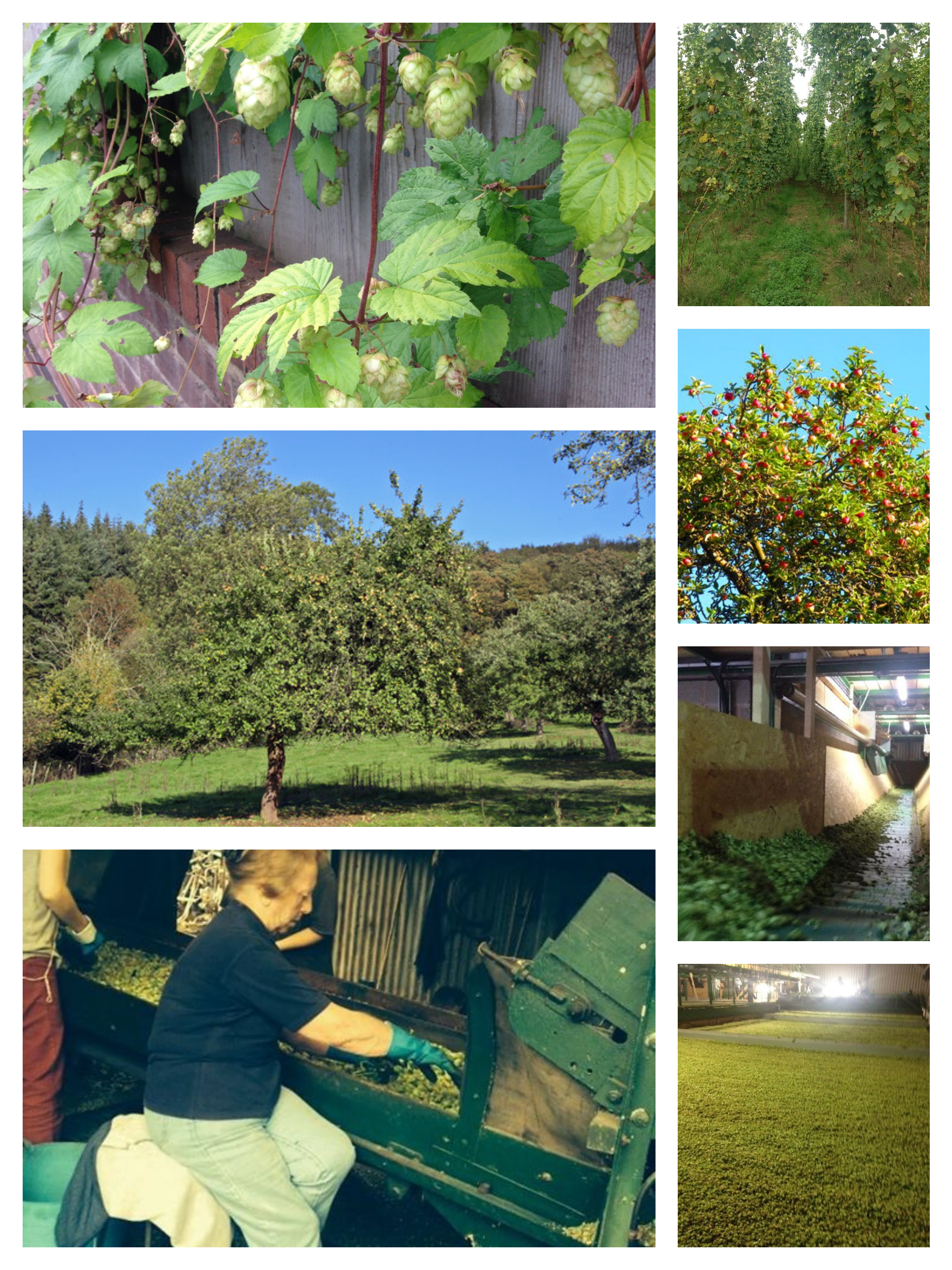
Just outside Ledbury, heading west, is apple tree land. The trees follow the natural contours of the land, planted years ago in immeasurable stands forming today’s superficially boundless orchards. The apple seems a proud tree, rounded in form yet spiky close to; planted en masse yet independent, shapely, interesting to the eye. This year, apparently, has been a bad year for wasps and a good year for fruit. So it seems; trees lining the roads hang saggily under the weight of a large and ebullient crop; dessert apple in size; preening themselves with red-robin bellies to the sun. Earlier I had drunk some farm-pressed apple juice; it was rich, fat and delicious; now I looked forward to the fermented version from these same apples.

Later that evening, I inspected my hops. They’re ornamental not for brewing, but they snake and bind pleasingly through a corner of my garden; bullying some plants, clinging on to others, finding holes in my fence where knots have fallen out, and pushing through, looking for the sun. The cones are just passing their best but are still lime green and resinous, almost to the point of dripping their oils. Some I will dry; others I will put in the house for the aromas; most will be cut back in waiting for next year’s hop shoots and riotous cycle of growth.

The apple-hop connection was only made later when a former colleague, Jo, posted some pictures of a Ledbury hop farm onto facebook. She had been to the farm the same day as I had been gazing on the apples and to watch their harvest; the bines twelve to eighteen foot; broad leaves like maples and dark, fleshy cones in bunches like a prize fighter’s fist. Most cones are stripped from the bines on a heath robinson contraption that cycles a hook round and round at head height; the bines dangle like a freshly butchered carcass before being sifted and sorted by hand and laid out in a thick pile carpet to dry. Like the fat apples, they spoke of spicy, citrusy, earthy beers to come; I licked my lips in anticipation.

For many, and for many a long year for me, cider and beer were like cats and dogs: you are a ‘beer man’ or a ‘cider man’; the fruit or the grain; the press or the boil. But nature doesn’t see it that way. In this thick tilled soil, on those rolling hills, both are at home; growing, ripening with the passing of the sun; blossoming richly in time for harvest and to sustain us all.

Apple Tree in fruit_fotor

Some photos courtesy of Jo Miller

© Beer Tinted Spectacles, 2014