The Pocket Beer Book. Part 1: Thirty Years in Beer

It is now almost a generation since Michael Jackson published ‘The Pocket Beer Book’ – 1986, in fact.  It was part of a series of Mitchell Beazley ‘Pocket Guides’ – in my experience all crisply written; all concisely helpful; all pithily illuminating.  And I had other beer books: Jackson’s ‘The New World Guide to Beer’ for one – now, rightly, considered a classic and for many the inspiration to brew.   But it was the Pocket Beer Book, hard backed, one hand high and a thumb length across in its succinctness, that lit my interest up.  It was elegant, erudite and more than a spark to my curiosity, more a rocket. And the real bonus: it was pocket sized; slipping neatly into an inside coat pocket and from there, travelling widely.

IMG_0891Why did it work so well? Every beer book starts with an overview to beer; and so did this. Yet it was not florid in phrase: this version got to the point, and in a few short pages helped the reader deconstruct beer styles; suggest how different beers could work with food (Jackson’s passion) or how beer varied by season. And then off at a canter, in fine-point text, through the world of beer as it was at the time. Then there was the pièce de résistance. The 4 star rating system that added the edge. Jackson said that they were merely meant as a guide and to assess beers within countries against one another; nonetheless, here was a proxy, a shorthand that showed what the principle Guru of beer thought of different beers.

What prompted this harmless reminisce was the publication of a new ‘Pocket Beer Guide’.  Different authors; different publishers; different format. But a pocket book all the same; paperback not hardcover, a little shorter but markedly thicker – three times so – which in itself says a lot about a generation of changes. The authors, Steve Beaumont & Tim Webb have made the decision to stick to the four start rating system – so the beauty is we can get a snapshot of how the world of beer has changed in that time. And so, my research began – I started with the new version, which despite the sheer overwhelming number of beers discovered and reviewed, is a real page turner; then back to Jackson’s original, equally so. Presented here, the main findings.

The tide flows in. It’s fascinating seeing the changes. Back in 1986, Sierra Nevada for example, was still effectively a start up, a “classic boutique” in Jackson’s words. He gave its Pale Ale 3 stars (‘worth seeking out’) and Big Foot Barley Wine 3 to 4 stars (4 stars being the coveted ‘World Classic’).  Today, Beaumont & Webb give Sierra Nevada Pale Ale and Bigfoot Barley Wine both a clear 4 stars. More than that, in 1986, only five US beers were judged 3 to 4 or 4 star beers. Today, it has more than doubled to 11 – this may not sound much; but if I had included the number of 3.5 star beers (a classification that Jackson didn’t use), it would be an even clearer illustration of the innovative, inventive and stunningly creative advance of American beer:  the reality is that in the U.S. and elsewhere a measure of the good health in beer is both the quantity and quality.  There are some beer writers who bemoan U.S. beer culture and its quality – claims not without substantiation – but at this level, of beers ‘worth seeking out’ or ‘World Classics’ the rising tide of quality is undeniable*.  It will be difficult for Sierra Nevada, Anchor Steam or Lagunitas (say) to hold onto their ratings in thirty years’ time if the level of brewing and beer development proceeds at the pace it is now.

It’s still about the ‘old world’ – old ‘beer’ world that is. What is striking about the new guide, despite the wealth of detail on countries where in the mid ‘80s there was nothing to write about, is that the creative momentum behind beer still resides in the old – largely Germanic and Anglo Saxon world.  And by this, I include North America and most northern European countries. We simply cannot argue, with the U.S. in particular at the forefront of the ‘craft beer’ revolution thirty years ago that it is a new front.  No, the next few decades will surely increasingly be about the now nascent craft beer movements in regions such as Brazil and Argentina, Austria and Eastern Europe, even Australia and New Zealand. And at the forefront of this Italy now maturing as a country brewing sensational beers and Japan – where the authors scored many beers 3.5 stars but which haven’t yet pushed over the boundary to ‘World Classics’. Their time will be soon.

Large turns small.  Consolidation and acquisition sings out from the years between the guides. And with it the decline in quality is equally evident – particularly in Germany and the UK with brands like Spaten, Paulaner, Courage or even Thomas Hardy’s Ale falling away. The contrast between ‘big beer’ brewed for efficiency, scale and profit and ‘small beer’ brewed with pride, principle and integrity has never been clearer.

Small brews large. The question of innovation is fascinating. I’ve worked on both sides of the great divide and can speak with some experience (and at length, alas) on the subject. But the overall conclusion is this: the focus of innovation for big beer is on consistency; brewing speed, cost reduction and accessible flavour (not necessarily natural beer flavours).  Small brewers are the genuine innovators – and their innovation will in the long term have much more benefit on beer’s reputation as well as the brewery doing it.  And if you want envelope-pushing brewing then you have to look small. Take IPA: a beer style virtually dead 20 years ago. Now there is British IPA; American IPA; double IPA; Pacific IPA; New Zealand IPA, Black IPA – IPA is being brewed in lagering nations, like Germany and the Czech Republic. Equally, you’ll have to look hard to find one of the World’s top 20 brewers making a decent barley wine or Imperial Stout; or any that are aging their beer on wood.

Better burn out than fade away? With all the hoo-ha in beer blogdom with new styles created and old styles rejuvenated (Porter, Amber lager), it’s easy to forget that many classic styles have in the last few decades either remained in peril or almost gone. Take Lambic – whilst there are still amazingly exciting spontaneously fermented beers being brewed, I believe they have been weakened by faux-lambics and a raft of overly sweet mimics**. Or Dortmunder and Berliner Weisse which seem to have slipped below the mire –certainly the quality examples. Another – I remember driving out of my way to find the Rauchenfels Steinbier brewery – but alas, it had closed. Maybe in the world of craft these beers are either not distinctive enough or conversely too distinctive – a little too convoluted, complex or challenging to brew and make a commercial return?

Reading both books made me slightly wistful about a time of personal innocence; before I understood the breadth of beer and was walking into that world wide-eyed; before I had worked for a major brewer and learnt how the soul of beer can be crushed and I lost my passion for beer only for it to be reborn – reborn because of the characters working in beer today and the new wave of brews and brewers making change.  That is the hope that lies within the 320 pages of the new Pocket Beer Guide. Let’s pray that it is hopelessly out of date within a year.

© Beer Tinted Spectacles, 2014

* Of course, the scoring in the 4 Star system is bound to be highly subjective.   It’s clear from reading the guide that Jackson had a soft spot for some countries and some breweries for example (see Part 2), but such qualms would mean letting the tail wag the dog and losing sight of the bigger picture he was painting at the time.

** On a related note, I find it hard to rave about the main British beers ‘brewed with fruit’, which to me seem insipid, unbalanced and sickly compared with the elegant finesse of a true Kriek or Framboise, which has the boney, dry structure to handle the intensity of real fruit.

Epiphany

“Dost thou think, because thou art virtuous there should be no more cakes and ale?” (Twelfth Night)

Epiphany seems a good a day as any to write about beer. It should be a national holiday for a start. I mean, it’s the twelfth day of Christmas – we’ve had mince pies, crackers and trifle as well as twelve drummers drumming in the Tinted house; that is of course before we dashed round in a wobbly, inebriated state to take down all the deco’s.   There was/is a Cheshire tradition* that some of the old folk were still sticking to when I was growing up about the festive period really beginning on All Hallow’s Eve (31st October) and concluding on Epiphany – it feels more like a pagan celebration to me and given that this correlates pretty much exactly to when retailers start going crazy with their Christmas adverts and Christmas displays, that’s probably bob on.  It certainly doesn’t feel particularly Christian all this over the top consumerism.  Yet, there is something bewitching, magical and at times, even ever-so-slightly eldritch about the pre Christmas period – and that it should finish on Boxing Day (or New Year’s Day at a stretch) is more like a whimper than a bang.  No, Twelfth Night – or more strictly speaking Twelfth Day – is when Christmas properly closes and the New Year opens up ahead.  Twelfth Night was traditionally one of the wassail days when the fields were blessed in the hope of a good harvest to come. Twelfth Night has the sense of being preternatural; mystical, final… as if one door is closing and another opening up. So it feels right and proper to reflect on the year gone by and consider the year ahead.

Anyway, over the Christmas break I jotted down some reflections on beer and Christmas, prompted in part by Pete Brown’s commenting about wine still getting all the column inches in the papers despite the fact that there’s very little new news in wine**. In no particular order:

IMG_2454Own label: the rule in beer was always that there was no place for a supermarket’s own label beer brand.  No place emotionally because the quality would be poor / perceived to be poor. No place commercially because why have own label when the Big Brewers are offering their brands at three 24 packs for a tenner?  And oh, and no place socially because we all drink in the pub at Christmas anyway.  But this Christmas was the first time I really noticed a change: ironically via wine. If you want any signal that there’s a paradigm change in supermarkets going on right now witness Tinted family events on Boxing Day, when my father proudly regales us with his story of how Aldi Prosecco is better than other supermarkets and considerably cheaper (it was actually a Cremant de Jura, to my palate better than Prosecco, being drier, but still considerably cheaper).  And if you haven’t drunk Sainsbury’s own label US craft ales (see http://www.beertintedspectacles.com/?p=206) ‘American Pale Ale’ and ‘Tap Room IPA’ then silly thee, is all I’ll say.  Particularly because….

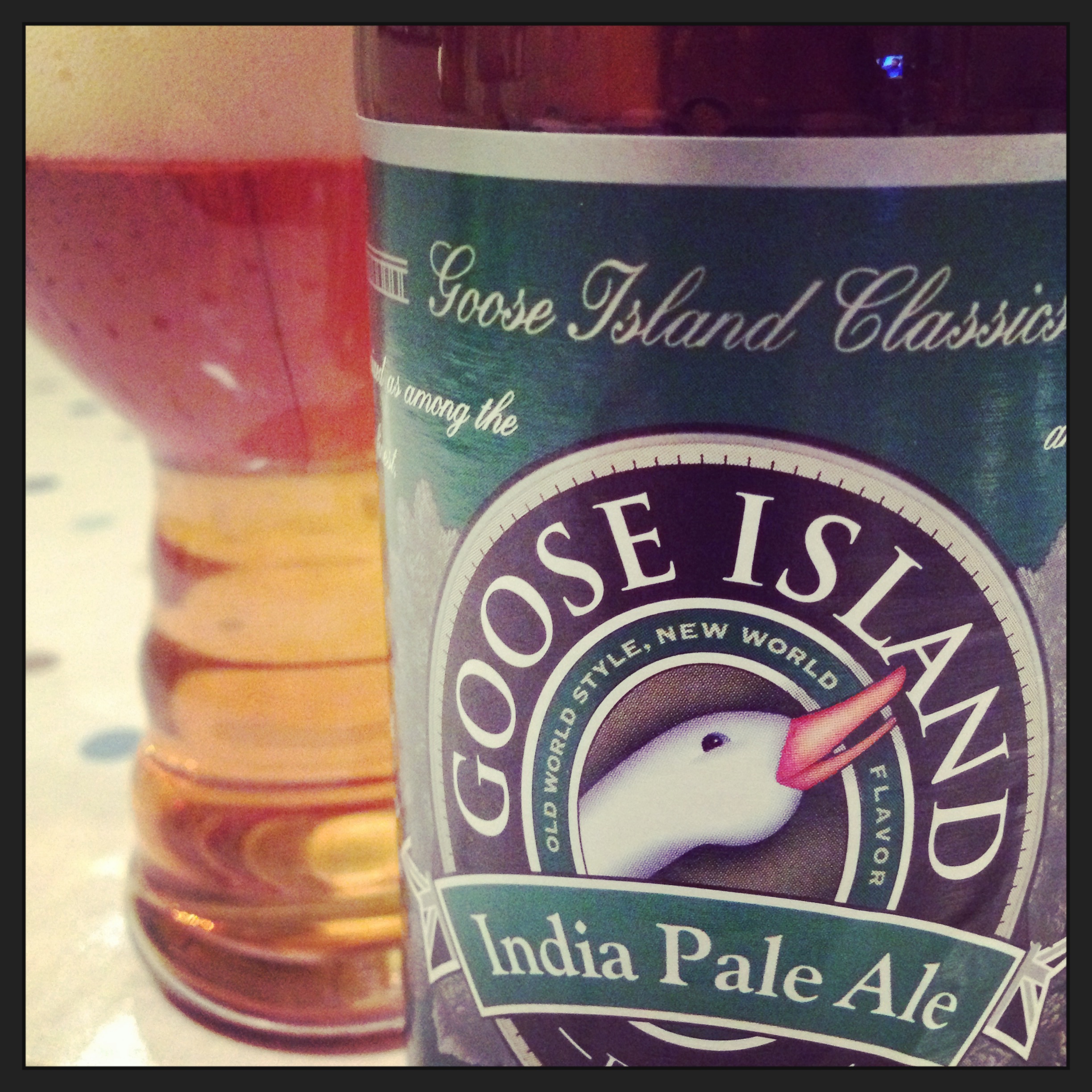
The interesting things are NOT on display: blimey, the retailers are clever.  Free Clubcard points for buying two of this; multibuy discounts for buying three of that…  Yet for me, it’s the power of display that is just staggering.  Retailers don’t give names to certain areas for store for no reason: the ‘Power Aisle’, the ‘Goal Posts’ – they’re key to winning the retail war.  The way the supermarkets both bludgeon you with promotions and  gently nudge you too into altering what you buy is just fascinating.  But what struck me this year is that the really interesting stuff isn’t on the big displays – the ‘gondola ends’ and the pallet displays by the entrance – but on the shelf.  And it doesn’t mean you won’t get a good deal.  If you did shop in Sainsbury’s this year, you might have seen the big push on craft beer:  3 bottles for £5 across brands such as Tap Room IPA, Goose Island IPA, Blue Moon, Brooklyn Lager:  amazing beers; not on display.

Natural hunting ground:  why, other than a simple beery bias, does it make sense for beer to enjoy more press coverage, especially at Christmas?  Of course craft beer is on the up but there’s more to it than that.  Forget the bah-humbuggishness of the commercialisation of Christmas; forget the endless celebrity chef programmes on how to cook the perfect roast potatoes; drilling through all of that what is more than skin deep is the continuing need for human togetherness which few other celebrations – or institutions – provide these days.  And beer is the natural partner: inebriating but not too much so; interesting, versatile, not too closely associated with a particular mood or particular occasion…

No champion: …which is an issue too.  There isn’t any consistent beer coverage in print, celluloid or digital.  There is so little retailer inspiration: I mean, how much Carlsberg or Stella is it possible to buy? And when will they clear those Christmas packs of Budweiser? Easter?  St Swithin’s Day?  No, everyone seems to bang on about matching beer with food, but actually beer needs more than a creeping barrage: it now needs someone to actively champion it in the national media.  We need more than Jamie dishing up bottles of Asahi Super Dry when he makes a lemon posset. And we need more than recommendations that this year’s Champagne is Prosecco. No hang on, that was last year. This year it’s Saumur.  Bloody hell, all beer is sparkling: we have to get a look in.

No food porn: and on a related theme, food has become porn hasn’t it? Or at least, it’s like those Victorian peepshow boxes.  In the run up to Christmas there were about a dozen Jamie programmes (“lush”); Nigella, River Cottage, Delia, Hairy Trikers, Big Tom Kerridge (“proper lush”), Saturday Kitchen, Sunday Scullery, you name it.  But you know what?  I watched a load of them, all to get inspiration on how to spice up my Sprouts or titivate my turkey. And where was beer in all of this?  See above.

A quiet, proper food and drink revolution continues was more noticeable than ever this year – there was just more interesting stuff, and not all in gourmet ranges at gourmet prices. My nearest Tesco Extra has 6 ‘modules’ (a unit of shelving approximately 5 shelves high and 1.5m wide) of space dedicated to craft beer and world beer; a further three to cider (far too many actually but beggars can’t be choosers); there’s interest and inspiration all around.

No reason to believe then that 2014 won’t be an even more exciting beer year than 2013; no reason to think that the job of revolutionising beer isn’t as big as ever. And certainly no excuse not to eat more cakes and drink more ale.  Happy 2014 everyone.

* and forgive me, you can guarantee that this isn’t a Cheshire tradition but one that was celebrated much more roundly. But that’s where I’m from and that’s where I witnessed it. So there.

** sorry, can’t find the link. Must do better.

© Beer Tinted Spectacles, 2014

My Kind Of Town

IMG_1074
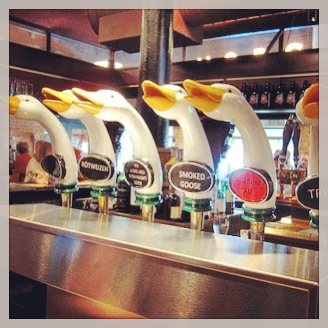
The Goosey Geese Tap Handles of Goose Island.

One city is the United States in microcosm. New York is amazing: soaring, spiky, spectacular. It’s almost a caricature of itself though; too showy; too extreme. San Francisco on the other hand is happening, boho, liberal, supremely geeky – so much so that it could never be described as typical, wonderful though it is.  No, that microcosm is Chicago; a city that for me encapsulates a little of everything you imagine heralds from the States, a little of everything the States is great at. There’s the architecture (Skyscrapers, Frank Lloyd Wright), the music (the blues, the jazz, gospel), the sport (the Cubs, the Giants, the Bears), the weather (+35°C Summer, -27°C Winter anyone?), the industry (head offices of Kraft, McDonald’s, Boeing)… all this and more. Yet there’s something else, something more elusive.  First, there’s the setting.  Most US cities have height in their downtown, but Chicago flies. It’s a city that simply rockets upwards, out of the Plains like the vision of ‘Metropolis’ imagined in early science fiction.  Although not the tallest skyscraper, the Hancock tower provides the best view as undisturbed, you can look out east over Lake Michigan, eyes straining to see the curvature of the Earth, or north as the city drops away, tracing the lake coast as it falls block by block, gradually descending like a city built from Lego, until it is just the shoreline heading into the horizon.  Then, there’s the food and drink culture.  Oh, this may be the Mid West; this may be Six Pack Joe central, but make no mistake, this is a great food city and what’s more, an amazing beer city too.

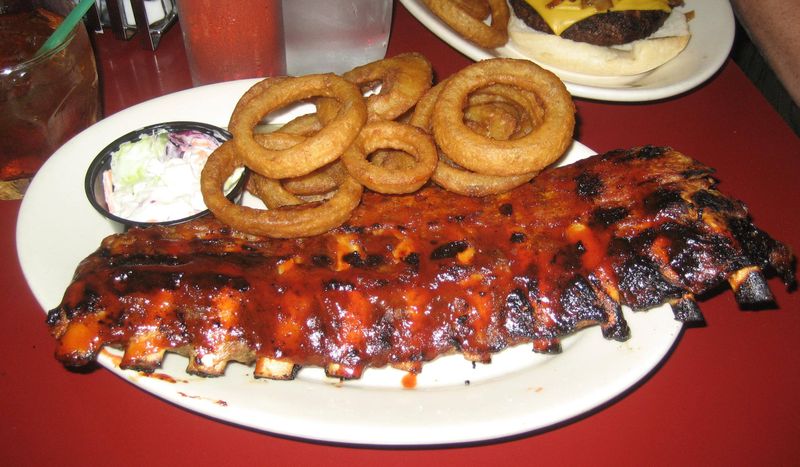
Twin Anchors rack of ribs: “Like an orchestral Xylophone being brought in sidew

IMG_0782

IMG_0784
Take two pizzas. Stack one on top of other. Invert. Add more cheese and tomato. Bake.

I first went to Chicago in the late 1990’s. To be honest, I hadn’t really genned up on the place as the days beforehand had been stupidly hectic, but it didn’t take long to be astounded by the native Chicagoan foods – and the vast quantities served.  It was also the first time I had witnessed Starbuckisation in action.  We stayed in a pretty basic hotel, a Days Inn located perfectly just north of downtown for the bars, business and eateries and bang next door to the Lake Michigan shoreline over Lincoln Park. In no more than 100 yards of us in each direction were 6 coffee shops, 4 of which were Starbucks – easily within sight of one another. Anyway, that first week was business, and as a group we investigated Chicago’s dining and drinking scene. There was deep dish aplenty, a Gino’s East pizza restaurant not far from the Museum of Contemporary Art was my first experience of the famous upside down, inch thick pizza; there were others but Lord knows how we made room for them. Sandwiches too, bagels for breakfast of course, and downtown somewhere just below the Loop tube train, we had a two-inch thick Italian beef sandwiches soaked in gravy and served with whole heads of roasted garlic. Then there were the ribs: the most memorable assaulted us in the Twin Anchors chophouse where I went with my brother the night before Halloween. We were overawed, and not just by the skull decorations – there’s no other word to describe the speechlessness you get when a rack of ribs the size of an orchestral xylophone drenched in pungent BBQ sauce has to be squeezed out sideways through the kitchen door to the diner’s table. We shared a half rack (kids portion?) and were still fit to burst.

IMG_0766 IMG_0765The leitmotif of the trip though was the beer. The bar in our hotel was a bit like a ground floor ‘Cheers’.  It was not just frequented by guests but locals too, office workers mainly, popping in for a swift beer and bite before they headed off home.  Horseshoe shaped, with the barman seemingly at the centre of every conversation, many sat there at the bar for a few hours, making conversation with anyone who would listen.  As a group of Limeys we were, I’d like to think, entertaining as much as entertainment. Beers? Well, there was the normal selection – Miller, predominant, this being Chicago –  Michelob, Bud and Coors too, even Schlitz which you’ll hardly see now.  But none of these stood out nearly as much as the tap handles of Goose Island – my first encounter with the brewery and its beers. US bars can look like an array of wobbly wickets at the best of times so the Geese of the Goose Island hissed and honked like no others.  And the beers stood out too. At the time I hadn’t realised that we were only two blocks away from the island in the Chicago river that gives the brewery its name. With the passage of time, I can’t remember exactly which beers were on sale apart from two – both still parts of the Goose Island range today. The first, Honkers.  I mean, with the name alone you have to try it. And what a delight – a beautiful lustrous copper colour and fruity aroma with malty bitterness assisting drinkability.  And India Pale Ale, the beer that nowadays you can easily buy over here.  It’s simply an incredible beer: incredible when you consider it’s a fairly basic infusion mash off a single malt base and extensively hopped both with American and English hops. Yet for such a punchy, full on beer it remains well balanced – so its both one to savour and one to drink. My kind of beer; my kind of town.

© Beer Tinted Spectacles, 2013

Porter house Black

The Cathedral Close in Exeter must be one of the finest in the country.  The Cathedral Church of St Peter, an architectural beacon for miles around with it’s twin towers straddling an enormous vaulted nave, look down genteely on a full enceinte of hotch potch buildings constructed in all styles and through all the ages.  Today the shops are mostly cafes and restaurants, a bookshop and some gift shops, yet through all the change one pub still thrives. The Well House must enjoy one of the most spectacular views from its doors of almost any British pub.  And it was an old haunt of mine, taking our pints outside in summer, perching on the low wall in front of the cathedral lawns and wiling away a pleasant hour or three.

I associate The Well House with porter – a beer style that is increasingly in vogue these days but back then was a rarity. It was most definitely unusual to find it on draught in a pub at the time – and in fact still not so common today I suppose.  Alas, the beer was a struggle – I can’t remember the brewery or the brand, but it was an earthy, acrid, scratching beer – it fought you, it bit, it spat – making you work for the rite of passage – one I chose not to take. Almost unbelievably therefore, I have either avoided porter since, or more accurately, allowed myself to be tempted by other types of beer when the choice arose.  Daft really, but it shows the power of a single experience – just one ‘bad’ pint and the whole family of porters is tarnished, wiped off the map for two decades.  Tch.

Porter is one of those fascinating beers that would be of interest for general historians not just beer enthusiasts.  One of the first ‘mass produced’ beer styles, it caught on during the industrial revolution allowing its brewers to scale up as urban population exploded: steam powered breweries; wooden-staved conditioning tanks so large that brewery Directors entertained the great and good within them. All today’s porters guess at what we believe they might have tasted like. It’s believed for example that given that the beer was matured in wood, that the original porters of the 19th century would have undergone some secondary fermentation – from the yeast contained in the casks. It’s believed too that the malt bill would have contained a pretty high proportion of almost burnt grains from the direct firing methods employed at the time. So perhaps my experience in The Well House was accurate. We can only imagine the flavours that would have arisen – winey, vinous, with a cider-like cut of sharpness at their best, vinegary at their worst.

Shepherd Neame brew what for me drinks like a classic porter. They actually brew it for Sainsbury’s ‘Taste the Difference’ range.  It’s ink black – blacker than many stouts (and particularly, much blacker than Draught Guinness which nowadays is almost reddy-brown), definitely as black as squid ink and blacker than the heart, soul and naughty thoughts  of the Lord Of The Underworld. This beer is Seven Hells black and pours with a rocky, caramel toffee head which lingers beautifully and laces frillier than Agent Provocateur frilly knickers.  The smell: it’s Bonfire Night come round again, with cinder toffee and a whiff of Guy-Fawkes-is-Burning pure smoke or perhaps just gently smouldering pallets – all following through into the taste, with an extra sharp edge of charcoal.  Not then a pint-after-pint supping beer; but definitely one for sitting down in the Dickensian bay window seat of a local hostelry on a cold December night, looking out over the Cathedral before crunching home through the winter snow.

© Beer Tinted Spectacles, 2013

The Session #81. Women and Beer: Nothing To See Here, Folks.

The Session, a.k.a. ‘Beer Blogging Friday’, is an opportunity once a month for beer bloggers from around the world to get together and write from their own unique perspective on a single topic. Each month, a different beer blogger hosts the Session, chooses a topic and creates a round-up listing all of the participants, along with a short pithy critique of each entry. This month’s topic is from Nitch at Tastingnitch who has chose the topic, ‘Women and Beer: Scary Beer Feminists or a Healthy Growing Demographic?’.  Let the battle of the sexes commence. Or not.  Check out Nitch’s blog at http://tastingnitch.com/

Here we go again. If you have been awake during the last ten years of the craft beer revolution then you can’t possibly have missed the growing narrative around women and beer.  Be it the failed launches of beers aimed at women; be it the Second Coming of the Female Brewer (should I say, ‘Brewster’?); be it the hefty punch carried by many female beer bloggers; be it our first female Beer Sommeliers. The Session Image

In truth, I’m tired of it: not as a bloke, but as a lover of beer. It’s a no news story.

Let’s take the first side of the topic:  ‘Scary Beer Feminists…?’   Well I’ve met some Scary Feminists.  And in the world of work, I’ve met as many nasty, bile-filled and spiteful alpha women as I have nasty, bile-filled and spiteful alpha males. That’s life.  But in the world of beer where beer is celebrated, not just a big bucks business: the craft, cask, micro, flavourful, blogging world, all I’ve met are enthusiasts.  Men and women, ardently pushing their case; why their beer is the best beer ever brewed; why their town or region is the hottest of brewing hot spots.  Sometimes this ardentness pushes into the female:male gender debate – for example, why the growth in brewsters is simply a rebalancing; getting back to a pre-industrial time when women did the brewing, and therefore this is a good thing because women are regaining their rightful place at the ‘brewing table’.  Well, it is a good thing, but a good thing because sufficient numbers of women are now interested enough in good beer without all the stereotypical, schmaltzy, nostalgic arguments that run along with them.

To the second side of the topic: ‘…or a Healthy Growing Demographic’.  Women are just over half of the population worldwide. It tends to be slightly more because women live longer than men, so let’s just park that right there.

The ‘issue’ with beer and women isn’t about demographics.  It isn’t about blokey advertising, although I’m sure that hasn’t helped. It isn’t about the ratios of male to female brewers. It most definitely isn’t about the taste of beer; I dare anyone who encounters the salami and smoked roast meat flavours of Aecht Schlenkerla Rauchbier not to find it extremely challenging when they first try it.  I dare anyone not to find an American double IPA a full-on experience when they first try that.  What I do see is many, many women trying beers like these and more besides, just as they would a new spirit, or a wine, or a coffee. Why the hell not?

No, the issue is culture. Take the UK: whether it was agricultural labourers or factory labourers after the Industrial Revolution, what you were selling was hard, physical, graft. No holidays, long hours, miserable conditions.  Women worked in the fields and they worked in the factories: my gran worked in the Cheshire cotton mills all her life, almost lost her sight through a flying shuttle and her fingers cleaning out the looms which they did without switching them off or slowing them down, weaving the cloth at full pelt. But overall, it bred a working population dominated by men, unburdened by the travails of childbirth (if I think my gran had it tough in the Mills, she was one of 14 siblings – spare a thought for her poor mother, two decades in almost continual child birth). It was a society of exploitation: of long hours and pitiful wages; homes were poor, often cold and dirty. The man would come home; eat; then go to the original ‘Third Place’ – a pub or club, to drink. And drink in quantity.

I don’t believe the change with regards to beer and women has much to do with the craft / cask revolution.  I do believe it has a lot to do with our post industrial society and the behaviour that it breeds: approaching equality in many more aspects of our home and work life.  Is it too big a leap to expect beer to follow?  Is it too big a leap to think how creative people don’t see beer as an opportunity and are getting after it, be it as a brewer, a sommelier, a writer or someone who just wants to try new things.

As far as I see, the healthiest thing for beer would be to make this a non-issue and move on. Celebrate it all. Gender. Creed. Beer Apostle or Beer Atheist. Man, Woman or Vogon. That’s what I intend to do.

© Beer Tinted Spectacles, 2013