Craft and consolidation

I’ve thought long and hard about a Tinted perspective on the ‘craft’ debate. Industry insiders and writers of all denominations here in the UK, in the ‘States and elsewhere have chipped in to make this a rich vein of beer column inches. Should I join in?

The answer I reached is no. And not because it doesn’t matter, but because it’s already too late. “Craft” as a word is already baseless, devalued. It’s become so over-used, so stretched that not only has it lost any useful meaning but it’s crossed the line and become unhelpful and confusing. At its bluntest it is a false amplifier, used to cast a positive halo on something questionable; at it’s most sophisticated, it adds no value to the more knowledgeable drinker who’ll work out for themselves what’s good and what’s not.

If we truly think that ‘craft beers’ are motivating for many drinkers then what do we think craft means? Or more to the point, what should it mean? Surely, you would imagine, it should involve some craft, some learned skill, human artistry, or personal flair. I like ironwork when hammered and hewn by a smith; or glass art, igneously brought to life by the likes of Jo Downs. To me that is a ‘craft’. One piece, similar on face value, is totally different from the next. Each with its own unique fingerprint.

For me ‘craft beer’ should mean this too. A while ago, I visited the Žatec Brewery in the Czech Republic. It was fairly tumbledown, apart from where investment had been made in key places: in the copper room; in fermentation, in yeast propagation and in new lines throughout. In the main, Žatec brew familiar Czech, lagered beers, not the mega hop profile of a West Coast pale ale, or the counter-intuitive thinking of a black IPA. But their beers are craft: the ingredients are picked, selected and loaded by hand. Fermentation is judged to be completed by the brewmaster not the stopwatch, maturation also. There is some slight variation in the end result, precisely part of its charm. They’re now half owned by Carlsberg, but are they any less craft?

Likewise, I recently visited Westons cider mill in Much Marcle. The vat shed there is one of the wonders of British cider making; there must be over 50 oak vats, all old, all named, unique in height and girth, strapped together with iron belts and carrying titles as varied as ‘Gloucester’, ‘Worcester’ and “Aston Villa’. But every drop of Westons cider spends time in those old oak vats. There’s just no way on earth that each batch can be 100% consistent, yet alone the fact that much of their product is ‘vintage’ so will vary enormously from one season to the next dependent on the fecundity of the harvest. Surely, this is craft? Yet within cider circles, merely because of their ‘scale’ (medium-large in cider terms, modest compared with many breweries, minuscule compared with brewing multi-nationals) many commentators claim that they can’t be described as such. They remain wholly family owned and independent.

Yet equally, I have been round a number of craft breweries who use spankingly new, gleaming stainless steel equipment and whose brewing process features automation (grist loading, hop addition for example) and is run from an iPad. Is this craft?

Our perspective has become cock-eyed. What we have to nurture is something entirely different. What we have to nurture is the human desire for variety, to be curious, to discover and try new things. A desire that in the late 60s and 70s was almost suppressed. The role of ‘innovation’ in proper beer remains as important today as it has ever been. On the one hand, we have the major international brewers putting much of their focus into mass-produced hybrid products (part lager, part spirit, often mixed not brewed) that do little for the brand other than confuse and are, in essence, a way of supplying easy drinking, relatively low cost alcohol to young adults. Conversely we have a push for discovery and rediscovery in genuine beer from national brewers to micros (and even, more patchily, with some multi-nationals) that matches this human trait and is breathing new life, new vigour back into beer. This is what we must protect, through our inventiveness and as drinkers, through out wallets.

Because have no doubt. The threat of mega-consolidation is a looming large now, dwarfing any petty questions of how to define ‘craft’. The economics of acquisition demand cost and efficiency savings. Savings mean cuts, closures and simplification. Brands will die; brew streams will be reduced, provenance will count for little. And as in turn, growth slows, so the eye of the multinational looks out into the world of burgeoning smaller brewers and eyes them lasciviously. Once they’re ‘synergized’ into their networks, the clock on them being able to carry on brewing in the way that the Founders intended, the way that built the brand and brought them success, is ticking. Tick follows tock follows tick.

So call it craft if you want to. Call it ‘interesting’. Call it ‘flavoursome’. Call it what you will. To me, it doesn’t matter. But whatever you do, support independent brewers who continue to innovate and brew with principle. A dark shadow is growing.

© David Preston, Beer Tinted Spectacles, 2015
Bier und pretzeln

Our U.S. beer trip – well, I say that, but actually it was a holiday to Disney and the Gulf Coast with the kids – but you know what I mean – the beer trip, started with a wind up.

We were going to tell the kids at Christmas, but frankly their behaviour on the day didn’t warrant it, so we held the news back. And somehow, with the deft touch of time, the idea metamorphosised into a trip to Germany. Handy, that indirect flight via Frankfurt. But Germany? For two weeks? At Easter? “But dad, why do we need swimming trunks and beach towels?” asked my eldest. “Errr… there’s the largest indoor water park in Europe” I lied, unconvincingly. And damn, if she didn’t look it up on the internet too, but we brushed it aside and stealthily had a new Center Parcs built to accommodate my Pork Pies. “But what is there to actually do in Germany, Dad?” probed my youngest, incredulously, a weak seam obviously evident. “It doesn’t sound very exciting.”

But somehow the answer was much easier, and excitement veritably bubbled up from me. “Bier and pretzels”, I confidently replied. “Yes, bier and pretzels – or pretzelN,” – I stressed, always eager to fit in some extra curricular essential learning. And I meant it. Well the baked goods part in particular, them being below the legal drinking age and all that.

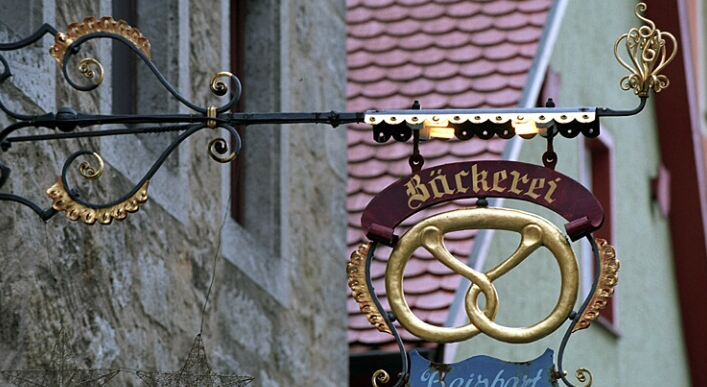
Pretzel signAnd they could see I really was excited. I told them of Mr. Jeffers, my first German teacher, who changed from the standard first language lesson from numbers 1 to 10 and ‘hello’s’ to how to order a beer. What would the number crunchers at Ofsted think today? But I remember it to this day and that’s surely the most important thing. I told them of a trip to the Rhine valley when I was a teenager and seeing the bäckerei with their gold leaf pretzel signs outside and glass shelves overflowing with wonderful rye breads, pumpernickel and amazing cream cakes. I told them about my first visit to Germany, also on the Rhine valley, and going to a würst and senf festival in the town we were staying in. A country where the festival is the sausages and mustard, not the accompaniment to something else. And these were not those briney, skinny, industrially squeezed sausages you buy in tins and plopped in a fluffed up white roll. There were sausages of all colours, shapes (well, not all shapes; they were mostly sausage-like) and manner of meaty flavours, cooked over wood barbecues. I can still smell the tingle of the appley charred smoke in my nostrils and picture it drifting down the bunting clad street. And then, to top it off, the creamy, vinegary soft, spiciness of the mustard. This wasn’t street food: this was beyond that; this was deeper, more heartfelt; this was passion, German food culture and love served up on a plate.   And I told them about the vine shaded beer gardens sloping down to the Danube in Regensburg with yeasty, clovey wheat beers and the accompanying oven bottom, bready sweet, dampfnudeln to fill up holes in the stomach, all presided over by a clucking Herr Ober who ruled the roost like his own front room, all clucking and full of pride. I told them too about the Cannstatter Volksfest and the Oktoberfest, but omitted many essential details.

Well, that served me right. My contagious enthusiasm was passed on, and suddenly the kids are researching things to see and do in Germany (distance no object). The Black Forest; the Eifel mountains; Cologne cathedral; a boat trip on the Rhine or Mosel. Oh, and the biggest indoor swimming centre in Europe, naturally.

IMG_3394In the end, the secret remained safe right through to the transfer desk at Frankfurt airport, where we had to check the Gate number for Orlando. My youngest was both delighted and upset. “Does this mean I won’t get to try a proper German pretzel?”. Tears were welling up and everything. So there we were, in the transfer terminal. Me with a glass of local Licher Pils, beautifully served of course, in a simple, stemmed glass and pretzeln all round: crisp, dark outers with the slash of double cream coloured dough poking through; lightly pebble dashed with rock salt for that crunchy bite.

No more wind-ups now: time to get back to Germany proper. 

© David Preston, http://www.beertintedspectacles.com, May 2015

Copper Bottomed

Sometime ago, I wrote a piece about recent efforts by some Czech lager brewers to bring ‘tanked beer’ to these shores. It’s a worthwhile aim: to attempt to deliver absolute authenticity and the ‘brewery fresh’ taste that rocks you on your heels if you drink beer straight from a lagering tank, ideally in a cave or cellar under a Bohemian brewery.

Recap #1: the players. Miller Brands, the UK arm of South African Breweries (SAB) were installing permanent tanks in a number of prime bar locations, and bringing over smaller barrels too, for a ‘from the wood serve’ with which they were ‘going on tour’ – essentially a PR exercise. Budweiser Budvar, without the financial clout of SAB, were cracking on with a slightly different riff, their ‘Krausen’ or yeast beer. Like the tanked PU it was unpasteurised and carefully imported from České Budějovice.

Recap #2: the results. The half-termly report was ‘not a bad start but with much room for improvement’. I tried the Pilsner Urquell from the permanent tanks at The White Horse on Parson’s Green. It looked glorious: served in chunky tankards to a variety of serving specifications. The beer’s famed bitter note were highly pronounced versus the packaged version – but strangely whilst it pleased the eye it did less for the taste buds; I didn’t get the rounded complexity of the unpasteurized PU that I had enjoyed in the Czech Republic. The Budvar on the other hand, here from the The Draft House on Charlotte Street, was the opposite. Looking nothing out of the ordinary, served in unbranded glassware and not forming or retaining its head, it was lively, fresh-tasting and spicy nevertheless – the only issue was that it was still quite close to the bottled beer (which I drank alongside).

Now there’s new news, to use the business parlance, from Budvar UK. The brand has been a bit quiet in recent times; still a fine, fine beer of course, with that lovely creaminess and a palate at the sweeter end for a Bohemian lager, but left a little breathless as wave after wave of new entrants, promising something ever funkier, have entered the market. But here’s the thing, brewing great lager – seemingly, so simple – is fiendishly complex, time-consuming and expensive. UK craft brewers who have set off down this road have realised the considerably higher level of investment needed, and the cash it sucks out of your business – assuming of course that the brewer is lagering their beer for a few weeks. The precious tank space which could be used for something well, quicker, is needed while the lager dozes. On top of this, there’s the unscrupulous cleanliness required, decisions about whether to use modified malt or decoct, a separate yeast bank, it’s never ending.

At the moment, Budvar Tankové Pivo is a trial, at the delightfully bonkers Zigfrid von Underbelly on Hoxton Square. The tanks, rightly, are pride of place; there are two stacked one on top of the other in the main bar area and another one in the cellar-proper. Each holds 10 hectolitres (about 6.5 proper barrels) and like the Crown Jewels, they are displayed behind glass. A nearby sign proudly announces when the next delivery is coming: this is, after all, fresh beer, unpasteurised. It can’t hang about, and initial sales show that it isn’t (currently about a tank a week and rising).

Let’s pause for a moment on what the tanks do to the experience of drinking. They’re copper and as such, have something of a Jules Verne, ‘20,000 Leagues under the Sea’ quality about them. With hand shaped, baffled ends, they’re only lacking a perescope. Copper piping too abounds, torpedo tubes no doubt. The font is copper too; and the beer, rather than being served in a standard tulip or nonic glass is a glass tankard. Everything marks this out as something different, something unusual. The expectation of specialness is copper bottomed, even before you even open your wallet.

Ultimately though, it needs to deliver: and no stone has been left unturned to ensure that the beer is as fresh as a daisy. The logistical complexity alone of getting beer from the lagering tank in České Budějovice, to the serving tank in London is eye watering: bespoke containers, refrigerated transportation; beer filled hoses (the beer goes to waste but ensures sterility): in all, four days of nail biting stress for those involved. It pays off: the beer sparkles with its crisp, gentle and all-natural carbonation – and here’s the clincher – it has that rounded softness, the biscuity base, the light fruity esters, the alcohol warmth – that only an unpasteurised and lagered beer has. The maturation adds the richness, serving it unpasteurised allows you to enjoy it in full.

The plans are for Budvar UK to extend the trial and hopefully roll this out more widely. It won’t (can’t) be something you’ll experience everywhere, it’s just too expensive, too labour intensive. But if you can, it is definitely something worth jumping in your tank to go and experience.

© Beer Tinted Spectacles, 2015

IMG_2998_fotor

Frozen

I know it’s my tendency, and that of other beer writers to focus only on beers that pass personal muster: new world IPAs, sour beers, perhaps discovery of a well hidden mild or brown ale and certainly not laaaager, dear boy (well, not the factory brewed lager anyhow). And if they (read: ‘I’) do write about lager it has to be ‘proper’ lagered beer; ideally all malt; hop restrained, double decocted and most, most, definitely lagered for a minimum of a month, ideally in a Bavarian or Bohemian cave or troglodytic vaults below a castle.  For the record they do exist, and yes, the beer is better (in the main).

When I set off on the Tinted journey though I wanted to reflect a personal stance in my writing. It was, and is, ‘pro beer’.  That is to say, whilst I may not enjoy or condone the beers and brewing practises of some breweries, typically those focused on a volume growth agenda and therefore targeting efficiency and profit over quality, integrity and craft, I wasn’t going to slag them off either. At least, not unless there was a clear rationale, a basis of a subjective truth; a deliberate contradiction in terms, I know. Goodness, I worked for a national, now multinational brewer for almost two decades and hypocrisy stinks: I am free to vote with my wallet and tastebuds and that’s what I have chosen to do. At the end of the day though, for a normal person, beer is beer is beer.  If people like me piss in the proverbial pot it pollutes the whole thing.

And today is one of those days that justifies my stance.  I am in the Canary Islands.  My wife is swimming a staggering amount of lengths in the pool outside; the kids resting under a metaphoric shady tree for it’s 29 degrees, with a cooling breeze off the ocean, that oftentimes whips into violent, short-lasting squalls, hurling inflatables, whistling at windows.  The landscape is stark but not bleak: this island is volcanic, the rock is young, black basalt, with deep holes where the gas and air hissed out as it cooled. Ever ingenious, man has worked with it; walls contrast in white; plants are tolerant of both drought and malnutrition, houses are concrete slabbed & whitewashed, unheated, airy. Water is scarce compared with our blessed isles further north. In short, you perspire just walking to the shop at 9am; air conditioning is blessing, a dip in the pool more so; a swim in the sea most of all.

That’s not to say that you couldn’t enjoy more beers here.  Sadly perhaps, I love shopping on holiday (or on business trips away), it’s a short cut to local culture. And the beer range always depresses me around the mediterranean shores just as it does here too. Quick brewed, pale beers, 50 shades of magnolia. Lager by name but rarely lagered by nature.  Yet, in an environment where you sweat just sitting outside, there’s something right about them.  The alcoholic level isn’t debilitating; refreshment is promised and is delivered.  As I type, I am drinking a Cerveza Dorada. It’s 4.7% ABV and it proclaims on the front, so I assume they deem it important, that it’s “100% malta”.  Our apartment had some ‘Tropical’ beer steins, so I popped them in the freezer.  Heavens! Heracy! A factory brewed beer, chilled to nut numbing temperature in the fridge and then poured into a frozen glass.

IMG_2181_fotor

But here’s the rub.  It’s great. The glass is exciting (no, really), steaming as the ice formed as I drew it from the freezer drawer; pouring the beer, you could hardly make out the amber body for the frostiness on the outside, I feared my lips would meld onto the rim. But no, it melted away and left gossamer strands of ice on the head of the beer. A beer which was OK by the way:  it doesn’t profess to be an earth shatterer, and I wasn’t seeking perfection.  It was a good beer, on a great occasion. And it was… right.

Lager, Part 8: Frankenbier

In Western Europe and North America breweries are opening again at a tremendous rate.  There are more breweries now in the U.S. than there were before Prohibition in 1919; there are more breweries in the U.K now since about the same.  Countries traditionally more focused on the vine than the bine are now tooling up and building breweries, with craft beer in healthy growth in countries such as France, Spain and Italy.

Yet until recently, over half of the World’s breweries – the World’s breweries – were in one country. You don’t need me to tell you which, I’m sure.  Not only was Germany easily the most breweried nation, over 50% of those breweries were in just one State, Bavaria.  And whilst we tend to associate Bavaria with Munich, the most heavily breweried part is further north, a band of rolling, rich agricultural land called Franconia. Indeed, it is said (although not officially measure or recorded) that it isn’t the Czechs who drink the most beer per head, but the Franks. It’s probably true. The region is peppered with breweries, from Nurenburg in the east to the traditional wine lands of Wurzburg in the west. From large, industrial breweries now part of national or multinational chains, to farmhouse breweries operated as co-operatives by village residents.  It is a beer dreamland; the royal palace of beer. And the crown jewel is Bamberg.

I have written of Bamberg before. Go there. Even long suffering partners will not complain when they see this medieval peach of a town. If needs must, passing off visiting the numerous beer halls as essential cultural, tourist-trail immersions should be a relatively straightforward strategy.  But for wine lovers, one brewery in particular may be a step too far. For Bamberg is known in particular for brewing one speciality, one style of beer utterly uncompromising in flavour. Like Lambics in Belgium, it is a style of beer that will transport you back to a distant past; of primitive brewing technologies, an age of agriculture and beer as subsistence not savouring.

The beer is rauchbier. Smoke beer. Open a bottle of rauchbier and you don’t get the aromas of malt or hops – well, not initially at least. Rather, these are the aromas of smoked meat or smoked salmon. A campfire, with damp kindling is brought to mind, woodsmoke drifting lazily through the sluggish early Autumn air.  The aromas come from smoked malt, kilned most typically over beechwood, the benefit, it is generally believed, was to enhance the keeping qualities of the beer but more likely, it was a taste acquired when many foods were preserved with smoke. A natural partner: spicy, smoked German sausage, or deliciously oily smoked eel perhaps, washed down with a rauchbier.

These are not beers for the faint-hearted. Once, in a bar in Leith – the Pond – I spotted a bottle of Bamberg’s most famous rauchbier from the Heller brewery in the fridge. I ordered a bottle and let an inquisitive colleague stick his nose in. He recoiled, aghast: “Peperami!” he spat. “You can’t drink that!”.

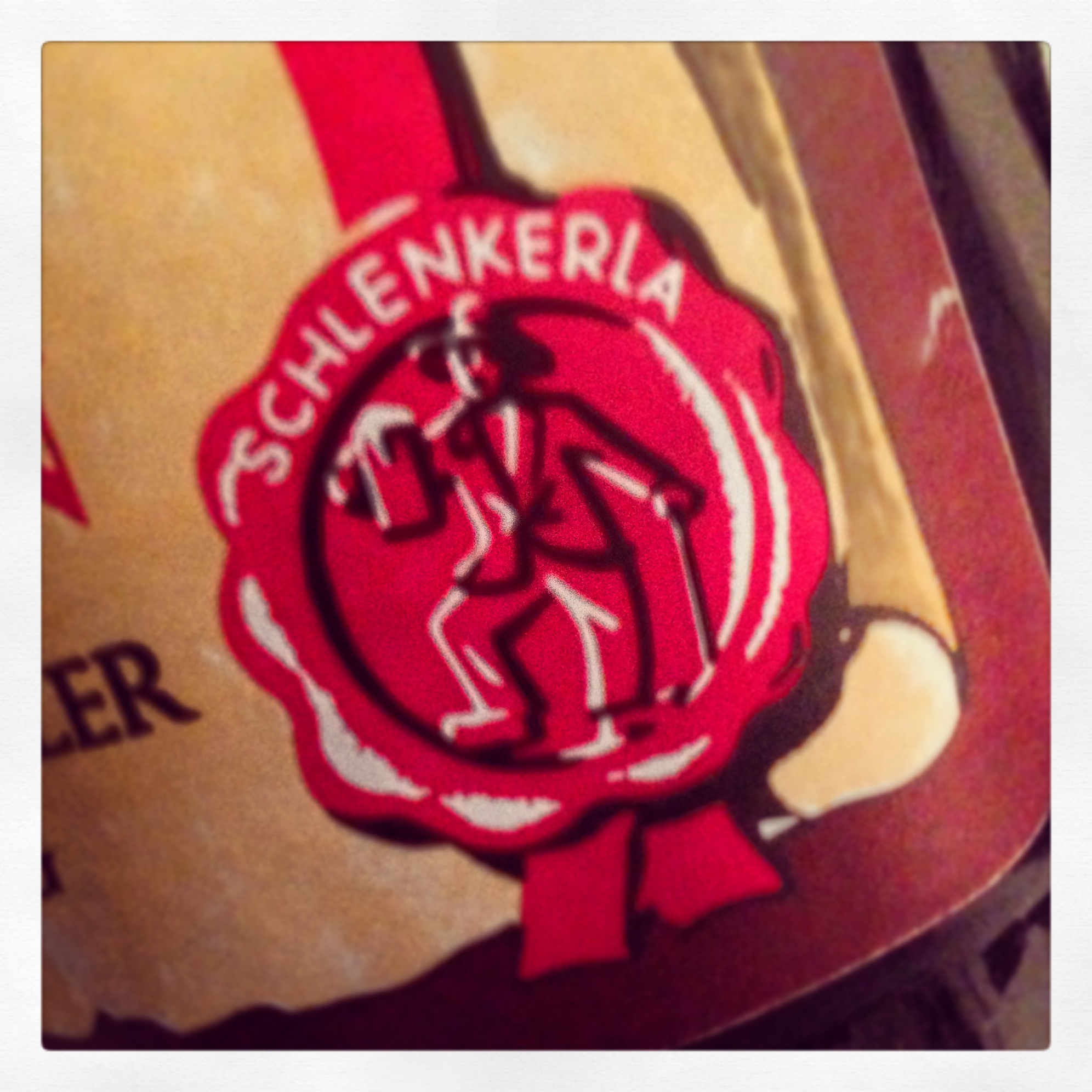
IMG_1316IMG_1317That was the beer I first encountered in Bamberg many years ago. It wasn’t a chance encounter – we, my brother and I, went in search of it. The Heller Brewery is tiny in global terms, but big in the town. It’s the bar against which other rauchbiers are measured and their bar serves rauchbier in large measures.  The brewery itself has a wonderful tap & restaurant, with dishes paired to go with their beer. And that beer is Aecht Schlenkerla Rauchbier. Genuine Schlenkerla smoke beer. It is baroque. No, medieval is better – even the bottle label seems smoked stained. The typography is illegibly Germanic. The bottle shape, chunky, straightforward, utilitarian.  Everything about it says ‘what is inside is important’. Yet there are surprises. For such a full-on flavour fest, this is a lagered beer. Not, obviously in the Bavarian helles style, this is a dunkel lager – a stronger Märzen in fact. And as it proclaims on the label: “Dem Bayerische Reinheitsgebot entsprechend gebrautes” This is a beer authentically brewed according to the Bavarian Purity Law – no funny business to deliver that smoky flavour; just malt, hops and water.  And all this makes sense. Because Schlenkerla drinks counter-intuitively. Everything about the bottle says heavy, intense, challenging. The aroma on opening the bottle and pouring the beer strengthens this views; the first sip taking it further.

Yet wait. Go beyond what your mind is telling you and drink. Breathe. For a powerful beer, this isn’t overpowering. The smoke is mainly in the head, captured in the cells between the bubbles. The liquid is softer; a digestive-like maltiness is there, some gentle warming alcohol esters and most surprisingly, little bitterness. The flavour in fact fades quite quickly. It is a remarkably drinkable beer.  More than that, it is an evocative beer. A beer that takes you back to a place. Even if you haven’t been to Bamberg, Schlenkerla takes you back in time. To steep gabled, half timbered, medieval streets maybe. And certainly, to a taste of how beer once was that we have now almost forgotten.

© Beer Tinted Spectacles, 2014