
Crises drive innovation. Crises drive quick decisions.
Brewers are having to manage tragedy and opportunity as equal bedfellows. Brewers, shorn of their sales to the on trade, are having to step rapidly into the opportunity presented not just by off sales, but specifically by selling their beer and brands direct to the door of their customer…. particularly as we hear of more stories of the big supermarkets using the opportunity to negotiate hard (well, who would’ve thought it?) and squeeze those who cannot afford the squeak. Perhaps the ‘direct to customer’ model is a taste of the future. Perhaps this pandemic will be the tipping point.
Localish to me is Thornbridge – well, not quite local. There are tiny micros on my doorstep selling in poly pins and ugly flagons, but they were slow to react. Right at the start of the lockdown, I was fishing around for a brewer to support nearby and the e mail arrived from Thornbridge as I was doing it. I had the task. I needed a brand to hire. The marriage was made.
Of course they’ve been on my radar, Thornbridge. Of course I’ve had Jaipur and one or two others. Of course I rated their beers’ quality. But they remained a brewery in my soft focus. In the periphery of my mental vision, not dead centre. The lockdown, the e mail, the desire to go local, shifted them into my cross-hairs.
A mixed case chock-a-block with their core range and seasonals arrived soon after. Four of Jaipur. Four of the eminently sinkable Green Mountain, a new go-to beer. Four of their seasonal Jamestown, with ‘Hamilton‘ ringing in my ears and a suspicion it was a close relative of Jaipur (on another continent). Tall cans of the ripe grapefruit-bomb, a fruit-laden smack in the face, Halycon – too strong for supping, just right for sipping. Four of Florida Weisse which I’m still trying to work out whether it is a raspberry sour as described, or a funky twist on a Berliner Weisse.
And then Lukas. A pale, Helles-style lager beer. The most straight. Frankly, of the lot, the most… boring.
 I know I’m off beam in the beer writing world in my love of lager. Yes I get excited about new ale and sour releases. God, how I enjoy a pint of a well-kept cask. Yes, I can cock-an-eyebrow at milkshake sours served with coffee ice-cream. And yes, who can’t enjoy the sheer boldness of the wavy-Hazy generation, or quintuple IPAs from Cloudwater and their progeny. But there comes a point – perhaps 3pm on Friday (or Thursday); or just after some exercise, when the only beer that will do is a lager.
A proper lager. Not this waspishly light, rice-and-enzyme brewed nonsense, where all you taste is a tingle. No, proper lager. Malty and rich; layered with subtle, perceptibly-imperceptible complexity. Lukas is one such beer. It’s worryingly light in its colour, but any Fosters-Alarm-Bell-Sounding-Here stop right there. It pours with a billowing, effusive head which needs careful control. It sports a sensible, ‘Oh, just another one‘ level of alcohol (4.2%). It leads on its grain bill, but the hops are there, providing the gilded cage within which the malts (and touch of wheat) can roam free. It laces down a clean glass in gulp-measures; it’s gone in seconds.
There’s all sorts of nonsense claims about how everything will be different post Lockdown – the non-sensical queues for McDonald’s or Ikea prove those lies, sadly. But one change we should all make permanent is to buy independent; buy direct and buy beer done properly.
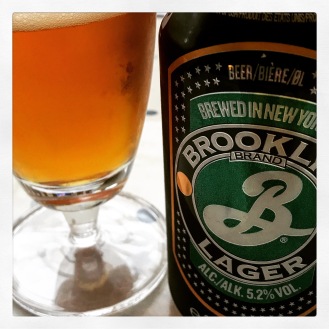 But there’s something going on in their core. Drinkers are turning back to lagered beer. And yes, they’re undoubtedly turning to the real deals: like Budvar, brewed with Moravian Malt and Saaz hops and matured for 102 days; or like Brooklyn Lager, brewed to a recipe from before Prohibition, with it’s deep conker-red colour, and off-white head and thick, coating body or they’re discovering little gems like Windsor & Eton’s Republika, which may not be true to a particular style, but is as damn fine a lager beer as you’ll find.
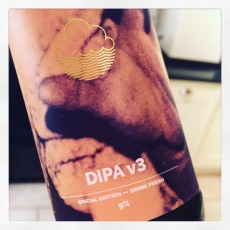 It’s this ‘when it’s gone it’s gone’ word of mouth that seems to be fuelling Cloudwater’s burgeoning reputation. Their Double IPA v3 (DIPA v3) has a menacing, grasping hand jumping out as a greeting: it sports bittering hop in abundance and then four aroma hops Citra, Chinook, Comet and Mosaic, a blend of east coast, west coast and the Pacific all raining down in Manchester. With the addition of brewing sugar, this beer is a whopper and it seems to cover every dimension of IPAdom: piney and tangy, like you’re shoes scuffing up pine needles in a forest; grassy and dry, with the aromas of newly mown lawns in Spring and that spiciness, both I think, from the prodigious hopping and the yeast strain. I drank it whilst reading the paper (at 9% ABV, I should say whilst I could read the paper – it got a little blurry after a while, but that could be age) and the ever-so off white head lasted and lasted as only the real cream of Manchester could.
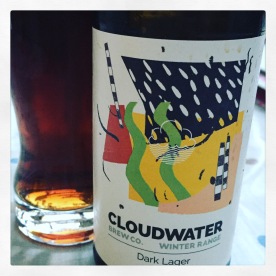 I was actually more impressed though with their Dark Lager from their winter range. A more modest 5.5% ABV, but actually a ‘dark’ ‘lager’, i.e. it was dark from the more roasted proportion of the malt, but it’s many stratifications of flavours, its layers attested to good lagering. This wasn’t a mild ale that’s been laid-low for a week more and masquerades as ‘lager’. This had that rounded smoothness, that matured and assured depth of character where no single element overwhelms – and – and this is important, it is drinkable, sessionable, call it what you will. A lager in name, with the character of a refined ale. And there is something of the Lowry about these beers; seemingly simple – from the labels, to the styles – but underneath it is beguilingly complex and fulfilling. A fitting revitalisation to a part of Manchester that has been under a raincloud for many years.
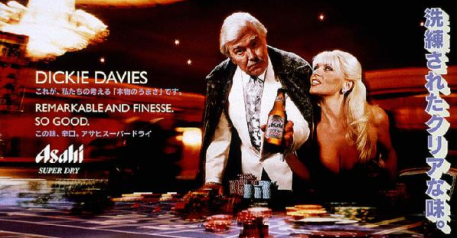 For a brief period, I marketed Asahi Super Dry in the UK. Success with the brand was reasonable over here, albeit, it was always more ‘push’ than ‘pull’ and the relationship with the team from Asahi themselves was always an interesting one – a ‘quick dip’ into some of the differences of business conducted Anglo-Saxon style from that conducted Japanese style. The contract, for example, was always used as a guide by the UK team (de facto) – whereas for the Asahi team it was always ‘de jure’. One year, slightly behind the contractual volumes, the Japanese team decided to deliver the remainder to the UK depot anyway, even though it hadn’t been ordered. Twenty trucks rolled into Burton on Trent carrying enough Super Dry to keep shelves stocked for – well – let’s just say, you could over-winter pretty easily on it. But as far as the Asahi team was concerned, we had committed to a given volume in a contract and we had to find a way to sell it (no B&M Bargains in those days).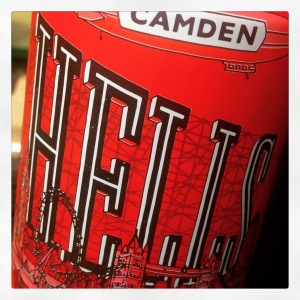
 Beer Tinted Spectacles