
The Micro Roasters

It’s fascinating how trends can manifest themselves in different ways in life.  Take ‘craft’ or ‘micro’ brewing for example – an output from people seeking greater linkage to ingredients, to food production, to provenance and a reaction to mass-production and everything that can attend it (additives, adjuncts, over processing…) – often in the quest for better taste, or more taste, or a more authentic experience.    Well I had missed how this same trend, this same reaction is going on with coffee at the moment.  This was brought into sharp relief through a client I’m working with just now – a client operating near the top of the market in their sector but wanting to understand how they can continue their growth whilst at the same time, growing and protecting the reputation of the category they’re in.  And this got me into investigating coffee and specifically Micro Roasters as a parallel world.

Blimey. This coffee trend had passed me by; or perhaps more accurately, I had passed it by.  Whilst clearly we’ve been witnessing a veritable explosion in coffee shops, at the same time, high street coffee retailers, like Whittards, have been struggling.  So  I had managed to walk past Monmouth Coffee on Monmouth Street in London countless times, smelling the coffee but not pausing sufficiently long enough to arouse my curiosity and actually cross the threshold.  Even closer to home,  just round the corner from my office is a ‘Kaffeine’ – again a micro roaster, but more focused on the serve experience. Here I’d once purchased a latte on my way to work, swearing never to return after they had assaulted my wallet for a cup half the size of normal.  Mind, they put a lovely fir tree pattern in the froth.  But putting that behind me, once I learnt about this ‘micro roasting revolution’ I thought I’d go and investigate it with my radar turned on.
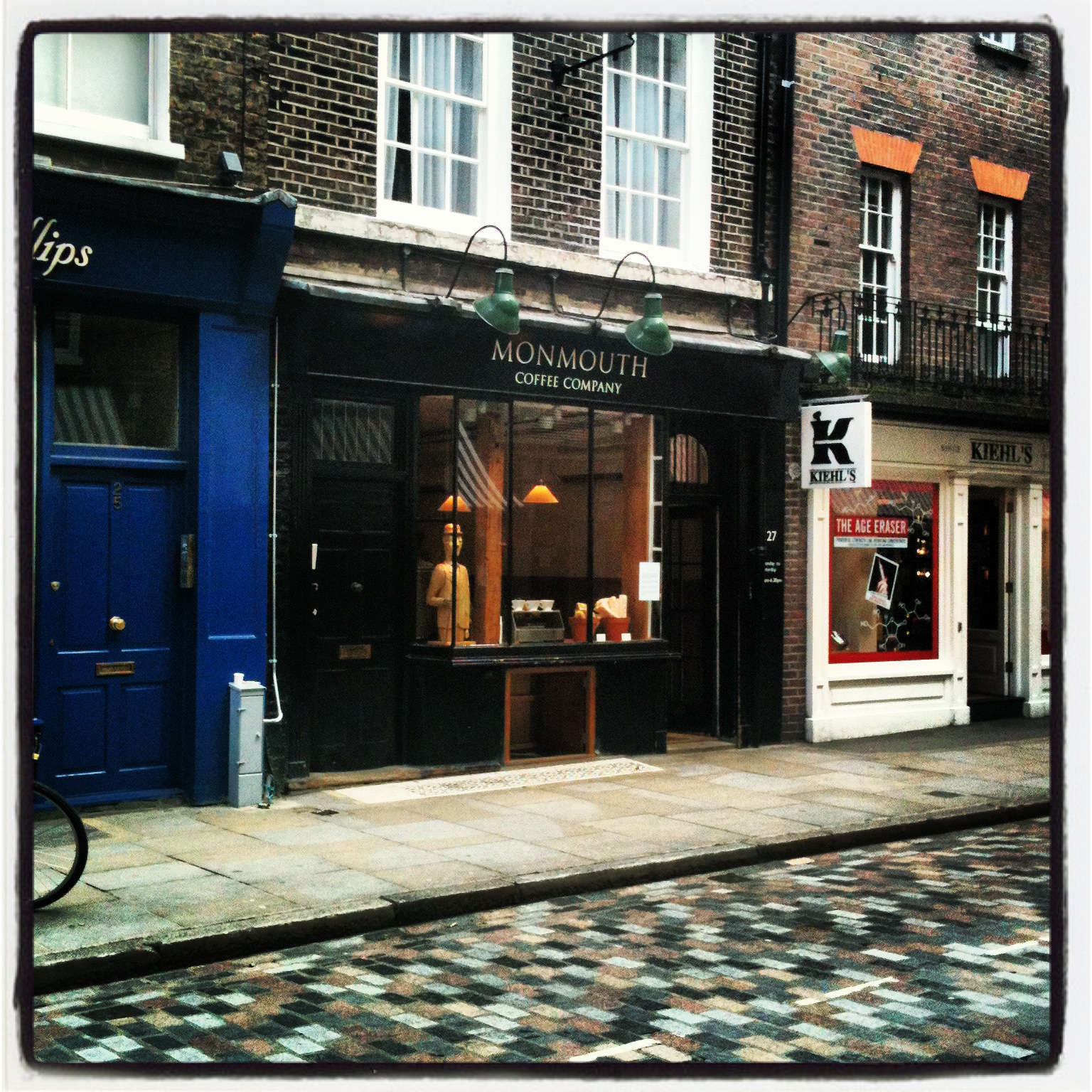
IMG_1563

Monmouth Coffee, or a Mumford & Sons album cover. You decide.

My brief immersion into this world has revealed lots of parallels of course.  Around the raw ingredients themselves; where and how they are grown, what varieties and how they can influence the end result. You’ve got to push further than the ‘Arabica’ vs ‘Robusta’ debate (who isn’t claiming ‘100% Arabica’ nowadays for Heavens sake?). But the actual species (Bourbon or Caturra anyone?). The roasting too – not just the level of roast, but the way the beans are roasted, how quickly, with how much movement, in which style of roaster.  And the grind – when to do this; how to prevent secondary roasting; how – like beer – to prevent oxidation and stale characters in the coffee particularly at the point of packing.  And how you pack it of course: how to let the beans ‘gas off’ (release CO2); how best to store.  Many parallels – but for me, no revolutionary learnings.  I’m left thinking that brewers could do more about the grain varieties – yes, I know that Maris Otter is a great barley – but there must be more to this.  Where is the best barley grown?  What character can different grain blends bring to the taste and texture of beer, to the head and colour?  But could brewers do a lot more than they currently are:  not much.

No, what has really struck me is about the potential for coffee to grow even more through the rituals: the ritual of selling and presenting coffee and the ritual of serving and enjoying.

This is an area that beer would consider itself strong I imagine, but there’s more we can do.  Just consider the experience in Monmouth or Kaffeine.  There’s the presentation of the beans. In one shop, these were laid out in individual oak tubs, with simple tasting notes, ready to be bagged for your purchase (the bags of course, simple, elegant and colour coded in an understated way to help you best enjoy your purchase). In another, blackboards did the same job, in a witty yet informative way.   And there’s the little touches – no bags of crisps with your pint here, but simple accompaniments designed to complement not fight the flavours of the coffee.

Yet more impactful was putting the serving of the coffee right at the heart of the action; the coffee ‘station’ turned round, facing into the room, sitting in close proximity to the baristas.  Making a display of grinding of tamping and tapping out the spent, washed through grains.  The serve too – water with the coffee of course, to cleanse the palate and let the flavours bite through with each mouthful, but simple touches like just warmed milk on the side.  Although the crèma I suppose is the staff, knowledgeable but not arrogant, imparting just enough information to encourage the mystique whilst holding back enough not to put off or bore their clientele.

I had a decaff single origin (Brazilian) Americano.  Beautifully served in beautiful surroundings by beautiful people.  Shame I didn’t like it….that’s taste for you I suppose.  But the experience left its mark.

© David Preston, Beer Tinted Spectacles 2012

The Session #64: The Pale Ale Counter-Reformation

the session beer blogging friday

In many respects, CAMRA came into existence to save pale ale. Yes, I know it should be a broad church the Campaign For Real Ale, but the reality it was pale ale that was being decimated by the rockets of kegged beer with all the day to day, ‘operational’ benefits they offered. Worthington ‘E’, Watney’s Red Barrel, Whitbread’s Tankard, Ind Coope’s Double Diamond were most definitely not ‘head and body above the rest’ (to paraphrase). Rather, for drinkers who loved and appreciated the subtle nuances of cask beer, these insulted through their artificial, aggressive fizziness and tasteless or unbalanced flavours.  In a way, they did damage on two fronts: they hurt cask, and they hurt the reputation of great beers that happen to be sold in ‘kegs’ for future generations.   My first surreptitious underage swig of beer was from a party 7 of Worthington’s at a party my Mum and Dad were having. I should have been in my room, but I cagily snuck downstairs for an illicit snifter of some sort. The beer was close to hand and I tapped some into a plastic camping cup.

Oh my dear God. It was the most unpalatably rank, wretched, drain-stinkingly awful experience. It didn’t help that I hadn’t yet been on a rite of passage with beer at that point in my life, but goodness me. This stuff had an acrid stink like beer changing from just about drinkable to off, and a taste that was aggressively sharp with carbonation and mildly painful.

There were two upsides though. Firstly it was bad enough to put me off tobacco and other illicit substances.  Secondly, it was so truly awful that I knew that there must be better stuff out there. Saying that, I left it a fair few years to find out more, and I have never trusted my Dad’s taste in alcohol since.    But no wonder CAMRA had a powerful cause. Here was our beer, a style of beer that had dominated our landscape for almost 300 years being right-royally buggered by the same people charged with doing the right thing for it…to tend it, nurture it, pass it on in better shape to their successors. Some hope.

So the movement grew. Not just the CAMRA movement, although undoubtedly that catalysed the change. Time became a powerful ally too. For with time, so the wash of characterless premium lagers revealed the hidden skeleton in the cupboard. Through the ‘80s and especially into the late ‘90s, drinkers began to see that ‘international lagers’ – at first so sexy and alluring – were in truth separated only by their clothes. An interesting label. An unusual font. A pertly shaped glass.

But where, oh where was the flavour?   And why, oh why, must I consume a 5% + ABV lager to get a mere skittering of taste?

And so the Pale Ale Counter Reformation began. And it began on many fronts.  Drinkers in the UK standing on the burning platform, with CAMRA helping them see what we were losing.  With the home brewers-cum-craft brewers in the U.S. challenging their beer norms and looking for interesting styles – sending ripples across the world.  This coincidental wave of drinkers unaccustomed, perhaps unaware, of this family of beers concentrated the flowing tide as it entered the mouth of the bay. To today, where it feels like Pale Ale is truly fighting back; is challenging the hegemony of international ‘lager’.

What a family of beers it is! From the unusual or less common Bière de Gardes, Blondes or Strong Ales, to the widespread, more accessible Bitters, American Pales or Burton Pale Ales.  Many of the bottles in the ale section of UK supermarkets today are pale ales; in the US no self-respecting bar would do without at least one great, often local (ish) Pale Ale on draft.  And pales are springing up all over now and gaining momentum.  In a bar the other night, I drank a Cooper’s (from Adelaide); a Sierra Nevada (from Chico, California), followed by a bottle of Llangollen Bitter (from North Wales) later that evening.

But let’s start with Burton Pale Ale. Not the first, but at their best, the style-definers.  Yes, you may beg to differ; and of course, the beauty of taste is how idiosyncratic and individual it is, but sorry, over this there can be no doubt. Burton didn’t earn its fame through fluke. It earned its fame because at their best, these Pale Ales were world class. At their best, they were beguiling, moreish, complex, rewarding, shocking and supremely drinkable. A combination that was….is…..awesome.

But there’s the rub. Where today are the pale ales that made Burton famous? In Pedigree, perhaps… but for me, still too unreliable when kept in the wrong hands and all too often these are the hands of Marstons publicans. And I do agree with my brother, who thinks it’s a bit ‘barnyardy’, a bit rustic, compared in his mind with the Daddy. With Bass.

But alas, alas. This, of all Pale Ales, a signature beer of its style, a world class beer, superbly balanced, flavoursome and nuanced, has been mugged by the shadowy yakusa of international brewer consolidation and left, breathing, but barely audibly, in a brewing back alley.  Once, not that many years ago, UK brewing’s biggest export, now a shadow of that, forced to become Disneyesque in Anheuser Busch InBev’s ridiculous attraction to serving it as part of a black and tan.  Damn you for wrecking this beer and damn you more for treating it with disdain.

Thank the Lord for Burton Bridge then. Their eponymous Bridge Bitter keeps Burton’s flag flying.  This is a beer with structure, with a delicate floral character but a spine to stand up for itself.  There’s just that drying, vaguely burnt, bitter linger that means your hand is lifting the glass for the next sip not long after the last one has been swallowed.  For like very few beers, great Burton Pale Ales have that quality that is so difficult to define:  tasty yes, but moreishly drinkable too.

Whilst Pale Ale found fame with the spread of the style from Burton, of course this is just a fraction of the story.  One of the interesting chapters is in Belgium; known of course for so many interesting, challenging, defining styles of beer, but a haven for Pale Ale too.  I travelled to Belgium a few years ago and met the chaps at Palm in Steenhuffel.  Palm Breweries is one of the larger national companies in Belgium today, but recent years have been tough.  Despite its reputation as a great beer nation, the reality is that the market is over 70% international lager and it’s as cut-throat as elsewhere in northern Europe.  So in the last decade Palm have redefined their business; adding true speciality brands like Rodenbach and Boon lambics.  And refocusing on Palm Speciale.

For many years, Palm Speciale seemed to play second fiddle to its Antwerp rival, de Koninck. A fine beer, no doubt, served in its bolleke (little ball or bollock). Palm seemed more grounded, less aspirational – it’s symbol of a Brabant Shire Horse the perfect manifestation.  Doughty and workmanlike.  Yet Palm is a terrific pale ale that shouldn’t be over-shadowed, and a great example of how the Belgians can appropriate and re-interpret different beer styles.  The base of Palm is undoubtedly a pale ale. A rich amber colour, a fruit-sugary crispness that you only expect from a warm fermented beer, but matched by a malt-led roundness. Cave Direct sell it in the UK (beermerchants.com) – look out for it, and look out for it’s cognac like bol glass, which doesn’t just add to the enjoyment but concentrates and directs the aromas in a way that enhances Palm’s drinkability. Only without the bolleks.

There are now so many pale ales in fact, with so much terrific variation that the style risks fragmentation. This may be no bad thing, especially when you consider how far the it has come in the last generation…from a time when it was on its knees, to today….a Pale Ale Counter Reformation, when for some, I drop to my knees and offer reverential praise.

© David Preston, Beer Tinted Spectacles 2012
Skinny decaff vanilla lager, to go.

There was a change involved in my normal routine this morning – always a bit destabilising after a long weekend.  I arrived into Euston as normal but then needed to head up the Northern Line to Brent Cross, not to shop thank goodness, rather to meet a client.  I had an hour to prepare so worked at the station before tubing out to the ‘burbs.

A much-needed coffee and spot of breakfast was on the cards at Caffè Nero after an early start and whilst this particular eatery would not be on my normal list of caffeine pushers (it’s a tad pricey), needs must.

Being something of a passive-aggressive eaves-dropper, I half actively, half absent-mindedly tuned in to the World around me whilst tapping away on the laptop.

“Decaff soya latte please, regular”

“Regular skinny latte to go, please”

“Can I get a small soy latte to take away please”

“Ristretto, please”

“A large cappuccino please”

“Hi, can I have a double Machiatto to drink in?”

“A white Americano please”

“A grande cappuccino to take away please”

“Skinny vanilla latte, please”.

“A large Mocha to take away, please”

So little time; so many coffee choices – and this a distilled list of the ‘traffic’ this morning.  It got me wondering about the vocabulary around beer. In particular the ire that seems to be caused amongst brewers and beer writers if a drinker, foolishly, mistakenly, ill-informedly, orders a “beer” or a “lager” at a bar.

Typically in the UK, this would lead to the default barstaff setting: pourers.  If someone orders a ‘lager’ then they get a Carlsberg or a Stella; if someone orders a bitter, they get a John Smiths.  Perhaps this is a little harsh – more typical today perhaps is to be offered a choice: “Is that Carling or Fosters, sir?”  Or you could suffer the ‘up-sell’, “We have Tetley’s sir, but perhaps you would like to try Greene King IPA instead”.

Yet compare this with that small sample of orders taken in a coffee shop on Euston Station concourse on a Tuesday morning. And note, no one had to be helped or prompted. No one had to ask the difference between a ristretto and a machiatto. And no one came in and ordered “A coffee please”.  Yet, I remember when I was younger, you could do that. Now, I grant you, I didn’t spend my formative years in a cosmopolitan metropolis.  Wilmslow was only an occasional visit.  No, Tiko on Alsager high street was as luxe as it got (Sandbach – get this – didn’t have a cafe – imagine that today where after tourism it is the second biggest employer in the service sector*).  I’d wait for my Mum to have her normal shampoo and set in Salon Esther next door whilst reading the Beano.  The choice was simple, if you wanted a coffee, it came from a pot on top of a filter.  Bear in mind, I was a nipper observing this. My order of choice was a fluorescent yellow banana milkshake and a Cadbury’s Rumba.  But I was old enough to remember the next big coffee innovation: Rombouts mini filters – you know, the ones that you sat on top of the cup and then you poured the water through. i.e. a filter on your cup, not on the machine. It was like magic.

But what’s really changed? The coffee hasn’t – a tad more fair-trade and organic perhaps; a few more brands on the supermarket shelves that’s for sure; but not a fundamental change in the product.  No I think two things have changed: two things which perhaps should now be on beer’s agenda:  Education & awareness of choice.

Education is a funny one. I don’t perceive that coffee roasters or merchants have made a specific effort to teach potential coffee drinkers about coffee. I think it’s more a process of temporal percolation, if you will. Over time we have been drip, drip, drip fed snippets – and basic ones at that. The difference between Robusta and Arabica; a little more awareness of provenance; a little more awareness of the trials and tribulations of coffee planters and their lot.  The foundations are there though; now rather like wine, there is a bit of one-upmanship in knowing your ristrettos from your machiattos; from asking for a glass of water with your Espresso; from dissing Tassimo and Nespresso for having the touch of mass manufacture and convenience.

And choice: I’m not actually one for gimmicks. I’m not offering up a manifesto to strain beer through filters into your glass.  But I do think that bars could offer greater choice; and in that choice drip, drip, drip a little knowledge about the beers.  Why does any bar need 6 lagers?  Why does any bar need six cask beers for that matter (by this I mean where the sales can’t justify it).

The answer for me is twofold: we need to push a manifesto to get customers to stock more beer styles and push an agenda for bars to pull out the differences between their beers too.  It might be slight, and you may be sniffy about this, but there is a difference between Carling and Carlsberg, between Kronenbourg and Grolsch.  It may be relatively slight, but it’s not so unnoticeable that only the trained palate can spot it.  And of course, there is enormous difference between our cask beers, but that difference is only any good if the beer is in fine nick.

Unlike coffee and coffee shops, beer doesn’t need fancy serves to stand out; but just like coffee, drinkers will only stay interested if we keep the offer new and fresh – and surely beer has enough raw ingredients to do that?

 * NB, a complete fabrication, in case you hadn’t spotted.

© David Preston, Beer Tinted Spectacles. Originally posted on Posterous, May 2012

Gezelligmütlichness – and a solution for pan European harmony.

We sat at a rough hewn, oak table that runs twenty feet in either direction, topped with light blue and white diamond table cloths. To my left and right, drinking companions who have accompanied me here, to this shrine, in a battered, white Fiesta. Opposite, an elderly gentleman – possibly in his ‘80s but it’s difficult to pinpoint – unremarkable except for his deeply wrinkled face, crinkled embroidered collar on a brilliant white shirt, a velvet green bridle across his chest slightly shrouded below his waistcoat, and on his head a small, mole brown feathered trilby.  His drinking companions are similarly attired.  In moments the new world meets the old – jeans clad English lads in a social stand-off with three gentlemen from an earlier age.

Three huge, monster, glasses – they must be all of two pints¹of beer are placed in front of us, and, as if a switch has been flicked, the elderly gent in the middle fixes me directly with his gaze, stands up, proudly slapping his black lederhosen, raises his similarly mammoth glass of glistening, bronze beer, smiles and duels me with a toast:

“Der Gemütlichkeit!”

Moments later, at the far end of the tent – far enough to appear like footballers viewed from the back of the North Stand – a deep, reverberating string of notes wobbles over to us, ‘Ummm Ummm Um Um Um Paaaah!’  Recently arrived puzzled tourists like me scan around nervously as everyone rises, lifts their glasses and starts to sing: “Ein Prosit, Ein Prosit….”

Spin on a few years. A business trip to the southern Netherlands, near Maastricht, down in the pointy bit on the map. We’re touring a brewery with a view to importing one of their beers. The brewery is almost pastoral – verdant green hills, shapely oaks, ash and poplar trees shape in the  immediate hinterland – the word ‘bucolic’ was made for this. The brewery itself faces directly onto the road, barn like in appearance, with large, triple hinged wooden doors hiding the shining, modern set-up within. At lunch we break to a small bar just round the corner from the brewery and enjoy a bowl of waterzooi – this being with welly-wanging distance of Belgium after all – and a Summer wheat beer.  In this part of Holland, speaking English is less common than further north; nonetheless our brewery guide – a Brewster no less, raises her glass and gently says,

“Ah thies is soo gezellig”

I looked it up. Gezellig?  Gezellig? I hear it a lot but no one can translate it. The Dutch being proud in fact that ‘Gezelligheid’( with the gargling ‘z’) You have no word for it in English’.   I did the same with Gemütlichkeit , although knowing a bit of German I was aware the story was similar.  How come in English – English of all languages – with a vocabulary more extensive (and growing faster) than either German or Dutch – how come we don’t have a translation?   And as they are so central to the beer situation, this only made it worse.  Our beer culture is rich too – surely we can translate these words?  If only to reduce the lexicological one-upmanship

The Wikimeister was the first point of call. Gemütlichkeit being ‘an environment or state of mind that conduces a cheerful mood and peace of mind with connotation of a notion of belonging and social acceptance.  And apparently the Nordic countries, many of the Balkans all have a similar word. In Russia their word, yιom, “carries almost identical connotations”.  As for Gezelligheid ‘depending on context, can be convivial, cosy, fun, quaint but can also connote belonging, time spent with loved ones….or general togetherness”.   I understand these words.  I get them wholly. The emotional connotations make absolute sense to me, yet, yet… we don’t have a word. I struggle to express that familiar sensation in our language. They are either too lacking in nuance (like convivial) or else you need a phrase and that’s cheating.

But I want to be able to express this word.  I reckon that it’s a bit of gezelligmütlichness that we Brits could do with. Because just as we may not be able to translate these words, so our neighbourly continental languages don’t have an expression for our way of drinking and what that means, how that feels for us. And no, I don’t mean getting lashed on a dozen pints, but rather that fuzzy, somewhere in-the-middle drinking that’s two too many to count as a ‘quick pint’ and two too few to constitute a ‘sesh’.  That’s where the spark plugs fire without sparks flying and causing a raging inferno. It’s the sort of occasion, with your friends, that you could easily do a couple of times a week and still function the next day, without feeling piously or piteously out of it.

There’s a more serious need too. Put to one side our current economic difficulties, the perception amongst politicians and legislators of the effects of beer, and alcohol, on how ‘we’ drink is still stuck in a different age.  ‘Minimum Pricing’;’Alcohol Harm Reduction Strategy’, talk of advertising bans, sponsorship bans, self regulation vs legislation – these are warning signs that the chasm of understanding between those in power and those who want to enjoy a relaxing couple of three pints exists and is a threat.  And it is a threat – to think, as I read in a quality daily recently for example, that minimum pricing in the off trade will lead to people going back to pubs again is folly.  We need to put gezlligmütlichness at the heart of a positive political agenda for beer – supporting not just good pubs, but encouraging bars and restaurants to serve a decent lower alcohol drinks range (beer) as well as a decent wine list  – and putting a new way of drinking, a little, often and good quality at the heart of licensing, rather than simply demonising supermarkets from stacking it high and selling it cheap.

In an earlier blog you may recall the journey my brother and I made to Czechoslovakia and Franconia just after the fall of the Iron Curtain.  Mere sprats we were, still on a hideously giggly voyage of beer discovery – it could have been one long trip of drunken debauchery and leery British embarrassment on the continent.  Yet one night, we sat in a wood clad bar drinking dark lager and Dunkel, having a conversation with the locals yet utterly unable to converse in their language.  And then, to paraphrase the Good Soldier Svejk, ‘it did happen to us that we drank one beer after another’…modestly so I like to think.  Of course, we’ll never meet those chaps again, but for all talk of ephemeral European Harmony, legislated by endless Treaties, perhaps it would be more constructive to just share a few beers and enjoy some gezelligmütlichness.

¹In fact, it turns out to be a 2 litre glass – or ‘mass’ which in German feels almost onomatopoeic.

© David Preston, Beer Tinted Spectacles. Originally posted on Posterous, May 2012

Or was it Penry… the Mild mannered janitor?

At work this week, we were having that seemingly inevitable conversation that spins round with alarming regularity. “Doesn’t seem that long ago since Christmas… I can’t believe it’s May already!”  But fear not, fair dwellers of the Office World, for ‘tis May and this is a good thing. For CAMRA have proclaimed May as officially the month of Mild.

Mild. What does it conjure up for you?  If you read about this beer style there’s generally a passage or two suggesting that your memory is likely to involve people who say “Yow” not “You”, and feature, amongst other things, flat caps, looms, steel mills, 26 hour days and allusions to ‘honest working men’ or some such pap.  I mock – and perhaps without justification. Certainly for me, some of these impressions are supported by my early experiences.  Wilko, a school friend of mine, was at the root of it.  He was an interesting old fish, Wilko, being a few years older than me meant that in those impressionable years he had some traits I aspired to. He couldn’t be described as an oil painting, but he also had a remarkable knack with ladies, which was mystifying and frustrating in equal measure.  His politics were as Red as they come, and politically, only an Ultra Communist Utopia could solve the world’s ills for him.  Part of this Utopia featured a fascination with the past – not an accurate past of course, just  those elements of the past that suited his world view and crucially his arguments about the direction we should take as a country.  And strangely, Mild was part of it.

And so it was that some of my early drinking experiences with Wilko featured Mild (the ‘proper’ drinking experiences that is, not the ones that featured necking pints of fizz at the Cheshire Cat or French Connection, in a vain attempt to bolster the courage to try for a snog with assorted female classmates). And, boozers too. In back streets. Generally with the stereotypical set of old men sitting around in felt caps and grubby flasher Macs, publicly farting like it’s what you do in good company.  But the Mild was there. There’s no doubt it was deemed a starter beer.  And it needed to be. You had to keep your wits about you in the Ring O’Bells, The Midland Inn, or Iron Grey on a Thursday night and one too many pints of Greenall’s Original was enough to leave me only fit to be dragged home*.

I remember the beer being good – so much so that in later years I always kept a look out for a Mild… in fact it was buying a pint of what I thought was a dark Mild in The Well House on Exeter’s Cathedral close that introduced me to Porter.  In those days, there were a few we drank – Greenall’s did a good one, I think its gone now sadly, but I remember it being nut brown with a creamy head, and having a corresponding nutty taste. Robbo’s too did a good one – we used to drink it down the Lawton Arms, a ‘border’ pub which still to this day is the flag to me that I’m back in the North.  I think the beer is called dark smooth today and only on keg for what it’s worth.   More recently, in Burton I was in the Roebuck, a bit down on its heels, but was pleasantly surprised to see M&B Mild. It was dark, light in alcohol and…. awful. Somehow it was artificially toasty, like essence of astringency had been added as a deliberate flavouring. Plain, downright, rank. I put it down to the pipes not the beer, but I have my suspicions.

It hasn’t put me off Mild though, and the reason is very simple: the West Midlands.

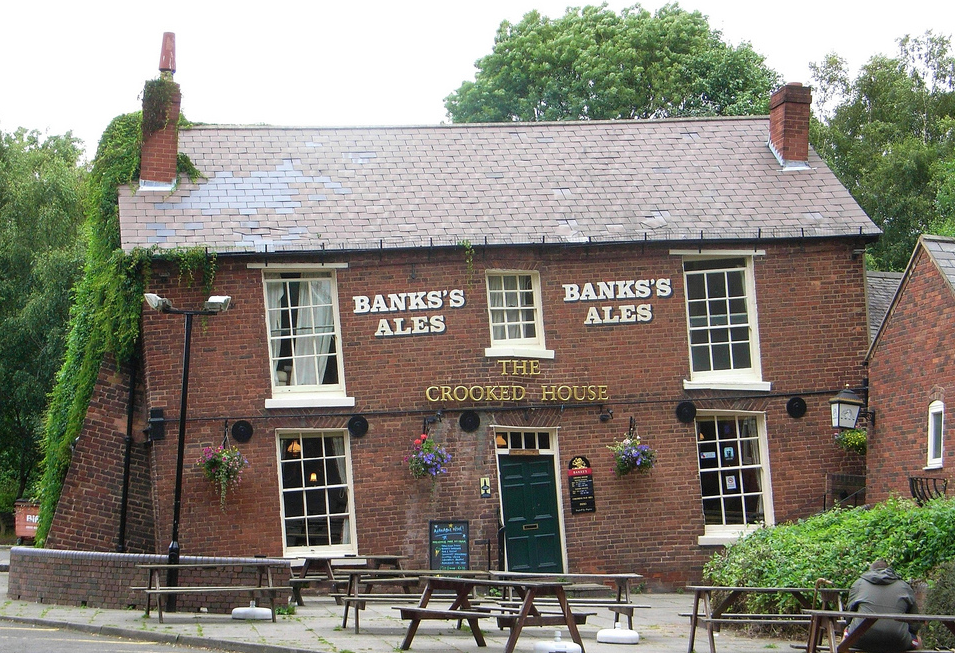
In the Summer of 1990, I stayed with my friend Helen who was a house mate from Uni.  It took a while to realise that in her neck of the woods, I had to call her  ” ’Ilin” so her friends knew who I was referring to. And, she lived in one of the posh parts of the West Mids – Hagley – so posh in fact that they refer to it as ‘Worcestershire’.  Helen introduced me to some characterful pubs, and some lovely, characterful beers.  I’d never really liked Banks’ Bitter, but Bank’s Mild was and is, a cracker (although in these low confidence times for mild, it’s called ‘Original’).  I tucked into a fair few of them at The Crooked House in Gornal Wood, and was still sober enough to realise it was the pub leaning, not me.  A day later, in Chaddersley Corbett, we had a pint of Batham’s Mild .  This little brewery seems to exist in a protected niche; few know about it, and perhaps if you go into their Heartland and reveal their location, you die a painful death. Only time will tell. But in my defence, what a cracking beer – worth taking the risk for.  Ruby brown, if you know what I mean, with some hoppiness and great flavour, a bit like liquid bread and butter pudding. (Check them out: bathams.co.uk)

Yet Mild puzzles me too.  Putting my rational hat on, they seem an ideal beer for modern times. So many of us now like to enjoy a few pints, but want, or need, to remain compos mentis** for the activities of the day ahead.  Likewise, for many, beers that assault you with hoppiness are a step too far for everyday drinkability.  Yet Milds are the antidote.  Typically gently hopped, with a chewy malt character and a residual, comforting and coating sweetness that underscores their moreishness.  I love them because they offer refreshment, drinkability and rewarding taste. The holy trinity, right there.

And they provide a comforting link with the past without being nostalgic.  For the roots of mild go back much further than we think.  Their slighty tarnished reputation comes from a post-industrial time when our heavy industry was dying and sharper, lighter Bitters were on the ascendancy.  Throughputs fell, quality suffered, and associations were with generations before the war. Yet the taste profile, and indeed the strength of Mild (mid 5s not mid 3s) can trace its roots back to earlier times, when hops were prohibited, never used, or not appreciated and British beer would have typically been sweeter, maltier and darker.  I hear tell too, that those stronger milds (5 – 6%) are now making a comeback – that sounds like a pilgrimage for another day.  You certainly don’t need the month of May to drink a Mild, but you know what? It’s as good a time as any.

Crooked House

*Pints of Greenall’s Original featured in a legendary New Year’s Eve session which culminated in me running home from Wilko’s house to mine.  I can still picture it now. It was like that bit in Chariots of Fire where Eric Liddell pins back his head and takes off; the wind rushing through his hair… a vision of athletic perfection & beauty.  A friend of mine saw me, and apparently the reality was somewhat different. Uncoordinated feet flapping randomly and noisily as I dribbled home in the linear direction of the Circle Line.  Utterly pathetic and an abject lesson in the need for responsible drinking.

**There’s a Malaprop opportunity if I ever saw one. What am I saying? I need to remain Compost Menthol for tomorrow.

© David Preston, Beer Tinted Spectacles. Originally posted on Posterous, May 2012