The Brown Dog returns

For whatever reason, I’ve never really got on with Newcastle Brown Ale… but I wanted to.  There was a bit of a boom for the brand in the mid ‘90s, fuelled by a failed attempt by an Australian brewer to buy it.  For a while front labels were inverted (I hadn’t noticed until someone pointed it out) and there was a general fuss made across the north east.  So I gave it a crack again back then, but no, it just didn’t flick any switches for me… at least not on taste anyway.  I’ve always liked the bottle; I’ve always liked the schooner glass and I’ve always bought into those hard-working leg-pulling Geordie values. Taste though – didn’t get it and still don’t.

IMG_1854Yet, like with mild, there’s a bit of a general brown resurgence going on.  This was triggered this last weekend gone by a pint of ‘Milkwood’ in a local Vintage Inn. Brewed by Brain’s in commemoration of Dylan Thomas, it’s a 4.3% brown ale.  And it is brown, which is a start.  Don’t mock – one of my issues with Newkie Brown is that’s it’s not – it’s more of a deep, chestnut red.  No it is –buy one and have a look.  It’s not unattractive, just not that brown.  So anyway, Milkwood – a brown ale.  And putting to one side the less than scrupulously clean glassware, it was a decent enough pint. A tightly loose head with a thick creaminess that somehow managed to support some big bubbles, mid brown colour and a clean, malty taste with just a touch of granary crust nuttiness.  Nice lacing too which I like to see.   And selling well up against Pedigree and Everard’s Tiger.

The interest in the style is good to see, for it could have gone the way of the Dodo. Original styles, dating back 300 years or thereabouts were likely brewed with brown malt that a higher level of roast from direct fired malting. Pale malt revolutionised beer both in the UK and on the continent – but with every revolution there is a loser, and brown ale was one.  Whilst brown ale continued to be brewed, they became sourced from pale malt, or crystal malts, that add a more coating sweetness, or were pepped up with a generous pitching in of brewing sugars.  Strengths fell over time too, a trend exacerbated by two wars, until eventually only really Mann’s Brown Ale existed as a connection with the original brews from the past (Newcastle Brown Ale was a twentieth century invention, ironically by a brewer from Burton).

I wonder though how much of the recent resurgence in the style comes down to what’s going on across the pond.  Newcastle Brown itself has become that old chestnut: 15 year overnight success story – selling about 450,000 barrels of beer to the USA each year. It’s now the number one British brand over there. The once positively ubiquitous Bass has been soundly mismanaged by Anheuser and Newkie Brown has doffed its grateful hat and Dyson’ed up their business.  The American craft brewers too have copied and reinvented the style. As you would imagine, many US versions have a more distinct hop character, but are none the worse for it.  Sierra Nevada do a very drinkable Autumn Brown Ale, and the wonderfully named Dogfish Head also do an ‘Indian Brown Ale’ which I snuck into my repertoire whilst out in Denver on beer business one night. Something similar happened in Hawaii* too – where I had a brown ale from the Kona Brewing Company (which I only bought at the time because I was thinking of buying a Kona Mountain Bike and wondered if the two were linked. They weren’t – and remember folks, don’t drink and ride.) This one in particular was a smoothly drinkable version, reasonably hopped. It reminded me of the Geordie nick name for Newcastle Brown, ‘Dog’ so called because it bites your legs.  Well the Kona Indian Brown Ale certainly did, as it was secretly hiding a mid 5s alcohol.

I’m pleased the style is having a revival, particularly in the UK. Whilst I like the hoppier versions from the US, I find that there are enough IPAs and double IPAs doing the ol’ hop 1-2 full frontal.  A beer style that swings the other way as it were, with a lingering sweet character is needed in the lexicon of beers.  As well as being moreish, who knows, perhaps a brown ale will make it through to be a recommended beer with this week’s Great Beertish Menu!

*At the border, the normally serious and scary US officers were quite genial. The one who stamped my passport however was a little disbelieving: “You’re here on business.  Yeah, right”.  Alas, I was.

© David Preston, Beer Tinted Spectacles 2012

Great Beertish Menu: Rogan Josh!

So Simon Rogan came through in the North West heat of Great Beertish Menu. Funny old world isn’t it – he’s running a little restauant in Cartmel in Cumbria…and it just so happens to be one of the top 5 restaurants in Europe. So in fairness, he probably knows a thing or two about cooking.

As promised, here’s his winning menu and a proposed beer to go with each.  Let me know what you think and trump my recommendation please!

Starter: Grilled salad, truffle custard, cheese foam and cobnut crisp.

An interesting combination of textures here – and of course a vegetarian starter. We want something light on the palate which won’t dominate the food yet stand up to the custard.  Let’s go for a Deuchar’s IPA – I think the light body and modest hoppiness will complement well.

Fish Course: lobster with pickled beetroot & sweet apple

IMG_1015Tricky. You can easily wreck the lobster – and given the lengths he went to to reinfuse it with extra lobsteryness that would be a shame; but then there’s the pickled beetroot to consider.  This is a cracking dish to go with a beer though. I’m looking for a more malt accented beer, not too coating and with modest bitterness.  I’m actually going for a classic here. Timmy Taylor’s Landlord.

Main: suckling pig with northern mead, vegetables and artichoke

Right – lots to be getting on with. I’m thinking contrast and some body. The knotty bit is the mead I want something that will sit nicely alongside it but get noticed – bridesmaid not bride. Don’t want to upstage the meal, but I want people to fancy me. So for me, I’m going to go for a Rooster’s Wild Mule.  It’s got the sweetness and the hop attack.  Perhaps not enough alcholic body though.

Pud: poached pears, atsina cress snow; sweet cheese ice cream and rosehip syrup.

Delicate (pear) yet punchy (rosehip) – and then the sweet cheese ice cream which  could be quite mouth coating. I’m going to go left field here and actually go for Cain’s Dark Mild, but served in a wine glass to so volume doesn’t overpower the dish.


Grand. I’m off for pie and chips now.

Cartmel

Moan Label

I can’t make my mind up whether it’s a good thing or not.  Sainsbury’s ‘Taste The Difference’ range of beers is a sort of surrogate ‘own label’ range of beers – very much a mutant child of proud micro brewer father and pushy retailing mother.

You can’t miss own label in our supermarkets.  In some categories (think aisles – it’s the closest approximation in non business speak) own label rules the roost – it can be up to 50% of sales. Often this is with products that shoppers aren’t that bothered about – loo rolls, washing powder – or where brands can’t really develop like with fresh fruit and veg, meat or fish.  There are surprises too – categories like roast and ground coffee have a high proportion of own label despite some excellent products and pretty good prices from companies like Taylor’s or Douwie Egberts.

Beer has been the exception though – and for the wrong reasons.  You see, own label generally exists, and typically thrives because it keeps the brands honest.  If a brand gets too dominant, its share too high, then the retailer slips in a sharp priced own label offer and before you know it, the supplier is sitting around the table sharpening the proverbial pencil.  Not with beer.

Because unfortunately beer is cheap.  So cheap, there isn’t a meaningful space between the cost a retailer is buying at and the price it’s being sold out at.  You have to bear in mind here that a very high proportion of beer is sold on promotion and British consumers know this.  Wait a few days, or shop somewhere else and invariably you get a better deal.

So own label has withered on the bine.  There’s been a bit of activity: Tesco launched their own label Czech beer – Boheme.  They gave it lots of space and focus and activity. It’s still there, but it’s a runt.  And there are a few lower alcohol versions – drop the ABV, reduce the cost and you create space to play. Unfortunately, and unsurprisingly, drinkers are not interested in these insipid, tasteless and poorly brewed beers.  (We’ll have to see whether minimum pricing changes this landscape).

IMG_1519
And the last three digits of his security code are 996….

Sainsbury’s ‘Taste the Difference’ range is different.  It’s a clear hybrid.  The neck label, crown and aspects of the label are clearly branded; there’s a ‘structure’ across the range (each carries the brewers’ alleged signature for example*). But it ends there.  As you can see – the Suffolk Blonde is in  a St Peter’s bottle – the rest of the range are in their own.  There’s no attempt to hide the origin – in fact, it’s built around it.  There are beers from Harviestoun, Black Sheep, Meantime and others in the range. Each different in shape & format; each naming the brewery.

Yet I’m troubled.  My background is brand owner – and in a company that refused to do own label. This legacy I bring with me no doubt.  But it’s more than this. Somehow, the values of these small brewers feel just a little tarnished by the hand of the retailer.  Not that I am berating Sainsbury’s here – I like their effort, but it feels an uncomfortable marriage.

And the beers – well, I’m working my way through. Tonight I had the Suffolk Blonde.  Pleasant enough – certainly a bright back-lit gold in the glass, but I didn’t get the notes of banana and clove the label suggests, but rather a slight biscuity malt.  The Hallertau hop aroma was there but not overly pronounced. Good enough for sure; I wouldn’t refuse another – but ‘taste the difference’ – nope, had more different beers that taste better.  Mind you, the bottle – wow! The bottle is a stunner and perhaps not as pretty as their original flagon type, but practical and different too.

It just feels odd with a Sainsbury’s label on it.

*Watch out Mark Slater at St Peter’s. I’m after your credit card. Now I have your signature, it’s going to be a cheap Christmas…

© David Preston, Beer Tinted Spectacles 2012

Great Beertish Menu

Look. I admit it.  I really enjoy TV cooking programmes.  I’m sure that in my dotage I shall spend more time perfecting acts of culinary wizardry than I can afford today.  I’m not a cooking programme whore though; I do have a Premier League:  The Hairy Bikers (I know, I know); Masterchef; Rick Stein (you know, the poetry one) are 3 of my top 4.  But for me, the Champion of Champions – the Campionissimo if you will, is The Great British Menu.

I know I shouldn’t.  If I engage my rationale mind, I can see through it. The total fabrication of an excuse for a national banquet (“Let’s celebrate the work of the Great British Seaweed Farmer”).  The promotion of chefs to celebrity status even when many of them clearly either haven’t got the charisma, or in the case of the glorious Mark Hix, the desire. It was great – seemingly, he just couldn’t be bothered. Whilst his competitors slaved over their stoves, deconstructing sea bass into sea and bass, he cobbled together a pie, or jelly and blancmange and sat back, reading the paper, having a fag. (Even better that he got not one but two dishes through to that year’s grand finale.  Mind you his Stargazey Pie was inspired, and I’ve had a few good ‘uns in my time).

This time round, the feast is oddly, Olympics themed.  To compensate for all the Fast Food from America that is going to be consumed during the event, the BBC have struck out early, encouraging us to celebrate our Olympians with a gargantuan British feast in their honour.   I actually only tuned in last week (Northern Ireland), and this week it was my home region, the North West.  And it’s been sensational viewing – have you seen it?

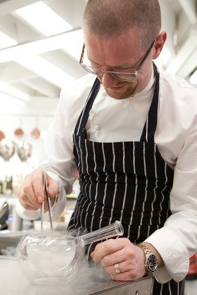
Marcus Wareing, the celebrated 2 Star Michelin chef took apart a Preston chef, Johnnie Mountain. Johnnie’s track record on the fish course has been poor.  In two attempts, the best he has done is 4 out of 10.  This time, he pushed the boat out, submerging himself (oops, that must be ‘pushed his submarine out’ then) in the world of molecular gastronomy.  He visited the Fat Duck to get top tips, and there he is with his baths of liquid nitrogen, ice cream wafers and smoking devices making a beach…and sea.  No chunk of fish in there, but anchovies and clams and various other fruits of the ocean.  And it looked pretty. But we can only glean that it tasted pretty bad.

And Marcus was not a fan. In a 30 second, calmly delivered diatribe, he took poor Johnnie apart and gave him a 2, accusing him of ‘playing with toys’.

Johnnie, unsurprisingly, was a little peeved and stormed out, clanking pots, pans and assorted sous chefs behind him.  Cracking viewing, and all the better as it supported my hypothesis that Marcus Wareing is a plastic northerner and an all round tit, even if he can bake a good tart.  But any way, that’s not the point.

The point is this: I am looking for your help.

I’m an advocate of beer and food – cooking with beer, pairing food with different beers – you know what I mean. I haven’t quite got to BBQ’ing a chicken with a can of beer up it’s bottom, but it’s on the list of things to do this summer.   But industry efforts are all very self-serving and ponderous.

So, here’s the plan:  when the winning course is announced on a Friday, I shall post a short blog with my recommended beer accompaniment and a short rationale for said choice.

I’d love your comments, but better, try and top my recommendation (this won’t be hard, trust me).  We shall then, with the wonder of modern science and the use of a public voting system (which shall be independent, and by the time it comes round, properly thought out) sally forth with our recommendations.  A column in the Guardian will quickly follow I’m sure, and by next year, yours truly will be on The Great British Menu recommending great beers to go with the great food*

Up for it?

*Sneak preview from the BBC.  Next year there will be a Feast Celebrating Great British Muck Spreading. Sounds like sh

Johnnie Mountain

Johnnie Mountain: I’d eat in your restaurant mate. Give me Wareing’s table.

© David Preston, Beer Tinted Spectacles. Originally posted on Posterous, June 2012

Hail, Hybrid!

My friend Paul drives a Toyota Prius, or ‘Pious’ as he calls it with a self-mocking glint in his eye. Mind you he does keep bees, so perhaps his car choice is consistent with his lifestyle.  I find the thing quite unnerving though. The other day, he gave me a lift to the station, and we had driven 50 yards before any sound kicked in…very surreal and even more unnerving. It was the same sensation as you get on a plane just before it touches down, when the pilot feathers back the engines in order to ‘plop’ the plane down rather than nailing it into the runway. 

Then, to prove that he is a real man, Paul flicked a switch and hammered the accelerator to demonstrate to me that (a) there is an internal combustion engine under the bonnet and (b) it was capable of warning others that it was there.  Now, the Pious is of course a ‘hybrid’ vehicle as they have come to be known.  This is different from other cars with ‘intelligent technology’ that switch off the engine when you are at the lights, or flip over into a low fuel use mode when the cruise-control is engaged for example.  ‘Hybrid’ is different – it’s bringing together two fundamentally different approaches to motive power. One, the suck-squeeze-bang-fart petrol engine, the other, using rechargeable batteries like a Duracell bunny that keeps on drumming, if you will.  This in itself was pretty radical when they first came out; more radical is the idea of combining the two, or better put, designing the two so that they can transition fluidly and effortlessly between each other.

Hence the term ‘hybrid’: as a noun, ‘something that combines two different elements: a mixture’; as an adjective: ‘of mixed character, or composed of mixed parts’.   We have all lived with the Toyota Pious and their like for a few years now, so we have, to quote a Canadian I know, “acculturated” the word – we get it, and it makes sense, much more than the word ‘acculturated’ in fact.

But the ‘H’ word is popping up more widely now.  I was walking to work this week, and I saw a poster advertising a new ‘Hybrid Library’, which I gather is one which has both printed and electronic materials (we had a microfiche reader at my University Library – I knew we were ahead of our times!).  I also own a ‘hybrid bike’ – I was sold on the ruggedness & practicality of a mountain bike with the aerodynamic features & acceleration of a road bike.  And it looks great – it’s a Specialized with a deep, metallic blue frame, 27 gears, and a suspension seat post for purtly-plush bottom comfort. However, it fails on two counts:  it cannot handle any form of rugged terrain, like my mountain bike, and compared with a road bike, it is slow and cumbersome. A compromise then, not an ingenious invention for an unmet need in our lives.

In fact, this phenomenon crops up surprisingly often in the world of brands and marketing.  In beer, for many years the gap between 4% beers and 5% beers was an intellectual opportunity but a practical graveyard – especially for lagers.  Many beers launched into the space, but because Stella cornered the ‘strong lager’ market and Carling and their like, had the ‘4% session’ lagers covered, drinkers didn’t want the confusion of beers in between.  It was a case of ‘I know I can have 4 pints of Carling and still function, but 4 pints of Stella and I’m finished.  I can’t risk Miller Genuine Draft at 4.7%…”

But these walls seem to have crashing down now particularly with ciders and some of the bottled lagers pushing into this ‘space’. And brewers are pushing in too – with careless abandon.  And I use the word ‘careless’ specifically in this context because my hunch tells me that describing a beer as a “Lager / IPA Hybrid” is a space that a Marketing person would identify, but not a brewer or a beer drinker.  But that’s what we have in the market now:  Williams Bros Brewery of Alloa have launched ‘Caesar Augustus’ which is described in said fashion, as well as ‘Microbrewed for maximum flavour’*.  Where to start?

IMG_1583

Hail Caesar Hybridus!

Look, I’m all for pushing out the boundaries in beer.  And the notion of brewing a beer, lagering it well and then giving it a generous kiss of hops sounds appetising.  But I have an issue with describing a beer as a ‘hybrid’.  This beer is a lager; it is generously hopped, but that doesn’t make it an IPA.  That in itself shouldn’t be a problem (I refer you to the ‘Black IPA’ debate for more reading on this subject), but in reality it’s confusing.    It’s confusing for this beer, and it’s confusing for lagers and more particularly IPAs. Because there isn’t a nod to IPAdom here at all. There’s no secondary fermentation, no bitterness for mellowing, just aggressive hopping.  And putting the word ‘hybrid’ front and centre on your label….come on. Beer should be appetising – that’s one of its main joys. ‘Hybrid’ isn’t – it reads icky; it sounds icky and it’s technically icky.  Go the whole hog and call it a ‘Juxtaposition Beer’.  We might as well get the wanky words all out and done with.

But so what?  Surely it’s about the taste?  And this beer is fine.  It has an appealing golden colour; a sturdy enough head to make for a smooth drinking experience and a snappy hoppiness that delivers a pleasant bite.  But it’s not in any way extraordinary: it has a pale colour; it has an ale bitterness…and that’s it.  And I’ve drunk plenty of lagers that have the same qualities but don’t feel the need to describe themselves as ‘hybrids’.

Well, “Ut Severis Segis” as Caesar Augustus might have said. “What the sower sows, so may he reap”. My fear for William Bros is that they sow the seeds of confusion and will only reap the rewards of that.

*What is this all about?  Why does ‘micro-brewing’ constitute ‘maximum flavour’?  I do wish brewers, be they large or small would get the bigger picture here….all beer should be embraced and celebrated, even if it some of their attempts end up being confusing.

I bought my bottle of Caesar Augustus from Sainsbury’s in Derventio.  You can’t miss it, take Icknield Street from Letocetum, if you get to Deva Minoris you’ve gone too far.

© David Preston, Beer Tinted Spectacles 2012