
Lockdown Lukas

Crises drive innovation. Crises drive quick decisions. 

Brewers are having to manage tragedy and opportunity as equal bedfellows.  Brewers, shorn of their sales to the on trade, are having to step rapidly into the opportunity presented not just by off sales, but specifically by selling their beer and brands direct to the door of their customer…. particularly as we hear of more stories of the big supermarkets using the opportunity to negotiate hard (well, who would’ve thought it?) and squeeze those who cannot afford the squeak. Perhaps the ‘direct to customer’ model is a taste of the future. Perhaps this pandemic will be the tipping point.

Localish to me is Thornbridge – well, not quite local. There are tiny micros on my doorstep selling in poly pins and ugly flagons, but they were slow to react. Right at the start of the lockdown, I was fishing around for a brewer to support nearby and the e mail arrived from Thornbridge as I was doing it. I had the task. I needed a brand to hire. The marriage was made.

Of course they’ve been on my radar, Thornbridge. Of course I’ve had Jaipur and one or two others. Of course I rated their beers’ quality. But they remained a brewery in my soft focus. In the periphery of my mental vision, not dead centre. The lockdown, the e mail, the desire to go local, shifted them into my cross-hairs.

A mixed case chock-a-block with their core range and seasonals arrived soon after. Four of Jaipur. Four of the eminently sinkable Green Mountain, a new go-to beer. Four of their seasonal Jamestown, with ‘Hamilton‘ ringing in my ears and a suspicion it was a close relative of Jaipur (on another continent). Tall cans of the ripe grapefruit-bomb, a fruit-laden smack in the face, Halycon – too strong for supping, just right for sipping. Four of Florida Weisse which I’m still trying to work out whether it is a raspberry sour as described, or a funky twist on a Berliner Weisse.

And then Lukas. A pale, Helles-style lager beer. The most straight. Frankly, of the lot, the most… boring.

I know I’m off beam in the beer writing world in my love of lager. Yes I get excited about new ale and sour releases. God, how I enjoy a pint of a well-kept cask. Yes, I can cock-an-eyebrow at milkshake sours served with coffee ice-cream. And yes, who can’t enjoy the sheer boldness of the wavy-Hazy generation, or quintuple IPAs from Cloudwater and their progeny. But there comes a point – perhaps 3pm on Friday (or Thursday); or just after some exercise, when the only beer that will do is a lager.

A proper lager. Not this waspishly light, rice-and-enzyme brewed nonsense, where all you taste is a tingle. No, proper lager. Malty and rich; layered with subtle, perceptibly-imperceptible complexity. Lukas is one such beer. It’s worryingly light in its colour, but any Fosters-Alarm-Bell-Sounding-Here stop right there. It pours with a billowing, effusive head which needs careful control. It sports a sensible, ‘Oh, just another one‘ level of alcohol (4.2%). It leads on its grain bill, but the hops are there, providing the gilded cage within which the malts (and touch of wheat) can roam free. It laces down a clean glass in gulp-measures; it’s gone in seconds.

There’s all sorts of nonsense claims about how everything will be different post Lockdown – the non-sensical queues for McDonald’s or Ikea prove those lies, sadly. But one change we should all make permanent is to buy independent; buy direct and buy beer done properly.
Lukas

No and low alcohol beer? Really?

There’s an elephant in the room in alcohol right now. Everyone seemingly is jumping on the no and low alcohol bandwagon. As well as new beers, BrewDog have launched an AlcoholFree only pub. Alcohol Free only breweries have opened. Craft breweries have launched multiple low and no alcohol beers in multiple styles: lagers, pale ales, hazy pale ales, sours. And commentators are fanning the fire too – ‘Top 10’ or ‘Top 20’ articles in the mainstream press; beer writers such as Pete Brown posting on his social feed on the topic.

But a few things bother me, and here’s why I remain unconvinced by the whole category.

  1. It’s been tried before. I know. I know. Long in the tooth. “We’ve tried it before” being the killer of new ideas and all that. Sure. But it has been tried before and frankly, with much greater scale than today (if less breadth). 30 years ago, in the days of the ‘Big 6’ vertically integrated nationals, no and low alcohol beer was the big thing. Not just in the UK, but abroad too. Back then, the predictions showed that by today alcoholic beer would effectively be a niche beverage for frankly, people with problems. Time and money was invested on creating brands; big brands that were were well distributed – bottles, cans, and draught – and were supported by huge advertising and marketing campaigns. Not a few social posts, but big, scale TV ads. Here’s one for Barbican (Bass). But there was Bass L.A. and Tennent’s L.A (also Bass, clearly). And Swan Light (Allied Breweries). And Kaliber (Guinness). And undoubtedly others. There were low alcohol wine brands too – Eisberg, anyone? Yep, this is when that delight dates from too.What’s different this time? Well, there are certainly more breweries giving it a go and there are certainly more beer styles being attempted. Oh, and of course, we’re all so much healthier and mindful of what we’re consuming today…. aren’t we?  Obesity crisis? Type 2 Diabetes rates anyone?
  2. There’s a difference between a trend and normal behaviour.  Here’s a stat for you to consider, what with all the coverage around plant-based eating, vegetarianism and specifically, veganism. The Vegan Society report that in 2019, there are 600,000 vegans in the UK (quadrupled since 2014 according to their statistics). That’s 1.16% of the UK population (this is presumably the whole population including non-decision makers such as children, but nevertheless). Yet, according to Mintel, 23% of food launches in 2019 were labelled as vegan. So it’s not vegans driving the growth, it’s those people who are choosing to cut down their meat consumption, but not cut it out – the so-called ‘flexitarians’ – people who are still consuming meat, fish, dairy as part of their everyday lives. And if that’s the case, why bother going to all the trouble of considerably more complex processes, complex sourcing and increased costs to make it vegan?Is this the future for no and low alcohol products? Part of the ‘smart’ repertoire for those moments when we either can’t drink alcohol, or want to cut down? Life hacks? Perhaps. But this was pretty much the same rationale 30 years ago too: drink drive laws were tightening. Fewer people drinking in regular ‘sessions’. Fewer ‘men only’ and more mixed gender social occasions with the bars and clubs that catered for them. And we were making healthier choices as our tastes expanded. What’s different? Really?
  3. Companies have to show willing. Brewers and alcoholic drink manufacturers are under more pressure today. There are voluntary codes. There are mandatory rules and regulations too, designed to prevent alcohol misuse and encourage moderation. There’s ‘Corporate Social Responsibility’. There are frankly, good reasons to be doing this both for company purpose and good reasons to be doing it for the responsibility to wider society. But that doesn’t necessarily correlate to a genuine, long-lasting commercial opportunity. One that’s rooted in real insight about how we run our lives.
  4. What is the insight here? People choose to drink alcohol for a whole range of reasons. Because they’re partying and want to let go a bit, or because they’re unwinding and want to either re-energise or de-energise. They may want to mark a moment, either a celebration or just celebrating getting to Wednesday. They may want to connect, to bond. Or even to show off. But what’s at the heart is the effect of alcohol. There’s no point denying it or pretending that everything would be the same if it weren’t there. And let’s be clear too, humans want ‘drugs’. I mean, wouldn’t it be ironic if just as we get rid of the alcohol we started ramming everything full of CBD?
  5. A matter of taste. I’m cutting down on meat, for all sorts of reasons and  the one thing I’m not missing is the taste of meat. Why would I? Food is all about taste, and the days of healthy foods being a compromise are over. Look at the lunch time meal deal aisles today. It’s not just triangles of brown with a coloured centre any more, there’s bread alternatives that are purple and green; there are salad pots that are as vivid as a double rainbow, vegan and vegetarian products – whether they feature meat substitutes or not  -now inspire not depress.But the low and no alcohol products I’ve tasted still taste like compromises. And I’m not prepared to compromise with beer, because life is too short for bad beer, and if I’m driving and not drinking, frankly I’ll have something that is, at least, itself, not a pale imitation of something else.

    And so begins a little quest to find a low or no alcohol beer that really tastes like a beer. No compromises. No tricks or hood-winks. Any recommendations are welcome. Reviews will be short and to the point. Whilst I hope I find this holy grail, my reservations still persist. And even if I do: is there ever a beer occasion where I don’t want the very thing that defines ‘beer’ over water, coffee, juice or a soft drink? Let’s see.

Ice to the Inuit

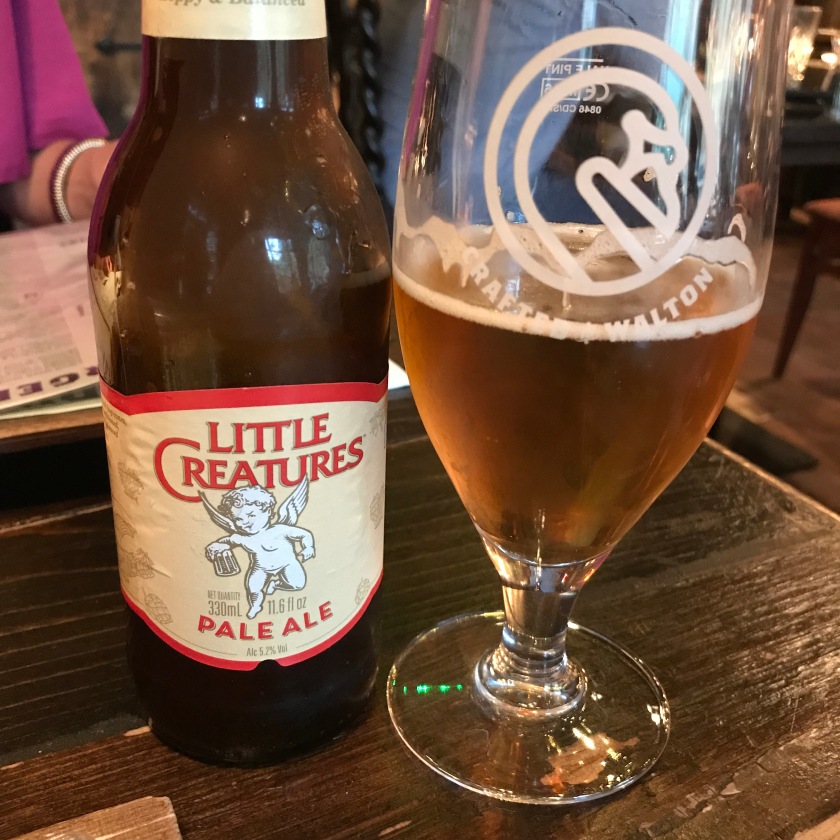
I had looked forward to trying one of this brewer’s beers – Little Creatures – for a long time; but frankly, hadn’t tried that hard to hunt one down, and none of those wretched PR companies who seem to fling out samples to all and sundry were flinging any out to me. So anyhoo, I find myself in a gastro pub – a contemporary free house if you will –  eating a wood fired pizza with a side-order of clichés and some stereotypes on a stick, drinking a Little Creatures Pale Ale.  It was very nice. ‘Earthy’ would be the word I’d use. Not vibrant with hoppy overload, but muted, balanced, the malt part of the choir, not just the hops – more in the Pommy style, dare I say it. More Burton than Portland. Drinkable and even exciting for not being a herbal, spicy assault on your bitterness receptors.

But there was also the slightly sour taste of guilt – not towards the beer, or indeed this brewery – and not, I am assured from the Antipasti Skewer Board – rather from the power of free trade and a society that has normalised shipping modified water around the globe for our pleasure. Am I being a spoil sport? Yes? But should it matter? Yes, too.

IMG_4111

Sizzle, sausage or both?

IMG_2966Be in no doubt that this beer – Beavertown Lupuloid IPA – is a fearsomely good one. Rip open the tab and there’s already an aroma of juicy hop oil spilling out… tinged with pine resin. You pour it, and it’s a hazy, wheat yellow – that dusty, golden colour you can get when some yeast is lingering; the head was billowing large and tight, rippling up the glass side as it was decanted and settling only slightly – and there in that head was the scent of a tropical lemon grove where the workers have been feasting on lunchtime chunks of juicy, sweet mango and pineapple (with no cheese or cocktail sticks anywhere to be seen). Yes, it’s fearsomely good.  It has all the attributes of a proper sausage. Sustaining. Meaty. Rewarding. Enticing. A beer with real substance.

Yet this sausage also has sizzle. Look at the can. It would be rude, demeaning even, to call it a ‘can design’. This is a company who know what they’re about and see the packaging as a canvas to tell us, to sell us and to beguile us. You can’t see it here, but the can top is also a deep pink to match that iridescent pink sky on the can itself. The tab is green to enhance the hop-beast artwork / mural. It’s folksy; it’s threatening and it’s deeply, pugnaciously attractive. This is the bar to which all others aspire. This is proof that whilst sausage is vital, when it sizzles too, the result adds up to much, much more than the sum of its meaty, chunky parts.

Craft Snugs

Everyone, surely, has a soft spot for a pub snug. Those cosy corners, the fugg of cigar smoke from years ‘BTB’ (Before The Ban) still greasily staining walls and furniture, in what can only be described as ‘Farrow & Ball shades’. The Bridge in Topsham, with its wood-lined snugs, one with a small direct serving hatch through to the bar; the Pianola room at The Yew Tree in Cauldon Low; the back room of The Cooper’s Tavern in Burton on Trent with its tall-backed pews lining the walls, undoubtedly hiding misericords venerating Burton brewers Great and Good beneath.  Yet snugs seem a feature of the past – no place in the huge drinking establishments built by the likes of Marstons or Mitchell’s and Butler today. Snugs make way for ‘covers’ and easy access for the table service and the Hunters’ Chicken.

There’s hope though. A new generation of micro bars, or craft snugs is opening up. Freed from the capital needed for cellars, kitchens and cooling, these bars tend to focus on bottles, spirits and nibbles. And because they’re small, they don’t need to be on the High Street or City Centre circuit, with their requisite ‘high footfall’. They don’t need to think about being chameleons, serving early breakfasts, frothy lattes or renting out to the local Slimming World group. They can just be a bar, with low rent, lower overheads and hours to suit.

Saying that, one’s opened in our village that goes in the other direction. It started as a cafe, working with the exposed beams and quarry tiles laid to earth; making the most of the sagging lintels and trip-hazard floor levels, all in the aid of ‘character’. And now it’s become an after hours drinking snug. What was once someone’s front room, what was once a scullery is now a series of inter-connected shadowy snugs, serving cocktails, cake, crisps and craft beers from wherever takes their fancy. So it was I enjoyed a Nelson Sauvin Pale Ale from The Kernel (Bermondsey), a Snakecharmer IPA from One Mile End (Whitechapel), and a Queen of Diamonds from Wild Card Brewery (Walthamstow). Oh, and there were beers from local brewers too, like Slater’s (Stafford) and Freedom (Abbot’s Bromley), but I wasn’t going to miss the chance to ‘go exotic’ now, was I?  And only one bottle of lager – a rather lonesome Nastro Azzurro peeped out from behind the fridge door. Which seems right – somehow, lager seem less well suited to these snugs of warmth, intimacy and close friends.


(https://skinnykitten.cafe (site still under construction at time of writing))